Small gas powered landscaping equipment such as leaf blowers and lawn mowers create a lot of noise and pollution. According to the California Air Resources Board (CARB), operating a gas powered lawn mower for one hour emits the same amount of smog-forming pollution as driving a 2017 Toyota Camry 300 miles from Los Angeles to Las Vegas. That is pretty remarkable but the emissions from a leaf blower are even more astonishing. CARB published using a gas powered leaf blower for one hour emits the same amount of smog-forming pollution as driving a 2017 Toyota Camry 1,100 miles from Los Angeles to Denver. CARB states the number of these small engines operating in California is 16.7 million which is greater than the number of light-duty passenger cars. The amount of pollutants emitted from the small gas powered engines rated at or below 19kW is being addressed and included in the emissions reduction plans.
Makello’s Ethical Energy Savings Report is the result of a detailed trade-off study of discount utility rates, Community Choice Aggregation options, grants, rebates, tax credits, and equipment options, to determine the fastest payback and highest return on investment, to meet your home, business and vehicle energy needs.
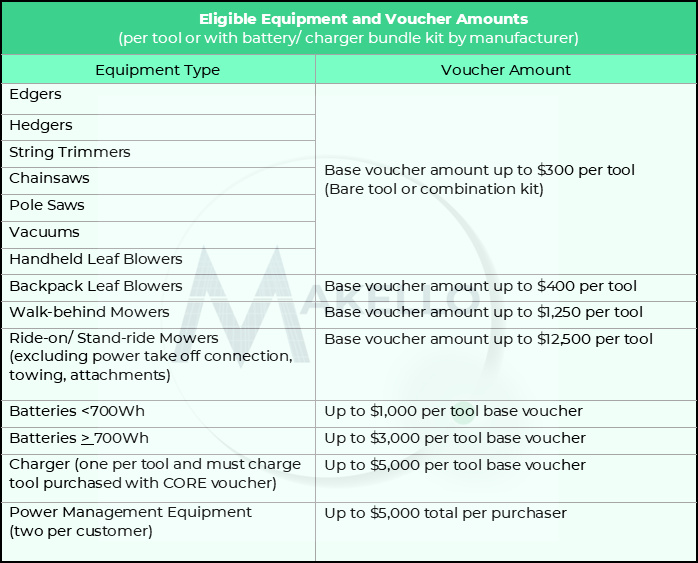
The program addressing emissions reductions is the California Clean Off-Road Equipment Voucher Incentive Project (CORE) https://californiacore.org. CORE is authorized by Senate Bill 170 (SB170) and funded by California Cap and Trade Investments. The program provides incentives for users of small off-road equipment to adopt zero emission equipment. Some examples of equipment being incentivized are: Leaf blowers and vacuums, Chainsaws, String trimmers, Edgers, Hedgers, Walk-behind/ Ride-on mowers.
The CORE program provides point of purchase vouchers and funding is capped at $25,000 per eligible purchaser. Eligible equipment must be listed in the CORE eligible equipment catalog and purchased from a CORE approved dealer. CORE program allows the stacking of funds but other programs may not. At any rate, stacking funds must not exceed 100% of equipment cost.
Program funds are distributed on a first come first serve basis until funds are no longer available.
In our blog post “Greenbacks for Green Tech, Cash Back for San Diegans”, we discussed incentives facilitating the adoption of energy efficient technologies for owners of residential buildings and vehicles. SD-Sequel http://sd-sequel.org reached out to us and thankfully brought to our attention rebates available for small and micro sized landscaping businesses.
My economics professor used to say “There’s no such thing as a free lunch”. Incentives and rebates for energy upgrades may not eliminate all costs for kicking gas and energy wasting appliances, but they sure can help take a bite out of the total project cost.
1) Find out how Makello can help you. 2) Discuss your energy needs. 3) FREE Energy Savings Estimate.
Finding and navigating programs can be confusing and frustrating so we have developed a brief summary of programs and categorized tables of incentives as a handy reference guide.
SUMMARY OF INCENTIVE PROGRAMS
Inflation Reduction Act (IRA)
The recent passage of the Inflation Reduction Act of 2022 allocates billions of dollars in incentives to support clean-air technology solutions through a number of programs. Incentives qualified individuals may receive were capped at up to $14,000 Total Rebates (upfront), and up to $18,550 in Tax Credits per household.
A very popular provision of the Inflation Reduction Act is the increase of solar/ battery tax credit from 26% to 30% for 2022-2032. This tax credit had previously been scheduled to drop to 22% in 2023, and sunset in 2025.
Commercial properties aren’t excluded from the savings. Commercial properties are eligible for a Federal Solar Tax Credit of 30% or for accelerated depreciation or Section 179 tax credits, up to 100% Write-Off; a total of up to 50% subsidies on solar-battery.
HomeOwner Energy Savings (HOMES)
HomeOwner Energy Savings (HOMES) rebate program is a $4.3 billion program to establish rebates for various energy upgrades. The HOMES program provides rebates for energy retrofits based on the amount of energy savings. Rebates up to the lesser of $8,000 per home or 80% of the project cost for projects producing at least 35% in energy savings for income qualified households. Projects with energy savings between 10% to 35% receive a lower rebate amount. Multi-Family projects may participate in the program and have a specialized rebate structure under the HOMES program.
Rebates are subject to State implementation but the Federal Inflation Reduction Act of 2022 Legislation sets the maximum values. States may increase the maximum value of the rebates for low and moderate income households. It is important to note that the HOMES Program rebates cannot be combined with the High-Efficiency Electric Home Rebate Act (HEEHRA) Program.
High-Efficiency Electric Home Rebate Act (HEEHRA)
High-Efficiency Electric Home Rebate Act (HEEHRA) is a 10-year rebate program to support low- and moderate-income (LMI) households who choose to electrify their home.
The Inflation Reduction Act of 2022 provided $4.275 billion for grants to State Energy Offices and $224 million to Indian Tribes for the purpose of establishing home electrification rebate programs. A key element of this program is the program explicitly includes rebates for main panel upgrades and electric wiring.
The rebate caps are income based. Single family households earning less than 80% of the Area Median Income may be eligible to receive 100% of project cost or the maximum rebate amount, whichever is less. Single family households earning between 80% and 150% of area median income have rebate amounts capped at 50% of project cost or maximum rebate amount, whichever is less. Households earning more than 150% of area median income do not appear to be eligible for these rebates. The maximum dollar amount of rebates offered under the HEEHRA program is $14,00 to any single household. The rebates are slated to be distributed up front at the point of sale.
TECH Clean California
The TECH Clean California initiative is designed to help California achieve the state’s mission to reach carbon neutrality by 2045. The program focuses on aiding residents in single family and multi-family homes to adopt low emissions space and water heating technologies.
The initial budget for the program was $120 million. The program was wildly popular and the budget was exhausted unexpectedly quickly and is currently suspended in most areas including SDGE territory. The State Legislature recently funded an additional $145 million to the budget to expand the program. Currently, budgeting efforts are underway to assign each territory in California its allotment of the funds.
California Energy Smart Homes
California Energy Smart Homes has incentives for new construction of single family, duplex and townhomes multi-family low-rise, additions and ADUs, alterations of single family, duplex and townhomes multi-family low-rise, and ADUs with plans to offer incentives for manufactured housing. There are two pathways for incentives. One pathway is for owners wishing to kick gas by removing all natural gas from the home and convert to all electric. The second pathway is to have a mix of fuels in the home. NOTE: The mixed fuel pathway will close December 31, 2022.
Both pathways have a number of requirements in order to receive the incentives. Obtaining the handbook from California Energy Smart Homes https://www.caenergysmarthomes.com/ is recommended for detailed information and help you to find the pathway that is right for your project.
Comfortably California
The Comfortably California program was developed to support contractors, manufacturers and retailers for selling high-efficiency HVAC equipment . The program offers no-cost training to contractors and sales support. Participants in the educational programs can earn Continuing Education Units (CEUs).
Incentives are offered to the distributors for pass-through to the contractor. The programs allow contractors to develop marketing programs that offer customers a competitive price. Visit https://www.comfortablyca.com/ for more information.
Homeowners wishing to test induction cooking can borrow a portable induction cooktop for three (3) weeks through the San Diego Green Building Council Electric Home Cooktop Program. The program is free and to sign up to check out a cook top visit https://www.sd-gbc.org/electric_home_cooktop_program_launch
Makello’s Ethical Energy Savings Report is the result of a detailed trade-off study of discount utility rates, Community Choice Aggregation options, grants, rebates, tax credits, and equipment options, to determine the fastest payback and highest return on investment, to meet your home, business and vehicle energy needs.
TABLES OF INCENTIVES
Whole Home Energy Reduction
Click the “+” above, for Whole Home Energy Reduction incentives details
BASIC WEATHERIZATION
Click the “+” above, for Basic Weatherization incentives details
ELECTRICAL UPGRADES
LIGHTING UPGRADES
COOKING
Click the “+” above, for Induction Cooktop and Ultra-Efficient Oven incentives details
AIR CONDITIONING (Heating & Cooling)
Click the “+” above, for Heat Pump Air-Conditioning incentives details
THERMOSTATS & OCCUPANCY SENSOR
Click the “+” above, for Electrical Upgrades incentives details
HEAT PUMP WATER HEATING
Click the “+” above, for Heat Pump Water Heater incentives details
HEAT PUMP DRYER (Clothes)
Click the “+” above, for Heat Pump Dryer incentives details
PLUG-IN VEHICLES
PLUG-IN VEHICLE CHARGING
PLUG-IN VEHICLE MISCELLANEOUS
Click the “+” above, for Plug-In Vehicle incentives details
SOLAR PV
Click the “+” above, for Solar Power incentives details
ADVANCED ENERGY STORAGE
POOL HEATING, CHILLING AND PUMPING
Click the “+” above, for Pool incentives details
Makello can help you prepare to take advantage of upcoming savings through our detailed Ethical Energy Savings Report. The Ethical Energy Savings Report is the result of a detailed trade-off study of discount utility rates, grants, rebates, tax credits, and equipment options, to determine the fastest payback and highest return on investment to meet your home, business and vehicle energy needs.
The fee for the Ethical Energy Savings Report is refundable (less the 3rd-Party $15 utility data access charge) or credited towards our installation services, after you attend the presentation meeting and complete a 5 minute survey after permission to operate. Service includes up to 7.5 hours research, and 1 hour Q&A, by an Ethical Energy Efficiency Expert and Research Assistants. Visit Makello.com today to book your appointment.
Disclaimer: We are not tax professionals. This guide is not intended to be Tax or Legal Advice, does not guarantee eligibility for credits, rebates or refunds and is not meant to be relied upon for eligibility for any program, rebate, refund or tax credit. Please seek advice from a qualified tax professional to determine eligibility for any particular program or tax credit, refund or rebate.
We make every effort to verify program information however, program metrics can change. Please contact program administrators with questions regarding their program.
Disclaimer: We have done our best to verify all the information in the tables. Please contact info@makello.com to report errors within the tables.
Notes: 1 Rebate amounts for income qualifying households may be higher than stated amounts.
2 ETA: mid-to late 2023. Low-income households (those making below 80% of their area median income) are potentially eligible to have 100% of their costs covered. Moderate-income households are potentially eligible to get up to 50% of their costs covered. Eligibility requirement for rebate, up to 150% Area Median Income.
* The FY 2014 Consolidated Appropriations Act changed the definition of extremely low-income to be the greater of 30/50ths (60 percent) of the Section 8 very low-income limit or the poverty guideline as established by the Department of Health and Human Services (HHS), provided that this amount is not greater than the Section 8 50% very low-income limit. Consequently, the extremely low income limits may equal the very low (50%) income limits.
**Income estimates calculated by Makello are not official calculations and may not be the correct income level as determined by program administrators. We have made our best faith attempt to estimate the correct value based on information provided by HUD noted below.
Y 2022 Multifamily Tax Subsidy Projects Documentation System NOTE: Very low-income (50% Income Limits) calculations published by HUD are used as the basis for determining the full range of income limits for minimum set-aside tests. The following illustrates the calculation of additional limits:
80% limit: 160 percent or (80/50) of the income limit for a very low-income family of the same size. 70% limit: 140 percent or (70/50) of the income limit for a very low-income family of the same size. 60% limit: 120 percent or (60/50) of the income limit for a very low-income family of the same size. 50% limit: Equals the income limit for a very low-income family of the same size. 40% limit: 80 percent or (40/50) of the income limit for a very low-income family of the same size. 30% limit: 60 percent or (30/50) of the income limit for a very low-income family of the same size. 20% limit: 40 percent or (20/50) of the income limit for a very low-income family of the same size.
For each person over eight-persons, the four-person income limit should be multiplied by an additional 8 percent. (For example, the nine-person limit equals 140 percent [132 + 8] of the relevant four-person income limit.) HUD rounds income limits up to the nearest $50. Local agencies may round income limits for nine or more persons to the nearest $50, or they may use the un-rounded numbers.
3 Eligibility is based on the household’s gross income over the past 12 months. Household income cannot exceed 60% of the State Median Income Level
**Income estimates calculated by Makello are not official calculations and may not be the correct income level as determined by program administrators. We have made our best faith attempt to estimate the correct value based on information provided by HUD previously noted.
4 income less than or equal to 400% of the Federal Poverty Level
5 Income less than or equal to 225% of the Federal Poverty Level
6 **Income calculation based on 400% of the Federal Poverty Level (FPL) (2021). Income criteria is updated to the next calendar year FPL on April 15th annually.
7 Clean Air Vehicle Vehicle Decal Program
8 CARE updates after May 31, 2023. Upper limit calculation = 200% of Federal Poverty Level (FPL)
DAC SASH Homeowners must also meet income qualifications as denoted by annual CARE and FERA guidelines.
9 FERA updates after May 31, 2023 *Lower limit calculation = 200% of Federal Poverty Level (FPL) (CARE/ESA) +$1 **Upper limit calculation = 250% of Federal Poverty Guidelines
10 SOMAH Income Limits = 60% Area Median Income (AMI)
11 SASH, MASH and SGIP Income Limits
As of June 2020, the SASH program in SDG&E utility territory is fully reserved (based on incentive dollars) and closed to any new applications.
Did you know that, whether or not you have an existing solar energy system, you can tap into a combination of up-front incentives, financing, to build up your savings into a 6-Month Emergency Fund and lower monthly costs?
Once-considered luxury items, such as Solar Power, Plug-In Vehicles, and Energy Storage, now payback quickly for cash purchases and are within reach for most homeowners, due to up-front incentives and lower total monthly costs from loan or Property Assessed Clean Energy financing.
Makello can provide you with a FREE Energy Savings Estimate! If you share your utility data with us we can create a solar energy system that is specific to your needs. We will NOT share your data.
Our model can also show the cost saving benefits of a Plug-In Vehicle or Energy Storage system, or both, in addition to your solar system. All of our team works to get you the most comprehensive, thorough Energy Analysis in the San Diego area as quickly as possible.
The software engineers are constantly updating our computer model to reflect the most current utility rates and product costs. We have a dedicated GIS analyst who can qualify you for as many rebates and incentives possible. Our Energy Efficiency experts can also provide other solutions to reduce energy costs such as appliance changes or switching utility rates. Press one of the buttons to see how much you can save!
Representatives from the CCSE, Wipomo, Dave Roberts (County Supervisor, 3rd District), SDRES,
ESW, and Butler Sun Solutions celebrate Wipomo’s Mobile Energy Ecosystem during the residential 13th San Diego Sustainability Tour.
Our off-grid, Plug-In Vehicle & personal electronics charging station delivers “Power when you want it, where you want it, day or night, even during a utility blackout”.
You can save with Wipomo’s Energy Ecosystem, and now we’re bringing it to you so you can see for yourself. The Wipomo Mobile Energy Ecosystem is an on-grid and off-grid charging station that demonstrates the versatility of Wipomo’s Ecosystem. Wipomo saw the potential for a mobile demonstration unit in the first iteration of the then called Solar Slider. Two versions later, the Mobile Energy Ecosystem now has an advanced energy management system that accepts energy from solar photovoltaic modules, batteries, grid connection via a standard 120V outlet and input from an electric vehicle. The electricity flows through the whole system, recharging the batteries, powering loads and sending excess energy back to the utility, if available.
Upgrading the unit started and ended in August and Setember of 2013. Wipomo supplied the electronics that make the Energy Ecosystem possible while Roger Davenport, an advisor, designed and installed the system. The Wipomo team took the Mobile Energy Ecosystem to the Sustainability Tour at UC San Diego for the commercial tour and then to Wipomo’s Home Showcase for the residential tour (pictured above). After another round of improvements for safety and display, the Mobile Energy Ecosystem is ready for more events.
The Wipomo Mobile Energy Ecosystem
Basic (Entry Level) system: 8 x 240w PhonoSolar PV Modules = 1.92kW DC (nominal) 4 x 10⁵Ah Trojan 27TMX 12v Batteries @ 48v = 5.04kWh capacity (nominal) 1 x SunnyBoy 2500 watt inverter at 220v 1 x SunnyIsland 4500 watt inverter / charger 1 x Wipomo EV Export Power 1kW = 2 x 500 watt power supplies @ 210-375VDC input voltage (nominal)
Chad Castler (ESW, UCSD), Charlie Johnson (Wipomo), Joseph Ocampo (Wipomo, ESW, UCSD).
As a tour stop at UC San Diego for the 2013 Sustainability Tour, we demonstrated vehicle-to-vehicle (V2V) charging using Wipomo’s energy solution. The 2013 Sustainability Tour was organized by the San Diego Renewable Energy Society (local chapter of American Solar Energy Society).
It was an honor to be a stop at UC San Diego in the same arena as prototype concentrating solar arrays and the UCSD fuel cell. Of course, that’s why we had to demonstrate the full capability of the Solar Slider. -Joseph Ocampo, Wipomo Research Intern
The Mobile Energy Ecosystem is second generation off-grid electric vehicle and personal electronics charging station, designed by Wipomo and Butler Sun Solutions, Inc.
[supsystic-slider id=3 position=”center”]
Wipomo’s design made it possible to power a house or business from an electric vehicle.
During the event, Wipomo demonstrated vehicle-to-vehicle (V2V) high voltage power transfer, through the Mobile Energy Ecosystem. Our design shows that electric vehicles and distributed power generation can provide wide ranging possibilities, from EV rescue, to ancillary services for the utility. The first generation system, called the “Solar Slider“, powered up students between classes at UCSD for more than a year, and served as a renewable energy educational tool.
The Solar Slider is the result of a SunEdison grant awarded to Engineers for a Sustainable World (ESW), to build a “Green Island” utility vehicle and electronics solar charging station for UCSD campus.
ESW@UCSD students designed and built the solar PV deployment cage and hydraulic lift, attached to a single axle trailer.
Charlie Johnson, Wipomo, CEO, participated in the ESW Solar Slider project as grant writer for the SunEdison “Green Island” national contest, and as a community leader in assisting in organizing a student ASES chapter at UCSD, fulfilling his pledges as an elected board member of the San Diego Renewable Energy Society.
ESW’s UCSD chapter won Projcect of the Year award, for the off-grid mobile electric vehicle and personal electronics charging station called the “Solar Slider”.
From left to right, Will, unknown ESW UCSD student, Ben Pollay, Joseph Ocampo, Chad Castler
Engineers for a Sustainable World’s UCSD chapter students pose for photographers at UCSD Jacobs School of Engineering, for the “First Launch Ceremony” of the SunEdison awarded grant project called the “Solar Slider”, used to charge campus electric vehicles and personal electronics.
Charlie Johnson & Joseph Ocampo (Wipomo), Chad Castler & Ben Pollay (ESW), with Kristen Hansen & Dave Weil (UCSD).
Wipomo sponsored the unveiling of ESW’s “Solar Slider” electric vehicle and charging station at UCSD.
The “Solar Slider” popped pop-corn and cotton candy for students between classes, to demonstrate solar power generation and energy storage, in a park setting.
Led by SDRES board member and UCSD Engineering professor, Kurt Lund, PE, the Engineer’s for a Sustainable World design and build the cage to be mounted on a trailer, to raise and deploy a 2kW DC solar array.
Our advisor Kurt, a professional engineering consultant, graciously opened his garage, tools and skill up to us for building the cage. As a group of undergraduate engineers (and one Psychology Major), we knew we had many hours ahead of us and plenty of “learning incidents” (where we completely mucked a few things up and had to fix it), but that’s why we started this project in the first place. -Joseph Ocampo, Wipomo Research Intern
The Engineers for a Sustainable World “Solar Tree Project” initial design document lists Charlie Johnson as an advisor, on behalf of Wipomo and as an elected board member of the San Diego Renewable Energy Society (SDRES).
Joseph Ocampo takes the Green Island project to radio on CarTalk, to promote sustainability education for renewable energy and electric vehicles at UCSD. With help from Kurt Lund (SDRES, UCSD PE) and Charlie Johnson (SDRES, Wipomo), the Engineer’s for a Sustainable World take a victory lap for their grant awarded project for on-campus off-grid, solar powered, electric vehicle charging station on a mobile trailer.
From left to right, Kelsey Ellis (ESW), Kurt Lund (UCSD, SDRES), Lauren Rueda (ESW), Joseph Ocampo (ESW, Wipomo), Eric Tran (ESW), Hien Nguyen (ESW)
The Engineer’s for a Sustainable World (ESW) chapter at UCSD was awarded a grant by SunEdison to build a “Green Island” off-grid electric vehicle and personal electronics charging station, to be used to by the students and staff, as part of a renewable energy education campaign to support UCSD’s campus green initiative.Charlie Johnson, on behalf of Wipomo, and as elected Board Member the San Diego Renewable Energy Society, was a grant writer for the awarded project.
Joseph Ocampo, the ESW student group project leader and Wipomo intern, worked as a liason between UCSD and for-profit corporations, to solicit additional contributions, in funding or in-kind expertise.