Let me talk to you about my favorite towel of my entire life, Peshtemals. But I have to let you know, we’re not going to be talking about how plush it is. It isn’t the thickest towel. It isn’t the softest towel, but it’s still my favorite towel. And it’s for a number of reasons that you wouldn’t know unless you had these towels.
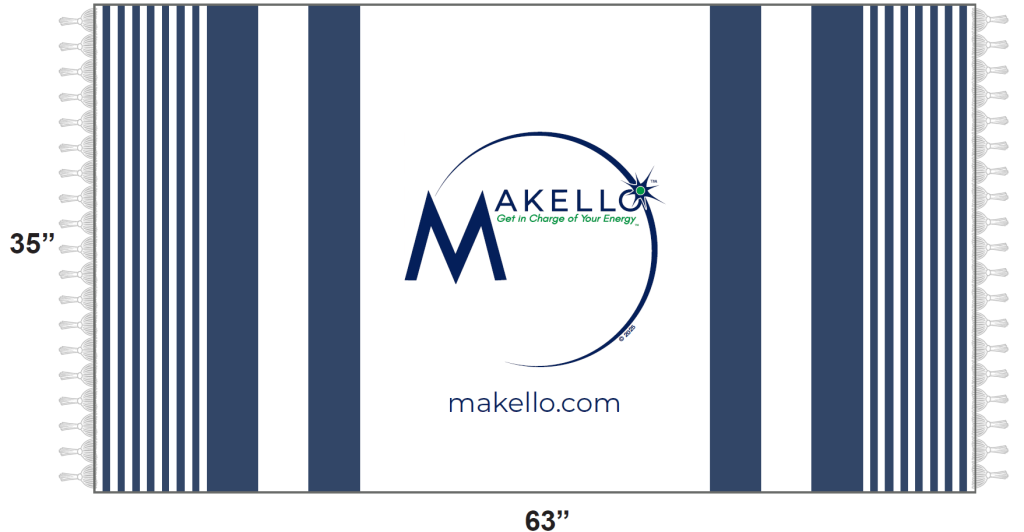
Peshtemals, also known as Turkish towels, or hammam towels, were created during the Ottoman Empire in modern day Turkey. They are thin cotton towels that are the perfect do-it-all towel for home use, beach use, gym/ spa, etc., and have become popular globally because of their functionalityand versatility.
Peshtemals are fast drying, packable and durable. The fabric is made using 100% Turkish cotton, regarded for its long fibers and softness, spun from manually operated looms in Turkey. The cotton is tightly woven, making it strong and highly absorbent without taking up too much space. The tightly spun fibers help repel sand and earth easier than other fabrics making it perfect for beach days or picnics. Their stylish designs make them perfect decorative pieces and furniture covers as well.
When you’re visiting someone’s house, the guest towels are sometimes the thickest, plushest towels, too thick to be useful. You wouldn’t take a thick plush towel to the swimming pool or the beach and put it down in the sand because it would pick up a lot of sand and grime in those thick plush fibers.
You’re already aware of a variety of towels and that certain towels serve certain purposes. Towels can be made of a variety of fabrics including cotton, cotton polyester blends, linen, bamboo, and synthetic microfibers. Cotton is common because it is soft and absorbent, linen is known for its durability, bamboo is prized for its sustainable softness, and microfibers are known to be quick drying.
Peshtemals are more hygienic
Doctors recommend that when drying ourselves off we pat ourselves dry rather than rub. With a plush towel, you can rub the thick sock fibers over your skin with some force to it. But you might not do that with a thinner towel because it might scratch your skin. If you’re not wanting to be abrasive, you would pat.
Doctors also recommend that we should be washing our towels after each use because dead skin and bacteria collect on the towel and grow when it’s hanging on the towel rack. We may be reusing the plush towel for days in a row and then try to dry it out between the days and that doesn’t work because it introduces new bacteria colonies to the skin. So instead of going that way and reusing thick towels, use these thin towels and wash them after each use – you can fit 2 to 3 times as many peshtemal towels in the washer!
Peshtemals are so convenient
You can take it anywhere! For example, in your carry on luggage, you can pack for about three or four days of clothes and towel for each day. You wouldn’t be able to fit four traditional bath towels and have any room left for your clothes. But you can take a peshtemal towel with you because it’s very lightweight. In fact, when I travel, I might take a whole week’s worth of peshtemals in my bag because I’m a swimmer. So I might swim two or three times on that three or four day trip. I might take four towels and clothes for three to four days, all in one carry-on bag. And you just can’t do that with any other towel.
Utility Cost Savings
Understanding your energy profile is critically important for being able to take control of your energy independence, so that you don’t have to buy too much solar or too much battery to get to your goal, and your energy profile is affected by usage such as washing your towels.
I’m sure we’ve all experienced over loading the washer with thick, plush towels to the point the spin cycle stops working and the towels are left just sitting in still water. We’re forced to run another wash cycle and sometimes the final spin cycle doesn’t ring out enough water and then we have to leave them in the dryer longer, increasing energy costs even more!
Plush towels increase the electric bill more, especially at times of the year when the solar power isn’t producing as much. If you’re running all this extra power to dry your laundry when it didn’t need to be that wet anyways, there’s an incredible amount of savings in changing your towels.
Instead of three plush towels, you can now wash up to 15 peshtemal towels in one load and the washer will not be overloaded. And when it spins dry, it’ll be much drier. And then the heat pump clothes dryer doesn’t have to go through as long a cycle.
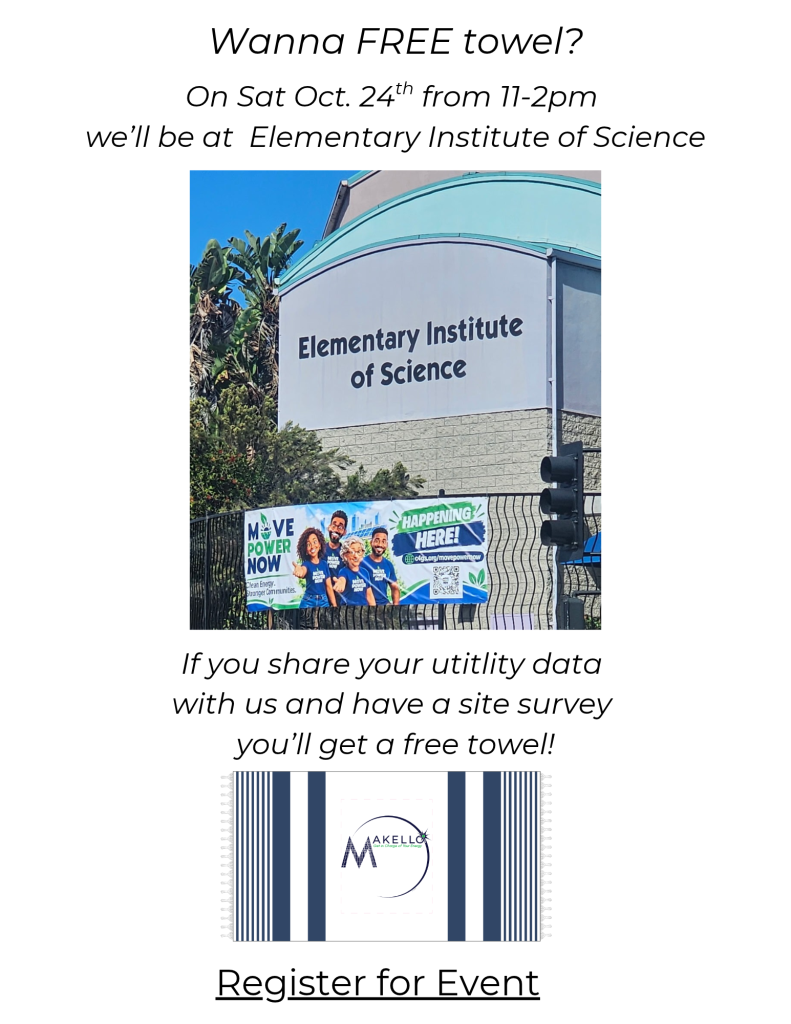
Wanna FREE Makello towel? Come to Elementary Institute of Science, 608 51st Street, San Diego, CA 92114, on Oct 24, 2026 @ 11am-2pm.
When you Book an Appointment for Energy Analysis, and securely share your utility data, you’ll get a FREE Peshtemal Beach Towel: Full length, lightweight, compact, sand resistant weave, and water & energy efficient. Up to 15 towels per large washer!
HOA managers often have an onerous time when preparing new budgets as costs to run the HOA increase but the Board doesn’t want to raise assessments. Investigating whether the HOA has energy zombies or phantom loads is a clever way to reduce energy costs and maintain the bottom line on the budget. It is also a great thing to do before starting a solar system capital improvement project.
What can an HOA do to reduce common area electric usage? HOA developments can vary widely in structure and amenities so we will cover a few general energy efficiency options that often apply to HOAs.
Are you ready to save money? Get a custom energy savings report fromMakello.
First on the list is to find the energy zombies and identify phantom loads by conducting an Energy Treasure Hunt. To conduct an Energy Treasure Hunt, teams of treasure hunters can walk the common area looking for ways to save energy. Materials and instructions are available at https://www.energystar.gov/buildings/save-energy-commercial-buildings/ways-save/treasure-hunts This can be a community building project for resident volunteers or you can hire Makello to perform the energy savings analysis for you. Where can the Treasure Hunters find the Energy Zombies and Phantom Loads?
Does the HOA have a pool? Are the pumps functioning properly? Pumps need proper maintenance and to be set at the right speeds to effectively filter pool water. Pumps not working correctly or efficiently can waste energy and run up electric bills. If it is time for a pool pump replacement, look for Energy Star Rated variable speed pumps. Another way to save energy for pool pumps, besides installing a solar system to run your pool pumps, is to install a timer and run your pumps only when the pool is in use. Most HOAs aren’t open 24/7 so it may be possible to stop the pumps when the pool is closed. Please check with your pool maintenance professional to ensure your pool is functioning properly and meets health and safety requirements.
Solar system with room for several picnic tables underneath. Installer:Green Energy EPC, Sales: Makello
Yes, we did just say you can install a solar system to run your pool pumps. Pool pumps are powered by electricity and are able to reliably run on solar power just like other electrical equipment. You can install solar to power your pool pumps even if you don’t have a pump room or community room with a large roof. Solar and pools are a 2 for 1 common area upgrade. Solar modules can be installed on a patio cover type structure and a covered seating or picnic area near the pool is created in the common area under the solar modules while the solar modules power your pool pumps. What a great capital improvement project for the HOA residents.
Let’s talk about lighting. Lights in HOA common areas are an essential part of safety and well designed lighting can enhance the quality of life and value of a property. Electric costs for common area lights may eat up an HOAs assessments. A lighting survey can help cut costs by analyzing the number and types of lights in use and evaluate the effectiveness of the lighting then implement energy saving measures.
There have been a number of improvements in lighting options that can help protect the bottom line in the HOA budget. LED bulb options are available for every fit, form and function, in a variety of fixtures, to replace less efficient bulbs. Switching to LEDs can reduce power consumption by up to 50% when replacing fluorescent lamps, and by up to 80% when replacing Incandescent/Halogen lamps. Lower total consumption and lower instantaneous peak use can trigger a change to a discount utility rate, and save even more money in avoided solar, battery, electrical and utility integration costs.
Solar outdoor light fixtures are available in a variety of styles. The fixtures are often a self contained unit with LED bulbs in a wide range of sizes and last for several years. Many fixture options include motion sensors which switch the light on and off as needed to preserve the battery charge and eliminate the need to fuss with timers.
Light bulbs aren’t the only lighting upgrade option. Sensors on light fixtures are capable of turning your lights on and off when the light is not needed. Motion sensors may be included on interior or exterior fixtures and light sensors may be utilized by outdoor fixtures. A sophisticated sensor is a geofence that is utilized with smart technology to detect when the perimeter has been crossed and triggering the appliance to perform the correct function. There is no need to spend money on electricity to light an area when the light is not needed.
Charlie Johnson and Sam Syed standing under pool side solar installation. Installer: Green Energy EPC Sales: Makello.
Water heating uses a lot of energy no matter what the size of the tank. Manufacturers have been implementing energy efficient technologies from the smallest system up to industrial size boilers. There are several technologies in use today including tankless systems, heat pump water heaters and solar water heating systems. Solar water heating systems are popular with pool owners for pool water heating and can be installed in conjunction with solar modules to run the pumps.
Not all energy efficiency measures involve technology. What you plant around your structure can make a difference on indoor comfort and energy use. Using plants to shade walls reduces heat build up inside your building and cuts cooling costs not to mention how a beautiful garden can improve the property value and quality of life.
Makello sells solar systems but why would we tell you how to save energy before selling you a solar system? Wouldn’t we want the system to be as large as possible? No. We believe the ethical thing to do is to help our customers reduce energy use before the solar system is designed and installed. We perform an energy efficiency analysis and use the data to help us design the best solar system for our customer, potentially saving our customer thousands of dollars. Please contact us if you would like for us to perform an energy analysis for your HOA.
Please visit our blog at Makello.com for more articles on energy efficiency, solar systems, and electric vehicles. If you are an HOA manager and would like some content for your HOAs newsletters please contact us a info@makello.com
Makello is an authorized distributor for Green Energy EPC CA Lic #978836
My economics professor used to say “There’s no such thing as a free lunch”. Incentives and rebates for energy upgrades may not eliminate all costs for kicking gas and energy wasting appliances, but they sure can help take a bite out of the total project cost.
1) Find out how Makello can help you. 2) Discuss your energy needs. 3) FREE Energy Savings Estimate.
Finding and navigating programs can be confusing and frustrating so we have developed a brief summary of programs and categorized tables of incentives as a handy reference guide.
SUMMARY OF INCENTIVE PROGRAMS
Inflation Reduction Act (IRA)
The recent passage of the Inflation Reduction Act of 2022 allocates billions of dollars in incentives to support clean-air technology solutions through a number of programs. Incentives qualified individuals may receive were capped at up to $14,000 Total Rebates (upfront), and up to $18,550 in Tax Credits per household.
A very popular provision of the Inflation Reduction Act is the increase of solar/ battery tax credit from 26% to 30% for 2022-2032. This tax credit had previously been scheduled to drop to 22% in 2023, and sunset in 2025.
Commercial properties aren’t excluded from the savings. Commercial properties are eligible for a Federal Solar Tax Credit of 30% or for accelerated depreciation or Section 179 tax credits, up to 100% Write-Off; a total of up to 50% subsidies on solar-battery.
HomeOwner Energy Savings (HOMES)
HomeOwner Energy Savings (HOMES) rebate program is a $4.3 billion program to establish rebates for various energy upgrades. The HOMES program provides rebates for energy retrofits based on the amount of energy savings. Rebates up to the lesser of $8,000 per home or 80% of the project cost for projects producing at least 35% in energy savings for income qualified households. Projects with energy savings between 10% to 35% receive a lower rebate amount. Multi-Family projects may participate in the program and have a specialized rebate structure under the HOMES program.
Rebates are subject to State implementation but the Federal Inflation Reduction Act of 2022 Legislation sets the maximum values. States may increase the maximum value of the rebates for low and moderate income households. It is important to note that the HOMES Program rebates cannot be combined with the High-Efficiency Electric Home Rebate Act (HEEHRA) Program.
High-Efficiency Electric Home Rebate Act (HEEHRA)
High-Efficiency Electric Home Rebate Act (HEEHRA) is a 10-year rebate program to support low- and moderate-income (LMI) households who choose to electrify their home.
The Inflation Reduction Act of 2022 provided $4.275 billion for grants to State Energy Offices and $224 million to Indian Tribes for the purpose of establishing home electrification rebate programs. A key element of this program is the program explicitly includes rebates for main panel upgrades and electric wiring.
The rebate caps are income based. Single family households earning less than 80% of the Area Median Income may be eligible to receive 100% of project cost or the maximum rebate amount, whichever is less. Single family households earning between 80% and 150% of area median income have rebate amounts capped at 50% of project cost or maximum rebate amount, whichever is less. Households earning more than 150% of area median income do not appear to be eligible for these rebates. The maximum dollar amount of rebates offered under the HEEHRA program is $14,00 to any single household. The rebates are slated to be distributed up front at the point of sale.
TECH Clean California
The TECH Clean California initiative is designed to help California achieve the state’s mission to reach carbon neutrality by 2045. The program focuses on aiding residents in single family and multi-family homes to adopt low emissions space and water heating technologies.
The initial budget for the program was $120 million. The program was wildly popular and the budget was exhausted unexpectedly quickly and is currently suspended in most areas including SDGE territory. The State Legislature recently funded an additional $145 million to the budget to expand the program. Currently, budgeting efforts are underway to assign each territory in California its allotment of the funds.
California Energy Smart Homes
California Energy Smart Homes has incentives for new construction of single family, duplex and townhomes multi-family low-rise, additions and ADUs, alterations of single family, duplex and townhomes multi-family low-rise, and ADUs with plans to offer incentives for manufactured housing. There are two pathways for incentives. One pathway is for owners wishing to kick gas by removing all natural gas from the home and convert to all electric. The second pathway is to have a mix of fuels in the home. NOTE: The mixed fuel pathway will close December 31, 2022.
Both pathways have a number of requirements in order to receive the incentives. Obtaining the handbook from California Energy Smart Homes https://www.caenergysmarthomes.com/ is recommended for detailed information and help you to find the pathway that is right for your project.
Comfortably California
The Comfortably California program was developed to support contractors, manufacturers and retailers for selling high-efficiency HVAC equipment . The program offers no-cost training to contractors and sales support. Participants in the educational programs can earn Continuing Education Units (CEUs).
Incentives are offered to the distributors for pass-through to the contractor. The programs allow contractors to develop marketing programs that offer customers a competitive price. Visit https://www.comfortablyca.com/ for more information.
Homeowners wishing to test induction cooking can borrow a portable induction cooktop for three (3) weeks through the San Diego Green Building Council Electric Home Cooktop Program. The program is free and to sign up to check out a cook top visit https://www.sd-gbc.org/electric_home_cooktop_program_launch
Makello’s Ethical Energy Savings Report is the result of a detailed trade-off study of discount utility rates, Community Choice Aggregation options, grants, rebates, tax credits, and equipment options, to determine the fastest payback and highest return on investment, to meet your home, business and vehicle energy needs.
TABLES OF INCENTIVES
Whole Home Energy Reduction
Click the “+” above, for Whole Home Energy Reduction incentives details
BASIC WEATHERIZATION
Click the “+” above, for Basic Weatherization incentives details
ELECTRICAL UPGRADES
LIGHTING UPGRADES
COOKING
Click the “+” above, for Induction Cooktop and Ultra-Efficient Oven incentives details
AIR CONDITIONING (Heating & Cooling)
Click the “+” above, for Heat Pump Air-Conditioning incentives details
THERMOSTATS & OCCUPANCY SENSOR
Click the “+” above, for Electrical Upgrades incentives details
HEAT PUMP WATER HEATING
Click the “+” above, for Heat Pump Water Heater incentives details
HEAT PUMP DRYER (Clothes)
Click the “+” above, for Heat Pump Dryer incentives details
PLUG-IN VEHICLES
PLUG-IN VEHICLE CHARGING
PLUG-IN VEHICLE MISCELLANEOUS
Click the “+” above, for Plug-In Vehicle incentives details
SOLAR PV
Click the “+” above, for Solar Power incentives details
ADVANCED ENERGY STORAGE
POOL HEATING, CHILLING AND PUMPING
Click the “+” above, for Pool incentives details
Makello can help you prepare to take advantage of upcoming savings through our detailed Ethical Energy Savings Report. The Ethical Energy Savings Report is the result of a detailed trade-off study of discount utility rates, grants, rebates, tax credits, and equipment options, to determine the fastest payback and highest return on investment to meet your home, business and vehicle energy needs.
The fee for the Ethical Energy Savings Report is refundable (less the 3rd-Party $15 utility data access charge) or credited towards our installation services, after you attend the presentation meeting and complete a 5 minute survey after permission to operate. Service includes up to 7.5 hours research, and 1 hour Q&A, by an Ethical Energy Efficiency Expert and Research Assistants. Visit Makello.com today to book your appointment.
Disclaimer: We are not tax professionals. This guide is not intended to be Tax or Legal Advice, does not guarantee eligibility for credits, rebates or refunds and is not meant to be relied upon for eligibility for any program, rebate, refund or tax credit. Please seek advice from a qualified tax professional to determine eligibility for any particular program or tax credit, refund or rebate.
We make every effort to verify program information however, program metrics can change. Please contact program administrators with questions regarding their program.
Disclaimer: We have done our best to verify all the information in the tables. Please contact info@makello.com to report errors within the tables.
Notes: 1 Rebate amounts for income qualifying households may be higher than stated amounts.
2 ETA: mid-to late 2023. Low-income households (those making below 80% of their area median income) are potentially eligible to have 100% of their costs covered. Moderate-income households are potentially eligible to get up to 50% of their costs covered. Eligibility requirement for rebate, up to 150% Area Median Income.
* The FY 2014 Consolidated Appropriations Act changed the definition of extremely low-income to be the greater of 30/50ths (60 percent) of the Section 8 very low-income limit or the poverty guideline as established by the Department of Health and Human Services (HHS), provided that this amount is not greater than the Section 8 50% very low-income limit. Consequently, the extremely low income limits may equal the very low (50%) income limits.
**Income estimates calculated by Makello are not official calculations and may not be the correct income level as determined by program administrators. We have made our best faith attempt to estimate the correct value based on information provided by HUD noted below.
Y 2022 Multifamily Tax Subsidy Projects Documentation System NOTE: Very low-income (50% Income Limits) calculations published by HUD are used as the basis for determining the full range of income limits for minimum set-aside tests. The following illustrates the calculation of additional limits:
80% limit: 160 percent or (80/50) of the income limit for a very low-income family of the same size. 70% limit: 140 percent or (70/50) of the income limit for a very low-income family of the same size. 60% limit: 120 percent or (60/50) of the income limit for a very low-income family of the same size. 50% limit: Equals the income limit for a very low-income family of the same size. 40% limit: 80 percent or (40/50) of the income limit for a very low-income family of the same size. 30% limit: 60 percent or (30/50) of the income limit for a very low-income family of the same size. 20% limit: 40 percent or (20/50) of the income limit for a very low-income family of the same size.
For each person over eight-persons, the four-person income limit should be multiplied by an additional 8 percent. (For example, the nine-person limit equals 140 percent [132 + 8] of the relevant four-person income limit.) HUD rounds income limits up to the nearest $50. Local agencies may round income limits for nine or more persons to the nearest $50, or they may use the un-rounded numbers.
3 Eligibility is based on the household’s gross income over the past 12 months. Household income cannot exceed 60% of the State Median Income Level
**Income estimates calculated by Makello are not official calculations and may not be the correct income level as determined by program administrators. We have made our best faith attempt to estimate the correct value based on information provided by HUD previously noted.
4 income less than or equal to 400% of the Federal Poverty Level
5 Income less than or equal to 225% of the Federal Poverty Level
6 **Income calculation based on 400% of the Federal Poverty Level (FPL) (2021). Income criteria is updated to the next calendar year FPL on April 15th annually.
7 Clean Air Vehicle Vehicle Decal Program
8 CARE updates after May 31, 2023. Upper limit calculation = 200% of Federal Poverty Level (FPL)
DAC SASH Homeowners must also meet income qualifications as denoted by annual CARE and FERA guidelines.
9 FERA updates after May 31, 2023 *Lower limit calculation = 200% of Federal Poverty Level (FPL) (CARE/ESA) +$1 **Upper limit calculation = 250% of Federal Poverty Guidelines
10 SOMAH Income Limits = 60% Area Median Income (AMI)
11 SASH, MASH and SGIP Income Limits
As of June 2020, the SASH program in SDG&E utility territory is fully reserved (based on incentive dollars) and closed to any new applications.
Makello and Green Energy EPC’s current customer referral leader has 15 referrals.
Referral bonuses can reduce the time to pay back by several years!
Just about everyone knows someone that is considering energy upgrades, appliance changes or plug-in vehicles, to save money on energy bills, be prepared for emergencies, and reduce their GHG emissions.
Other solar companies, especially leasing companies, offer bigger referral fees by raising prices, or by cutting corners on the balance of the system and going super fast on the installation, which can cause serious waterproofing and electrical problems later.
We are different. Makello provides an Ethical Energy Savings Report and proposes ways to use no-cost and low-cost alternative behavior change and energy efficiency, to reduce the size of the solar and battery system, and avoid electric panel upgrades, saving $1,000’s per installation. Green Energy EPC only uses the highest quality materials and workmanship, so you can trust we take the time to do the job right.
2X your $$$ in ’22!
From now through April 30th, 2022, when you recommend Makello to your trusted contact AND you Follow/Like/Share/Comment on our Social Media channels, we will double your referral payment so that you will get 2X the regular referral bonus after the Green Energy EPC installation is completed.
$400 x 2 = $800 for Commercial Solar Panel or Energy Storage.
$200 x 2 = $400 for Residential Solar Panel or Energy Storage.
$50 x 2 = $100 for Ultra-Efficient Appliance(s) or EV Charging.
Makello and Green Energy EPC’s referral offer, from now through April, is available due to a match from a generous supporter of clean-air technologies, quality workmanship, and equity.
So with Makello.com and Green Energy EPC, you can feel safe and comfortable recommending your friends, neighbors, and coworkers to speak with us about Solar Power, Plug-In Vehicles, Advanced Energy Storage, and Ultra-Efficient Appliances.
For twice the bonus, refer and friend AND
Follow/Like/Share/Comment on any of our Social Media channels below
Makello is an authorized distributor for Green Energy EPC by Makello, Inc. (CA C-10: #1110498)
Market prices are rising fast for Natural Gas, because of international and domestic natural gas supply shortages, and because damaged infrastructure is not fully operational.
Natural Gas prices doubled in 2021. Could Natural Gas prices double again in 2022? Prices spiked during the 2008 Financial Crisis. Currently, there are multiple financial crises, on-going. (Price on the left axis is in USD per MMBtu.)
Makello recommends to take the following steps, for Optimal Cost Savings, lowest GHG emissions and Energy Independence:
Solar Power + Energy Storage + Plug-In Vehicle + Replace Natural Gas Appliances
Q: What makes solar power and energy storage payback even faster? A: Plug-In Vehicles and Energy Efficient Appliances, charged from solar or from a battery.
Learn more about 400% – 700% Efficient Heat Pump Water Heater, Heat Pump Dryer and Heat Pump Air-Conditioner / Heater appliances for your home.
Makello’s Energy Analysis uncovers ways to save money in avoided utility electric cost, and avoided solar power and battery costs. Ultra efficient appliances that replace natural gas appliances, can clean up the Interior Air Quality and reduce risk in the home.
Ultra-efficient appliances, timers and controls, payback fast with savings in supplies and avoided solar, battery and electric panel integration costs. Do you really have the time to research everything yourself? Let Makello do the homework for you!
1) Find out how Makello can help you. 2) Discuss your energy needs. 3) FREE Energy Savings Estimate.
■ Outsmart the utility, by replacing natural gas appliances! □ Avoid non-bypassable charges, taxes, fees and Minimum Bill penalties that would normally occur for months of overproduction. □ Get a larger utility baseline allowance discount for electric Heat Pump Water Heating. • Add and store Thermal Energy when utility rates are lowest and when solar production is in excess of loads. • Cool / Dehumidify interior room(s). • If adding more solar for HPWH, then during a utility blackout, with a battery there is extended autonomy. □ Gain usable conditioned space in the home, currently valued at $700-$2,000/sq ft in San Diego, when replacing a gas furnace and removing ductwork, in exchange for a heat pump air-conditioner/heater. □ Reduce air pollutants and carcinogens, indoors and around the house. □ Reduce fire risk.
Welcome to Makello!
Money from Heaven
Get a heat pump water heater from Makello, today!
Once you have installed solar power and have a Net Energy Metering agreement with the utility, you may soon discover that it is advantageous to schedule loads during peak sun hours. This is because the utility charges a “loan fee” for each kWh of power used from the utility that is later replaced with solar power. Utility Cost Savings is highest when consuming solar power as it is produced or storing it in a battery for consumption during peak utility rates, rather than sending it back to the utility for credit.
50 Gal Rheem Professional Prestige ProTerra Hybrid Electric Water Heater PROUH50-T2-RU375-15 (15A) OR PROUH50-T2-RU375-30 (30A).
On December 31, 2021*, or as soon as the SDG&E Rebate program funds are exhausted, the $500 Rebate for 50 gallon Heat Pump Water Heaters expires. Makello has a wholesale supplier with access to reserve your Heat Pump Water Heater and claim your instant rebate. Your Heat Pump Water Heater will be shipped to you in as soon as 1-2 months and may be eligible for a $300 Federal Tax Credit.
$2,000 to reserve before December 31, 2021 at 12PM. (Don’t wait until the last minute! Most suppliers are sold out until 2022!)
*Makello, as an authorized distributor for Green Energy EPC (CA Lic #978836), cannot guarantee SDGE Rebate acceptance, funds availability, and rebate amount. Only the authorized SDGE Rebate Program Administrator can approve the application; program restrictions apply. We are not tax experts.
Makello Helps You Save Even More, With Energy Efficient Appliances
Makello can help you: 1 – Replace inefficient appliances to reduce the size and cost of a solar and battery system. 2 – Qualify for rebates, incentives, discount utility rates and a new larger baseline allowance. 3 – Determine if electric panel and site qualifies for energy upgrades. 4 – Make the emergency backup power last longer. 5 – Increase the value of the property and improve the quality of life.
*Prior blog posting reported that the SDGE Rebate ended on September 30, 2021, as quoted from SDG&E flyer where there was “an error” in the March 8 version downloaded from SDG&E website.