If you own a business and work from home, your solar and battery installation may qualify for significant federal tax credits and rebates.
Many business owners don’t realize that the business-use portion of their home can unlock commercial clean energy incentives through the federal 48E tax incentive structure, potentially allowing them to claim a substantial percentage of the system cost.
How Business Use Qualification Works If part of your home is used for business purposes, the solar and battery system may qualify proportionally based on either:
● Square footage used for business
● Percentage of total energy use attributed to the business
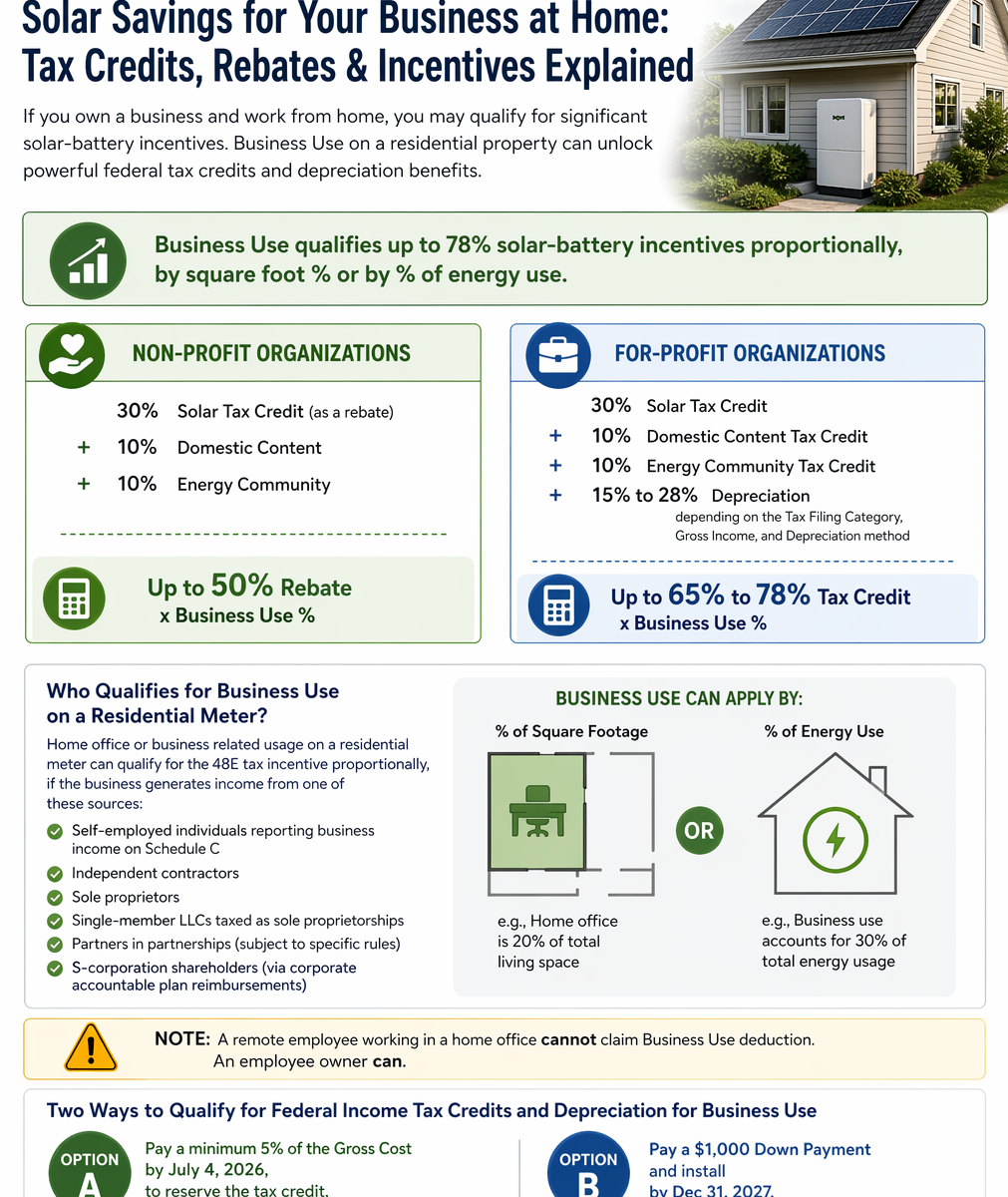
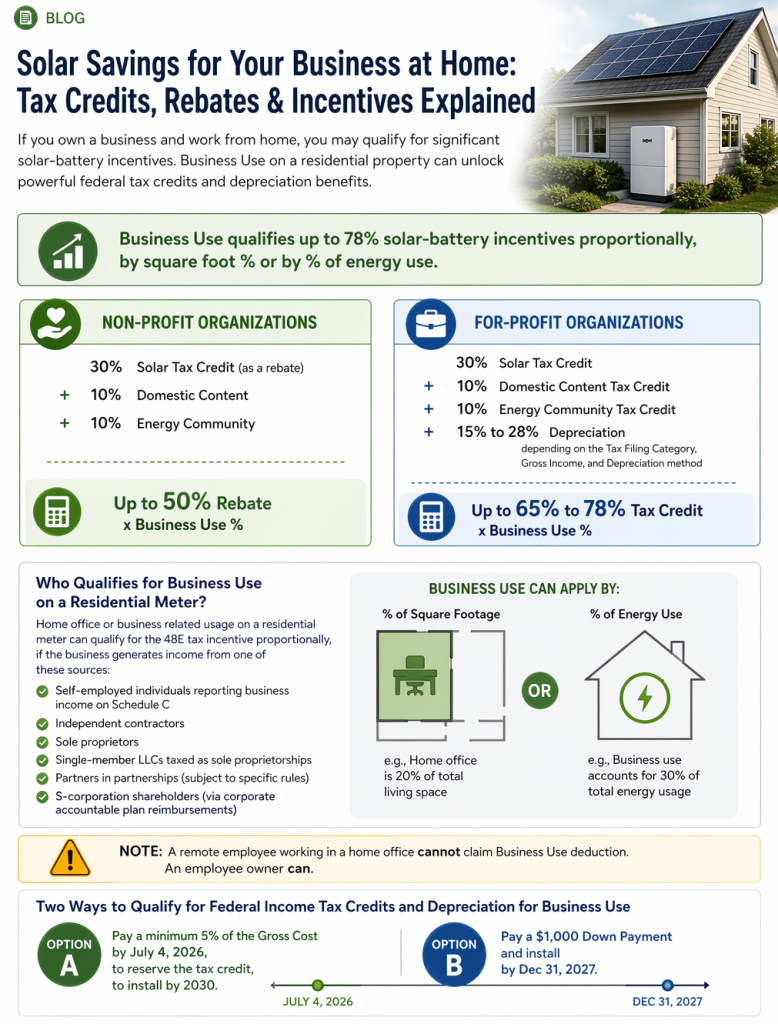
This means business use may qualify for up to 78% solar-battery incentives proportionally, depending on your tax structure and eligibility.
For example: If 40% of your home’s energy use supports your business operations, your eligible incentives may apply to that 40% business-use portion.
Incentives for Non-Profit Organizations Eligible non-profit organizations may qualify for: Federal Incentives
● 30% Solar Tax Credit (as a rebate)
● +10% Domestic Content
● +10% Energy Community
Total Potential Benefit Up to 50% Rebate × Business Use % This can significantly reduce upfront costs for qualifying churches, schools, charities, and other nonprofit entities operating from owned properties.
Incentives for For-Profit Organizations Eligible for-profit businesses may qualify for: Federal Incentives
● 30% Solar Tax Credit
● +10% Domestic Content Tax Credit
● +10% Domestic Content Tax Credit
● +15% to 28% Depreciation
● Based on tax filing category
● Gross income
● Depreciation method used
Total Potential Benefit Up to 65%–78% Tax Credit × Business Use % This makes solar + battery systems one of the most powerful tax-advantaged investments available for business owners.
Who May Qualify? Home office or business-related usage on a residential meter may qualify if the business generates income from one of the following:
● Self-employed individuals reporting business income on Schedule C
● Independent contractors
● Sole proprietors
● Single-member LLCs taxed as sole proprietorships
● Partners in partnerships (subject to specific rules)
● S-corporation shareholders (via corporate accountable plan reimbursements)
Important Note A remote employee working from a home office cannot claim Business Use deduction. However, an employee-owner may qualify depending on structure and reimbursement setup.
How to Reserve Federal Tax Credits
To qualify for Federal Income Tax Credits and Depreciation for Business Use:
Option B Pay a $1,000 Down Payment and install by December 31, 2027.
These timelines may help preserve eligibility under current federal incentive programs.
Why This Matters Solar + battery systems are no longer just energy upgrades—they are strategic financial tools. For business owners working from home, the right system structure may deliver:
● Lower utility costs
● Backup power security
● Major federal tax savings
● Accelerated depreciation benefits
● Improved long-term property value
Understanding your business-use percentage can make a major difference in total savings.
Disclaimer: Makello.com and Green Energy EPC by Makello, Inc. are not tax experts. This article is for informational purposes only and is not tax advice. We cannot guarantee incentive acceptance, fund availability, or final incentive amounts. Please consult your CPA or tax professional regarding your specific eligibility for business-use solar incentives on residential or commercial properties.
NeoVolta’s AC and DC coupled solutions work with existing residential solar systems. NeoVolta (San Diego, CA) has lithium iron phosphate (LiFePO4) chemistry ‘safer by design’. https://www.pv-magazine.com/2021/09/23/residential-battery-inverter-from-the-united-states
New Self-Generation Incentive Program (SGIP) Rebate application for Step 7 – Small Residential Energy Storage funding, becomes available starting Monday, Sept 27, 2021, at a rebate value of $0.15/wH.
Caller: “Quick question. I already have solar, so which Battery is right for me? I need an answer ASAP, because SGIP Rebates are back and who knows for how long.” Response: “If you already have a solar, then NeoVolta battery can work with just about any existing system, and is lowest cost to integrate as an AC Coupled solution, for up to 9.2kW solar. There are exceptions to the rule, if the existing solar is landing on a Renewable Meter Adapter (RMA), but we have custom solutions in that case. And, the NeoVolta battery can be DC coupled to solar as well, up to 8.448kW DC, using Tigo TS4-A-O Power Optimizers.
Californian’s reaped over $1B in SGIP Rebates. Don’t miss out! It is possible to qualify for up to 100% incentives for your solar battery in the Equity Resiliency $1/wH category and up to 85% in the Equity $0.85/wH category.
$1,000 to Reserve Solar Battery & SGIP Rebate Preparation by Makello (Don’t wait until the SGIP Rebate is gone!)
*Makello, as an authorized distributor for Green Energy EPC (CA Lic 978836), cannot guarantee SGIP acceptance, funds availability, and rebate amount. Only the Center for Sustainable Energy (CSE), the SGIP program administrator, can approve the Rebate Reservation Form application. When the CSE accepts our application on your behalf, you’ll be approved – and you’ll have up to 12 months to decide when to install, or request an extension..
A $1,000 refundable fee reserves your Solar Battery and SGIP Rebate Preparation, which includes the required site survey, Energy Analysis and purchase contract to sign, prior to the SGIP Rebate Reservation Form (RRF) submission. (The refundable fee terms are in the “Addendum-to-the-Green-Energy-EPC-contract-1” reference section below.)
Enphase’s AC Coupled solutions are eligible for SGIP Rebates. The Encharge’s lithium iron phosphate (LiFePO4) chemistry is safer by design and is 2021 EES Award Winner! https://enphase.com/blog/encharger-battery-wins-2021-ees-award
The SGIP Program may become wait-listed, it may be funded again, and it may run out of funds at any time, so it is critical to proceed quickly to process your SGIP Rebate.*
Makello Helps You Save Even More, With Energy Storage Solutions
Makello will help you: 1 – Qualify for rebates, incentives and discount utility rates. 2 – Suggest Energy Efficiency measures, to right-size of the solar and battery system. 3 – Determine if an existing electric panel can qualify for solar and battery. 4 – Provide an Ethical Energy Savings Report. 5 – Provide a purchase and installation contract for a solar and battery system to meet your goals and the site conditions.
LG Chem’s DC Coupled solutions are eligible for SGIP Rebates. LG Chem is one of the world’s top battery suppliers since 2016, with RESU Lithium-Ion batteries.
Makello offers NeoVolta, Enphase and LG Chem Advanced Energy Storage for residential solar and battery installations in our SDG&E territory for 2021 Reservations. (We are experienced with Outback and Sonnen battery systems as well.)
Reference:
Green Energy EPC and State of California Required Documents:
Enphase Documents: (For an existing Enphase microinverter solar panel system; M215, M250, S280, IQ7X, IQ8X). Note: S280 must be replaced with IQ8X inverters at extra cost $250/solar module installed. Note: M215 and M250 existing Enphase microinverters adds $900 to Gross Cost.
The value homeowners realize from having solar panels installed varies from state to state in the U.S. This value is most often measured as a solar payback or investment return. The solar payback period refers to the length of time it takes to realize enough electricity savings from a solar system to pay for the cost of installing it. The shorter the payback period, the greater the return on investment.
Book a FREE 15 minute appointment to: 1) Find out how Makello can help you. 2) Discuss your energy needs. 3) Get a FREE Energy Savings Estimate.
Any size solar array reduces the electric bill and provides access to discount utility rates. Makello’s Optimal Cost Savings determines the fastest payback and lowest upfront cost for the site characteristics and owner goals.
What is the typical payback period for residential solar installations in San Diego?
To determine a typical payback period and return on investment for a residential solar installation in San Diego two factors must be considered: 1) the cost of installing the solar panels; 2) the revenue earned by the solar system. The costs are typically easy to determine. A solar company will usually quote one fee that includes the cost of the solar panels and all approvals, permits and inspections for the authority of jurisdiction and SDG&E.
The revenue produced by a solar system is a function of the amount of energy it produces each year compared to what would have been paid to the utility if the same amount of energy had been purchased from the utility without the installation of solar panels.
Book an appointment to receive Makello’s Ethical Energy Savings Report, which is the result of a detailed trade-off study of discount utility rates, grants, rebates, tax credits, and equipment options, to determine the fastest payback and highest return on investment to meet your home, business and vehicle energy needs.
The fee for the Ethical Energy Savings Report is refundable (less the 3rd-Party $15 utility data access charge) or credited towards our installation services, after you attend the presentation meeting and complete a 5 minute survey after permission to operate.
Includes up to 5 hours research by the Makello team, and 1 hour Q&A, by Makello’s Ethical Energy Efficiency Expert.
Fundamentally, the amount of solar energy a residential PV system produces depends on weather conditions and climate. And most importantly, the amount of sunshine (the incident solar radiation or solar insolation in a given location). No surprises here that Southern California hits it out of the park on energy generation from solar panels. You can go weeks without seeing a cloud in San Diego. Electricity generation of up to 1,650 kWh per year per 1 kW of peak DC solar panels installed makes San Diego a very attractive location for solar panels.
Open air flow under carports can cool the modules and increase annual production. Beware of solar companies that tout extra short roof jacks and stylish tapered bumper edges that restrict airflow, causing overheating and reduced production.
Moving down to the bottom line, the financial incentives available for residential solar energy systems can make or break an investment decision. These vary widely across the US. In California, the most important incentives are the 26% federal solar tax credit and the NEM 2 net metering law passed by the California PUC. If we run numbers for a typical household, in San Diego, with a $250 per month SDG&E electric bill, through the “solar panels cost and savings calculator” we see the recent average cost of installed solar systems in San Diego and SDG&E electric rates, for all site location types, including clay tile, flat roof and ground mount systems that are more costly.
To what extent do high SDG&E electricity rates contribute to return on investment for solar users in San Diego?
San Diego topped a ranking of installed solar energy capacity and ranked second in installed solar energy capacity per capita in major US cities, according to a report from the California Environment Research & Policy Center. In so doing, San Diego surpassed Los Angeles, the previous first place holder, and trailed only Honolulu, Hawaii in the per capita ranking.
Let’s dig a little deeper and look at whether it’s actually worthwhile for a San Diego resident to invest in a solar PV system. To do so, we’ll make use of residential solar information resources of utility energy costs in major cities and metro areas across the country. To zoom in on the likely cost of actually having a residential PV system installed in San Diego, we’ll also make use of our tried and true, local guide to solar installation companies and residential solar cost calculator.
What we note from this is that SDG&E, the electric utility serving San Diego, has some of the highest electric rates in the nation. This, along with the exceptional amount of sunshine in Southern California, is why San Diego has the shortest payback times in the nation (and therefore the highest return on investment) for residential solar panels in California.
What incentives are available, in San Diego, to help with the cost of installing solar panels?
There are a variety of residential solar incentives available across the US. As the Solar Energy Industries Association explains: “Effective direct incentives can take a variety of forms depending on the particular situation and administrative abilities of a given state. Some states have chosen to offer tax credits, others to offer up-front rebates administered by state agencies or utilities, and still others offer performance-based incentives that are paid by an agency or utility over time based on kilowatt-hour production.”
Are you ready to save money on solar power, EV charging or Energy Storage? Get an instant quote from Makello!
Sorting through all these incentive programs, much less doing all the paperwork required to qualify for them, can be daunting. In all likelihood, you will be able to find and work with a solar finance/installation company that will assume much of the bureaucratic burden. Make it a point to include this on your checklist when shopping for the right provider.
For certain Low-Income qualified homes, it may be possible to have a solar system installed for free, through subsidies. Makello will tell you if you qualify, even if it means there is no sale opportunity. That is one of the ways we contribute to making solar accessible to everyone!
California continues to be a nationwide, and worldwide, leader when it comes to solar and “green” energy policies and programs. The most important incentive, by far, is the 26% federal solar tax credit and the NEM 2 net metering law that gives you almost full retail value for excess solar power exported into the grid during the day.
How much does San Diego’s high degree of sunshine contribute to the attractiveness of solar there?
Although we have touched on this topic, measuring the amount of solar energy a residential PV system is likely to generate over any given period of time is not as simple or straightforward as it might appear at first glance. It’s important to be sure you’re comparing apples to apples here.
By scientific convention, the amount of solar radiation available per unit area in a specific location is measured in kilowatt-hours per square foot per day, or for those more physics-minded, in megajoules per square meter per year. Other variables come into play, such as whether or not “direct” radiation, aka “direct-beam” radiation, or “diffuse” radiation is being measured. The former, as the term suggests, only measures the light that hits the earth’s surface directly, not any scattered or reflected sunlight. Diffuse radiation is a measurement of scattered sunlight while “albedo” radiation measures light reflected by the earth’s surface. As we have seen, 1 kW DC of solar panels installed in San Diego produces up to 1,650 kWh of energy per year. In comparison, many places in the north-east of America produce around 1,200 kWh per year. Using these numbers, San Diego produces up to 37% more power than the same panels would if they were installed in the north-east. This is a major contributor to making San Diego one of the most profitable cities in America for utilization of solar panels.
In San Diego, peak annual solar production is achieved by optimal orientation (180 degree south at 32.5 degree tilt), no near object and low horizon shading, with excellent air-flow underneath the modules and frequent module washing. Summer peak production is 17 degree tilt at 180 degrees south. Winter peak production is 47 degree tilt at 180 degrees south. If your south facing roof is shaded, Makello can install on the north roof with reverse tilt to the south. East tilt is 12% less than south and west facing tilt is 10% less than south.