Can Your Home-Based Business Qualify for Solar + Battery Tax Credits?

If you own a business and work from home, your solar and battery installation may qualify for significant federal tax credits and rebates.

Many business owners don’t realize that the business-use portion of their home can unlock commercial clean energy incentives through the federal 48E tax incentive structure, potentially allowing them to claim a substantial percentage of the system cost.


How Business Use Qualification Works
If part of your home is used for business purposes, the solar and battery system may qualify proportionally based on either:

● Square footage used for business

● Percentage of total energy use attributed to the business

This means business use may qualify for up to 78% solar-battery incentives proportionally, depending on your tax structure and eligibility.

For example:
If 40% of your home’s energy use supports your business operations, your eligible incentives may apply to that 40% business-use portion.


Incentives for Non-Profit Organizations
Eligible non-profit organizations may qualify for:
Federal Incentives

● 30% Solar Tax Credit (as a rebate)

● +10% Domestic Content

● +10% Energy Community

Total Potential Benefit
Up to 50% Rebate × Business Use %
This can significantly reduce upfront costs for qualifying churches, schools, charities, and other nonprofit entities operating from owned properties.


Incentives for For-Profit Organizations
Eligible for-profit businesses may qualify for:
Federal Incentives

● 30% Solar Tax Credit

● +10% Domestic Content Tax Credit

● +10% Domestic Content Tax Credit

● +15% to 28% Depreciation

● Based on tax filing category

● Gross income

● Depreciation method used

Total Potential Benefit
Up to 65%–78% Tax Credit × Business Use %
This makes solar + battery systems one of the most powerful tax-advantaged investments available for business owners.


Who May Qualify?
Home office or business-related usage on a residential meter may qualify if the business generates income from one of the following:

● Self-employed individuals reporting business income on Schedule C

● Independent contractors

● Sole proprietors

● Single-member LLCs taxed as sole proprietorships

● Partners in partnerships (subject to specific rules)

● S-corporation shareholders (via corporate accountable plan reimbursements)

Important Note
A remote employee working from a home office cannot claim Business Use deduction. However, an employee-owner may qualify depending on structure and reimbursement setup.


How to Reserve Federal Tax Credits


To qualify for Federal Income Tax Credits and Depreciation for Business Use:

Option A
Pay a minimum of 5% of the Gross Cost by July 4, 2026
to reserve the tax credit and install by 2030.

Option B
Pay a $1,000 Down Payment
and install by December 31, 2027.

These timelines may help preserve eligibility under current federal incentive programs.


Why This Matters

Solar + battery systems are no longer just energy upgrades—they are strategic financial tools. For business owners working from home, the right system structure may deliver:

● Lower utility costs

● Backup power security

● Major federal tax savings

● Accelerated depreciation benefits

● Improved long-term property value

Understanding your business-use percentage can make a major difference in total savings.


Disclaimer: Makello.com and Green Energy EPC by Makello, Inc. are not tax experts.
This article is for informational purposes only and is not tax advice. We cannot guarantee incentive acceptance, fund availability, or final incentive amounts. Please consult your CPA or tax professional regarding your specific eligibility for business-use solar incentives on residential or commercial properties.


Reserve Up to 78% Solar-Battery Incentives by July 4, 2026!

Safe Harbor for Solar & Battery Incentives in 2026: What Owners Need to Know

If you’ve been thinking about adding solar or battery storage to your property, 2026 brings a mix of opportunity and urgency. The landscape has shifted significantly over the past two years, and understanding what’s changed could make a substantial difference in your long-term savings.

The Big Change: Tax Credits in 2026

● Residential personal-use 30% solar and battery tax credits ended in 2025.

● However, solar and battery systems tied to Business Use are still eligible for tax credits in 2026, and these projects can be reserved now and built through 2030.

This means both commercial properties, and residential properties where homeowners who can legitimately classify part of their energy usage as business-related, such as a home office, rental activity, or EV used for business, may still qualify for meaningful incentives.

Why Timing Matters

There is a critical window to act. Contracts signed and a minimum of 5% Safe Harbor fee received before July 4, 2026 may still qualify for incentives, even if adjustments are made later through change orders. This gives owners flexibility while locking in potential financial benefits.

Exploring Your Options in Residential Business Use

Every home and energy setup is different, but most scenarios fall into a few categories:

● NEM Expansion (e.g., 3-module add-ons)
Ideal for homeowners looking to expand an existing system without losing the cost savings from a grandfathered utility rate.

● Solar + battery combinations
Increasingly popular due to rising electricity rates and grid instability.

● Battery-only installations
A strong option for homes already equipped with solar.

Within each of these, eligibility and savings can vary due to several factors.

Here are some examples of common scenarios for comparison:

● Busine Use Percentage

● Availability of local rebates (like San Diego Community Power’s Battery Savings Program)

● Whether the system is designed for backup power vs. cost savings

Battery Systems: A Growing Trend

While the solar market has slowed, battery adoption is accelerating. Homeowners are prioritizing energy independence and protection against outages.

It’s also worth noting:

● A battery designed purely for cost savings can be $4,000–$6,000 less expensive than a full backup system.

● Battery installations are more complex, requiring more labor, which affects pricing and margins.

Market Reality: A Volatile Few Years

The solar industry has experienced major turbulence:

● Equipment prices have fluctuated due to tariffs, inflation, and supply chain disruptions

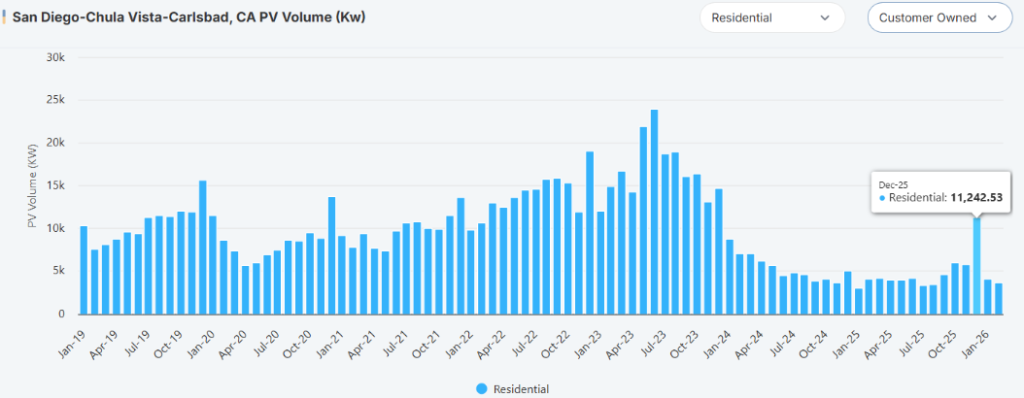
● The market saw a sharp contraction in 2024–2025, with many companies shrinking or exiting

● 2026 is shaping up to be one of the lowest-volume solar installation years in recent history

Credit: Ohm Analytics dashboard marketplace

At the same time:

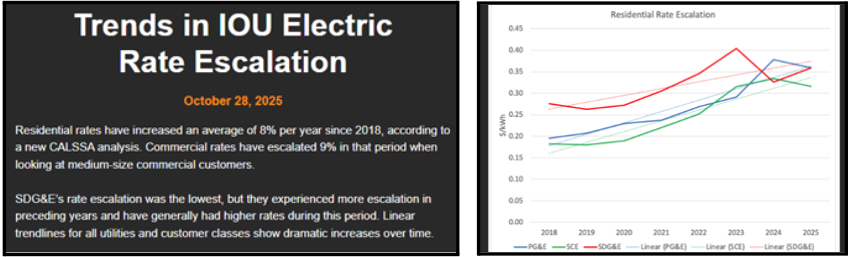
● Electricity rates have increased ~8% annually since 2018, doubling roughly every 7–9 years depending on rate structures

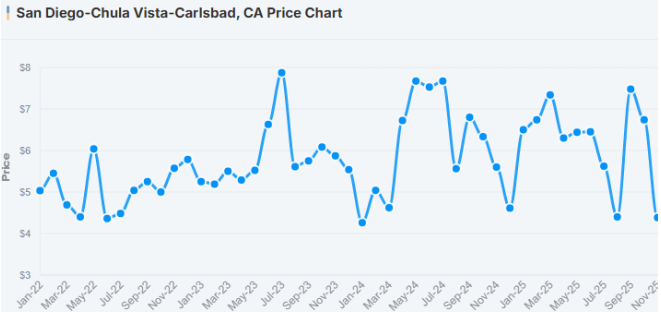
● The average solar PV cost/watt in 2025 ranged from $4.50 to $7.50 per watt, with regional averages around $6/watt, due to the 1kW CEC-AC add-on NEM Expansion limit.

Credit: CALSSA member newsletter. Click to become a CALSSA Member
Credit: Ohm Analytics dashboard marketplace

What This Means for You

Despite market uncertainty, the fundamentals still favor energy investment:

● Utility rates continue to rise steadily and SDG&E is already the highest cost utility power in the U.S., at $0.91/kWh Peak Rate (EV-TOU).

● Battery adoption is increasing due to real-world reliability needs

● Incentives still exist—but are now more nuanced and tied to usage type

The key question is no longer just “Should I go solar?” but rather:
“How can I structure my system to maximize savings under current rules?”

Final Thoughts

2026 isn’t the easiest year to navigate solar decisions—but it may be one of the most strategic.

If you’re considering solar or battery:

● Evaluate whether any portion qualifies as business use

● Understand your rate plan and energy consumption patterns

● Act before key deadlines to preserve eligibility

The opportunity hasn’t disappeared—it’s just become more tailored.

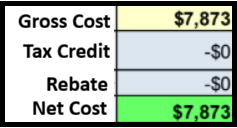
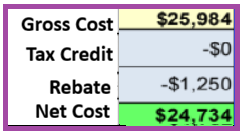
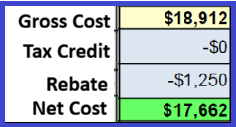
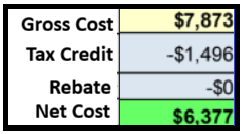
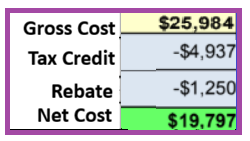
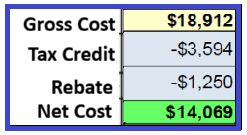
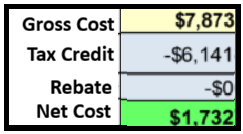
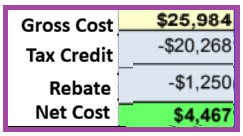
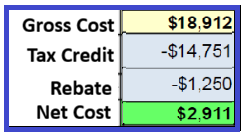
There’s a variety of options available for Residential Business Use NEM Expansion, for existing solar. Green Energy EPC by Makello, Inc has many hundreds of Current Customers with Net Energy Metering registrations that are eligible for an Alumni Discount. Click on the option that best matches your add-on Solar Only, Solar-Battery, or Battery Only NEM Expansion cost summary, to see a contract that is available for you to fill out, sign and return by May 1, 2027. Of course, Makello.com will be glad to help you through the process.

Solar Only Solar & BatteryBattery Only
0% Business Use
25 % Business Use
100 % Business Use

Remember you have until 2030 to build. You only need to pay a minimum of 5% before July 4, 2026 to Reserve your Solar Tax Credit and Depreciation incentives!

New SGIP Developments December 31, 2025

There are important updates to the SGIP rebate program coming.

The good news is SGIP AB 209 incentive budgets are open for submissions and will remain so.

However, CPUC Decision 25-12-003 impacts the SGIP Rebate Program significatnly on December 31, 2025. SGIP ratepayer incentive budgets are closing for new ratepayer application submissions including applications being submitted for the waitlist in the following budget categories:

             Large-Scale Storage

             Small Residential Storage

             Residential Solar and Storage Equity – Ratepayer

             Non-Residential Storage Equity

             Equity Resiliency

             Generation

December 20, 2025 is the last day to press the “submit” button for the incentive budgets listed above.

Ratepayer funding allocations discontinues after 2025. Applications in a “Waitlist” status on December 31, 2025 face cancellation.

Please reach out to SCE, CSE, PG&E, or SoCalGas if you have any questions regarding the changes to the SGIP Program. You may find program administrator contact information at https://www.selfgenca.com/home/contact/

Green Energy EPC by Makello CA Lic # 1110498

Community Choice is Here!

Map showing the service areas for Community Choice Aggregration Service Providers as of February 2022

Community Choice is coming to electric customers of San Diego County but what is Community Choice and what does it mean for you as a customer?

Community Choice Aggregation (CCA) is a locally run not-for-profit organization that was enabled by the California Legislature in 2002 AB117. The first CCA in San Diego County began operation in June 2018 and Community Choice Aggregation (CCA) continues to grow.

Community Choice Aggregation (CCA) does not generate electricity. Community Choice Aggregation (CCA) enables communities to pool ( i.e. aggregate) their electric load and purchase clean energy on the open market at competitive rates as well as develop local programs that benefit the community. The existing Investor-Owned Utility (IOU) continues to deliver power and maintain the grid. 

The goals and benefits of Community Choice Aggregation (CCA) are:

  • Accountability, transparency, local control and consumer choice
  • Assist communities with reaching their climate and economic goals
  • Promote transition to a cleaner energy supply
  • Reinvest revenues in the community instead of distributing to shareholders
  • Allow communities to develop renewable energy projects
  • Act as a tool for establishing local energy resources and programs

Since Community Choice Aggregation (CCA) works with local Investor Owned Utilities (IOU), customers are billed through their local Investor Owned Utility (IOU). Utility Customers are automatically enrolled in the Community Choice Aggregation (CCA) per State Mandate but can opt out of the program by contacting your local CCA. Terms and conditions may apply to opting out of Community Choice Aggregation (CCA). 

You still call your local Investor Owned Utility such as SDGE, SolCal Edison, or PG&E, if you have questions about your account or issues with your utility service such as downed power lines or power outages.

There are some programs offered through the Investor Owned Utilities (IOUs) that are impacted by the switch to Community Choice Aggregation (CCA).

For SDGE customers, the following programs are not offered to Community Choice Aggregation (CCA) participants: 

  • EcoChoice
  • EcoShare
  • Reduce Your Use Rewards (ended for all SDGE customers on 2-31-2018)
  • Direct Access

SDGE customers enrolled in any of these programs who choose to stay enrolled in Community Choice Aggregation (CCA) will be removed from the above listed SDGE programs. 

Makello’s Ethical Energy Savings Report is the result of a detailed trade-off study of discount utility rates, Community Choice Aggregation options, grants, rebates, tax credits, and equipment options, to determine the fastest payback and highest return on investment, to meet your home, business and vehicle energy needs.

SDGE customers receiving California Alternate Rates for Energy (CARE), Family Electric Rate Assistance Program (FERA), and Medical Baseline discount within their San Diego Gas & Electric (SDGE) energy delivery charges will continue to receive the discount after switching to Community Choice Aggregation (CCA). 

SDGE Customers on Net Energy Metering (NEM) rates will still have Net Energy Metering (NEM) if offered through the Community Choice Aggregation (CCA) provider. If you are grandfathered on a NEM pricing, you will see no change in your grandfathered rates if NEM is offered through your CCA. 

Please check with your local Investor Owner Utility to find out if your program enrollment or billing will be impacted by the switch to Community Choice Aggregation (CCA). 

Service territory of the now defunct Solana Clean Energy Alliance active between June 2018- May 2021

The first CCA in San Diego County was the Solana Energy Alliance which began operation in June 2018 and merged with Clean Energy Alliance in May 2021.

The Clean Energy Alliance CCA is currently servicing Solana Beach, Carlsbad, San Marcos, Escondido, and Del Mar. Service began in May 2021 for customers in Solana Beach, Carlsbad, and Del Mar. Service roll out began in December 2021 for Escondido and San Marcos. Please visit the Clean energy Alliance for more information regarding rates and other information for this CCA. https://thecleanenergyalliance.org/ The Clean Energy Alliance currently has all the information in pdf documents and does not have an online comparison tool. 

Map showing the Clean Energy Alliance service territory as of February 2022

The Clean Energy Alliance offers rates based on 50% clean energy production, 75% clean energy production or 100% clean energy production as well as Net Energy Metering (NEM) for customers with renewable energy production systems.

The Net Energy Metering (NEM) program from Clean Energy Alliance is similar to the current program offered by SDGE. The energy usage and excess production are tracked and at the end of the 12 month relevant period, the account is trued up. If there is a net charge due, the customer will be billed. If the customer had a net excess generation, they are eligible to receive Net Surplus Compensation which is set as of February 2022 at $0.06 per kilowatt-hour for Net Excess Generation.

SDGE customers enrolled in Net Energy Metering (NEM) will automatically be enrolled in the Clean Energy Alliance Net Energy Metering (NEM) Rate. Customers who install a solar, wind or other self-generation system after switching to services provided by Clean Energy Alliance can sign up for Net Energy Metering (NEM) with SDGE and be automatically enrolled in the Clean Energy Alliance Personal Impact Net Energy Metering (NEM) rate.

Map showing San Diego Community Power service territory.

The largest CCA in San Diego County is San Diego Community Power. This organization covers the majority of the County. The organization is initially offering two rates tiers, PowerOn and Power100 as well as Net Energy Metering (NEM). 

The City of Encinitas has opted for automatic enrollment of residents in Power100 rate and Imperial Beach, La Mesa, Chula Vista, and San Diego will be enrolled in the standard PowerOn rate. The Net Energy Metering (NEM) program is similar to the current SDGE program except San Diego Community Power bills monthly instead of issuing a potentially large bill at the annual true up. If you prefer to true up annually, you may contact San Diego Community Power and sign up for that option. 

San Diego Community Power has an incentive for customers that have energy generation systems producing an excess of electricity as measured in annual net kilowatt-hours at the end of their 12 month relevant period. Those customers will be compensated at the Net Surplus Compensation rate which is based on SDGE’s True Up Monthly rate plus a $0.0075/kWh adder. More information on SDGEs excess generation compensation may be found here https://www.sdge.com/residential/savings-center/solar-power-renewable-energy/net-energy-metering/billing-information/excess-generation

San Diego Community Power has a tool to help customers in their service territory estimate their bill with the different rates. The button for the Bill Comparison Calculator for residential and commercial rates is located at the bottom of the page.  Please click this link to access the tool. https://sdcommunitypower.org/your-choice/compare-service-plans/

Since the service territory is so large with such a large number of customers, San Diego Community Power service has been rolled out in steps. The dates are as listed in the chart below. 

 San Diego Community Power Service Territory Eligibility Dates

LocationResidential Eligibility DateCommercial Eligibility DateMunicipal Eligibility Date
Unincorporated Areas of San Diego County202320232023
City of San DiegoMay 2022June 2021May 2021
Chula VistaMay 2022June 2021May 2021
EncinitasApril 2022June 2021May 2021
Imperial BeachFebruary 2022June 2021May 2021
La MesaMarch 2022June 2021May 2021
National City202320232023

For those who prefer a picture, here is a map showing the Cities with residential roll out in 2022 for San Diego Community Power and the dates noted in the legend. 

San Diego Community Power Service Territory with Eligibility Dates for residential customers enrolling in 2022

Here is a map showing the communities that are scheduled to be eligible for service from San Diego Community Power some time in 2023. Stay tuned for more information on service roll out as it becomes available. 

Map showing San Diego Community Power service territory for customers with a 2023 enrollment date.


Makello is an authorized distributor for Green Energy EPC CA Lic #978836

Reference:

https://cal-cca.org/powered/https://

www.sdge.com/customer-choice/community-choice-aggregation/active-ccas

https://thecleanenergyalliance.org/

https://sdcommunitypower.org/

https://bill-compare.communityenergysolutions.com/ui-https://sdcommunitypower.org/v2/home/4/1/1

Learn to Love Solar HOA ARC Apps

Are you confused about installing a solar system in your HOA?

You’ve received an architectural application for a rooftop solar installation so what do you do next? Aesthetics are often the focus of solar installations in HOAs, but there are technical issues to be taken under consideration when the board of directors or architectural committee evaluates an application for a solar installation. Is the board or architectural committee prepared for the task?

First and foremost, governing documents pertaining to solar installations need to be reviewed by the board of directors together with the association’s attorney to ensure the governing documents are up to date. The solar industry is a rapidly changing industry with new advancements in solar technology being made regularly. Keeping the governing documents concurrent with Civil Code and solar technology developments can provide HOA management, board and architectural committee members with a solid foundation with which to evaluate solar applications and navigate the review process. 

HOAs with shared roofs such as town homes, multi-story buildings or carports may also wish to work with the HOA attorney to develop guidelines regarding which roofs solar modules are allowed to be installed and how the shared roof space will be allocated. Including a solar installation expert in the rules development process in order to help your association determine which portion of the roof is suitable for solar installations is a prudent decision. Required setbacks, obstructions, shading, roof shape, tilt and which direction the roof faces all impact the solar potential of a roof. Due to site factors and code requirements, some roofs may have little or no solar potential while other roofs may have amazing solar potential. It would be beneficial for the association to determine how to handle these issues ahead of time and address how to equitably divide up the roof space to avoid unnecessary conflict. Creating a map to document the usable roof space with good solar potential and allocation of that space would aid interpretation of the HOA guidelines. 

Makello works with non profits and HOAs to create maps that meet organizational needs.

Education for HOA managers, board and architectural committee members is also a good idea. It isn’t necessary to take a course in photovoltaics suited to solar industry professionals. There are free or low cost introductory courses that provide information on the basics of solar to help the non-professional or consumer understand the fundamentals of solar systems with minimal time commitment. Understanding the jargon and electrical concepts can help managers, HOA board, and architectural committee members feel more comfortable when reviewing an owner’s architectural submission for a solar installation. Being comfortable with the requirements and having a basic understanding of solar principles helps the association avoid missteps and misunderstandings. 

The SDGE Energy Innovation Center has free or low cost courses, https://www.sdge.com/energy-innovation-center.  Solar Energy International, https://www.solarenergy.org/,  is another resource for online introductory courses in solar energy. A third resource for solar education is Heatspring, https://www.heatspring.com. A final resource in North American Board of Certified Energy Professionals, https://www.nabcep.org, or NABCEP for short. NABCEP is mostly geared to professionals but they do periodically offer free introductory webinars or training for the non-professional or consumer.

An empowered HOA Board or Committee Member discussing solar energy.

There are a few things homeowners in HOAs can do to make the approval process for solar installations be less stressful.

Number one is to make sure you have the current version of all HOA governing documents that include the rules regarding installing solar i.e. the Rules & Regs. Architectural Guidelines and application and/or CC&Rs. Be ready to provide the rules to your solar installer because the installer needs to be aware of HOA specific issues pertaining to the installation that may impact system design.

Find out whether or not your contractor needs to indemnify the association and how much insurance the contractor needs to carry. Confirm your contractor meets the requirements. Not all contractors are willing to indemnify the association or wish to insure for the amount the association requires. 

Make sure you understand who is going to be responsible for maintenance and repair of the roof under the solar installation as well as maintaining insurance for the solar installation on common area roofs. This may impact your decision to proceed with the solar installation. It is also a good idea to find out if the association is going to be conducting roof repairs in the near future that may impact your solar installation. You may be responsible for covering the cost of removing and re-installation of your solar system so the association can conduct roof repairs. 

Give yourself time to obtain and evaluate bids, fill out HOA forms and gather supporting documents. Find out what the submission procedures and deadlines are for your architectural application. Solar installations are complex and not likely to be successfully submitted in a day or two. 

Together Everyone Achieves More

Additionally, don’t forget to check the insurance and licensing of the installer on the California State Contractors License Board https://www.cslb.ca.gov. 


Beauty is in the eye of the beholder and HOA owners can be divided in their opinion on the aesthetics of solar installations. Being prepared with knowledge about solar and having the correct procedures in place can help minimize issues and take the stress out of architectural applications for solar system installation. 

Makello is an authorized distributor for Green Energy EPC CA Lic #978836


Are You In Need of an Energy Upgrades LIFELINE?

In Case of Emergency, An “Energy Upgrades Lifeline” Pays For Itself
Get on the road to Energy Independence!

Did you know that, whether or not you have an existing solar energy system, you can tap into a combination of up-front incentives, financing, to build up your savings into a 6-Month Emergency Fund and lower monthly costs? 

Read more about the Energy Upgrades LIFELINE.

In Case of Emergency, An “Energy Upgrades Lifeline” Pays For Itself
Once-considered luxury items, such as Solar Power, Plug-In Vehicles, and Energy Storage, now payback quickly for cash purchases and are within reach for most homeowners, due to up-front incentives and lower total monthly costs from loan or Property Assessed Clean Energy financing.

Book a FREE 15 minute appointment to: 1) Find out how Makello can help you. 2) Discuss your energy needs. 3) Get a FREE Energy Savings Estimate.

How it Works

Makello performs the Energy Analysis:

  • Site survey.
  • Shading analysis.
  • Cash flow analysis.
  • Trade-off study.
  • Custom proposal.

Makello can provide you with a FREE Energy Savings Estimate! If you share your utility data with us we can create a solar energy system that is specific to your needs. We will NOT share your data.

Our model can also show the cost saving benefits of a Plug-In Vehicle or Energy Storage system, or both, in addition to your solar system. All of our team works to get you the most comprehensive, thorough Energy Analysis in the San Diego area as quickly as possible.

The software engineers are constantly updating our computer model to reflect the most current utility rates and product costs. We have a dedicated GIS analyst who can qualify you for as many rebates and incentives possible. Our Energy Efficiency experts can also provide other solutions to reduce energy costs such as appliance changes or switching utility rates. Press one of the buttons to see how much you can save!

Learn more about: Solar Panels, Plug-In Vehicles & Energy Storage

Are you ready to save money on solar power, EV charging or Energy Storage? Get an instant quote from Makello!

utility black out battery back up power
Where Will You Be In The Next Blackout?
Makello makes driving easy as 123
Makello Makes Driving Electric as Easy as “1-2-3”
battery backup power 2020
Get On The Road To Energy Independence

Energy Upgrades LIFELINE 1-2-3

In Case of Emergency, An “Energy Upgrades Lifeline” Pays For Itself
Get on the road to Energy Independence!

Pandemic stressing out the family finances? Turn your home and vehicle into a clean energy emergency fund!

Getting laid-off is stressful even in the best of times. In the midst of a pandemic, job loss and financial surprises can drain your savings account fast. Did you know that whether or not you have an existing solar energy system, you can tap into a combination of upgrade incentives and financing that can return money to you.  A Solar, Plug-In Vehicle and Energy Storage lifeline!

Recently, a solar-powered homeowner asked Makello to quote adding a Level 2 electric car charger for their Nissan Leaf, an installation often priced at $500 or less. Most solar companies refuse to take these small jobs as they are unprofitable for the installer.

But at Makello, we look at things differently. We know from experience that with the dizzying array of Solar Power, Plug-In vehicle, and Energy Storage incentives and energy cost savings, energy upgrades can pay for themselves. When the homeowner shared that their rooftop solar was installed for free under a low-income residential solar program (SASH), and that they had been laid off due to the pandemic, we started crunching numbers to see what we could do.  

We offered a plan to improve the homeowner’s cash flow and create a 6-month emergency reserve fund out of available incentives.

Makello Energy Analysis. LIFELINE Cost Savings Over Time
As you can see in the savings over time graph, the system is cash flow positive every year, meaning lower annual cost, through the term of the PACE financing, and then savings accelerates.

How did we do this?

Find Incentives  → Optimize Upgrade  → PACE financing  → Create 6-month ‘Lifeline’.

  1. Incentive Finder – Makello’s own GIS mapping database uses the home’s geographic location to determine eligibility for a wide variety of energy upgrade grants, rebates, discounts and tax credits.
  2. Optimize Upgrade – Makello’s own Energy Analysis software shows the optimal Solar, EV, and Energy Storage upgrade plan, for the eligible incentives. In California, benefits such as  emergency backup power for home and vehicles, water pumps, air-conditioning, air-purifying and fire-fighting equipment can all be worked into the upgrade plan.  In this case, Makello showed that a larger upgrade would tap into $23,448 in incentives, and give the homeowner more solar, energy storage, a second EV and Level 2 charger. 
  3. PACE program financing – The State of California offers a Property Assessed Clean Energy (PACE) financing plan.  Homeowners can qualify based on a recent tax return or pay stubs.  The financing does not appear on a credit report, is not considered a loan, does not trigger a property reassessment, and can transfer to the next home buyer.
  4. Create a 6-month financial ‘lifeline’ –  Makello’s “Lifeline” incentive payment program tracks the incentives and requirements, and allows the homeowner to choose the best time to draw on their earned incentives.  In the example used here, a homeowner can decide after receiving the up front incentives to purchase a new or used Plug-In Vehicle, further reducing their monthly costs, or pay their most urgent bills, such as mortgage, food, and medical. 
CA Property Assessed Clean Energy program (PACE) financing

Makello’s GIS mapping database, uses county parcel location to help homeowners determine eligibility for a wide variety of solar programs.  We also use mapping to help non-profit organizations to design programs in disadvantaged communities that promote solar energy and electric vehicle incentives for economic and environmental benefit.

Makello works with non profits and other agencies to create maps for Environmental Justice initiatives.

How the PACE Program works:

CA Property Assessed Clean Energy program (PACE) financing

The PACE program is intended for those that can demonstrate the ability to pay. Homeowners provide a recent tax return or a pay stubs for income verification, and credit check, and Makello provides the Energy Analysis to show that the energy efficiency project will be cash flow positive. 

Book a FREE 15 minute appointment to: 1) Find out how Makello can help you. 2) Discuss your energy needs. 3) Get a FREE Energy Savings Estimate.

PACE financing ranges from 5 to 30 years term for solar, 10 years for Energy Storage, and can be used for other energy efficiency improvements, such as electric panel upgrade, EV Charging, and a long list of energy efficiency upgrades.  PACE can be as low as $0 down. It provides tax deductible interest.

For our homeowner in this example, Simple Payback is possible in 3.7 years through Annual Energy Cost Savings.  That means it’s a good deal for a cash purchase or loan. For those on a fixed income, traditional loans might not be a viable option. In the cases where PACE financing is Cash Flow Positive, we can present the PACE option as an alternative to traditional loans and leases.

Makello provides full disclosure about PACE terms and program information, as well as programs offered through banks and credit unions. Please contact us and we’ll be happy to discuss the alternatives.

Click on the videos below to learn more.

battery backup power 2020
Get On The Road To Energy Independence!
utility black out battery back up power
Where Will You Be In The Next Blackout?
Makello makes driving easy as 123
Makello Makes Driving Electric as Easy as 1-2-3

A 6 Month Emergency Fund, Right Now?

In Case of Emergency, An “Energy Upgrades Lifeline” Pays For Itself

Recently, a solar powered homeowner inquired about adding a Level 2 charger for a 2013 Nissan Leaf, typically a $400 installation. Most solar companies would refuse the job due to low profit.

In Case of Emergency, An “Energy Upgrades Lifeline” Pays For Itself
In Case of Emergency, An “Energy Upgrades Lifeline” Pays For Itself.

Makello rose to the challenge and used our Energy Analysis tool to present an “Energy Upgrades Lifeline” option that improves the homeowner’s cash flow and can provides a “6 Month Emergency Fund”.

Parcel level GIS mapping software made by Makello, is used to determine eligibility qualifications for a wide variety of energy upgrade grants, rebates, discounts, credits and deductions.

Makello works with non profits and other agencies to create maps for Environmental Justice initiatives.

The rooftop solar on the home was installed for free in 2012 by Grid Alternatives through the SASH program, for qualified low-income residential California homes. An Energy Upgrade Lifeline can work even if the property already has solar.

One of the homeowners was temporarily laid off due to the pandemic. An Energy Upgrade Lifeline can qualify for financing by the State of California based on prior year tax return.

Makello’s Ethical Energy & Cost Savings Analysis provides $23,448 Incentives upfront for adding more solar, energy storage, a 2nd EV and a Level 2 charger.

What makes the solution possible is a Property Assessed Clean Energy (PACE) financing method that does not appear on the credit report, is not a loan, does not trigger a property reassessment and can transfer to the next home buyer.

CA Property Assessed Clean Energy program (PACE) financing

PACE financing ranges from 5 to 30 years term for solar, 10 years for energy storage, and can be used for other energy efficiency improvements.  PACE can be as low as $0 down, it provides tax deductible interest, there are no pre-payment fees, and no credit minimum.

The PACE program is intended for use by those that can demonstrate the ability to pay. There are safeguards to protect against abuse, such as a soft pull credit check, income verification from a recent paycheck or tax return, and a requirement that the energy efficiency project is cash flow positive, as it is here:

Makello Energy Analysis. LIFELINE Cash Flow Positive
Click to Enlarge

What makes the solution a “Lifeline” is that the incentives payments can be used as a reserve. In an emergency, the basic expenses such as mortgage payment, food, and medicine are met.  The system is designed to be cash flow positive, meaning lower cost monthly and annually, than the baseline status quo.  

Makello’s “Lifeline” Incentive Payment timing gives the homeowner flexibility to make decisions on what to do with the money and when to put the reserve to use.  In this case, after 6 months, the homeowner can decide to use some or all of the Incentives to purchase a Plug-In Vehicle to further increase energy cost savings, or for another important use.

Simple Payback is possible in 3.7 years through Annual Energy Cost Savings.  That means it’s a good deal for a cash purchase or loan. For those on a fixed income, traditional loans might not be a viable option. In the cases where PACE financing is Cash Flow Positive, we can present the PACE option as an alternative.

Makello Energy Analysis. LIFELINE Cost Savings Over Time
(Click to enlarge) As you can see in the savings over time graph, the system is cash flow positive every year through the 10 year PACE financing and then savings accelerates.

Book a FREE 15 minute appointment to: 1) Find out how Makello can help you. 2) Discuss your energy needs. 3) Get a FREE Energy Savings Estimate.

Makello’s Optimal Cost Savings Plan has other benefits for California in 2020, such as emergency backup power for home and vehicles, water pumps, air-conditioning, air-purifying and fire-fighting equipment.

Makello is ethical in our approach, offering full disclosure about PACE terms and program information, bank and credit union loan alternatives.

CA Property Assessed Clean Energy program (PACE) financing

San Diego Residential Solar: Just How Worthwhile Is It?

Makello determine fastest payback and lowest cost for solar.

The value homeowners realize from having solar panels installed varies from state to state in the U.S. This value is most often measured as a solar payback or investment return. The solar payback period refers to the length of time it takes to realize enough electricity savings from a solar system to pay for the cost of installing it. The shorter the payback period, the greater the return on investment.

https://www.youtube.com/watch?v=UsTqvgC_xaI&list=PLrHVPFynJo112gIIoavaCwlnz6n-2Z6Z0
Get on the road to Energy Independence!

Book a FREE 15 minute appointment to: 1) Find out how Makello can help you. 2) Discuss your energy needs. 3) Get a FREE Energy Savings Estimate.

Makello determine fastest payback and lowest cost for solar.
Any size solar array reduces the electric bill and provides access to discount utility rates. Makello’s Optimal Cost Savings determines the fastest payback and lowest upfront cost for the site characteristics and owner goals.

What is the typical payback period for residential solar installations in San Diego?

To determine a typical payback period and return on investment for a residential solar installation in San Diego two factors must be considered: 1) the cost of installing the solar panels; 2) the revenue earned by the solar system. The costs are typically easy to determine. A solar company will usually quote one fee that includes the cost of the solar panels and all approvals, permits and inspections for the authority of jurisdiction and SDG&E.

The revenue produced by a solar system is a function of the amount of energy it produces each year compared to what would have been paid to the utility if the same amount of energy had been purchased from the utility without the installation of solar panels.

Book an appointment to receive Makello’s Ethical Energy Savings Report, which is the result of a detailed trade-off study of discount utility rates, grants, rebates, tax credits, and equipment options, to determine the fastest payback and highest return on investment to meet your home, business and vehicle energy needs.

The fee for the Ethical Energy Savings Report is refundable (less the 3rd-Party $15 utility data access charge) or credited towards our installation services, after you attend the presentation meeting and complete a 5 minute survey after permission to operate.

Includes up to 5 hours research by the Makello team, and 1 hour Q&A, by Makello’s Ethical Energy Efficiency Expert.

Fundamentally, the amount of solar energy a residential PV system produces depends on weather conditions and climate. And most importantly, the amount of sunshine (the incident solar radiation or solar insolation in a given location). No surprises here that Southern California hits it out of the park on energy generation from solar panels. You can go weeks without seeing a cloud in San Diego. Electricity generation of up to 1,650 kWh per year per 1 kW of peak DC solar panels installed makes San Diego a very attractive location for solar panels.

Air flow can cool modules and increase annual production.
Open air flow under carports can cool the modules and increase annual production. Beware of solar companies that tout extra short roof jacks and stylish tapered bumper edges that restrict airflow, causing overheating and reduced production.

Moving down to the bottom line, the financial incentives available for residential solar energy systems can make or break an investment decision. These vary widely across the US. In California, the most important incentives are the 26% federal solar tax credit and the NEM 2 net metering law passed by the California PUC. If we run numbers for a typical household, in San Diego, with a $250 per month SDG&E electric bill, through the “solar panels cost and savings calculator” we see the recent average cost of installed solar systems in San Diego and SDG&E electric rates, for all site location types, including clay tile, flat roof and ground mount systems that are more costly.

To what extent do high SDG&E electricity rates contribute to return on investment for solar users in San Diego?

San Diego topped a ranking of installed solar energy capacity and ranked second in installed solar energy capacity per capita in major US cities, according to a report from the California Environment Research & Policy Center. In so doing, San Diego surpassed Los Angeles, the previous first place holder, and trailed only Honolulu, Hawaii in the per capita ranking.

Let’s dig a little deeper and look at whether it’s actually worthwhile for a San Diego resident to invest in a solar PV system. To do so, we’ll make use of residential solar information resources of utility energy costs in major cities and metro areas across the country. To zoom in on the likely cost of actually having a residential PV system installed in San Diego, we’ll also make use of our tried and true, local guide to solar installation companies and residential solar cost calculator.

What we note from this is that SDG&E, the electric utility serving San Diego, has some of the highest electric rates in the nation. This, along with the exceptional amount of sunshine in Southern California, is why San Diego has the shortest payback times in the nation (and therefore the highest return on investment) for residential solar panels in California.

What incentives are available, in San Diego, to help with the cost of installing solar panels?

There are a variety of residential solar incentives available across the US. As the Solar Energy Industries Association explains: “Effective direct incentives can take a variety of forms depending on the particular situation and administrative abilities of a given state. Some states have chosen to offer tax credits, others to offer up-front rebates administered by state agencies or utilities, and still others offer performance-based incentives that are paid by an agency or utility over time based on kilowatt-hour production.”

Are you ready to save money on solar power, EV charging or Energy Storage? Get an instant quote from Makello!

Sorting through all these incentive programs, much less doing all the paperwork required to qualify for them, can be daunting. In all likelihood, you will be able to find and work with a solar finance/installation company that will assume much of the bureaucratic burden. Make it a point to include this on your checklist when shopping for the right provider.

Up to 100% subsidies are available for solar installations.
For certain Low-Income qualified homes, it may be possible to have a solar system installed for free, through subsidies. Makello will tell you if you qualify, even if it means there is no sale opportunity. That is one of the ways we contribute to making solar accessible to everyone!

California continues to be a nationwide, and worldwide, leader when it comes to solar and “green” energy policies and programs. The most important incentive, by far, is the 26% federal solar tax credit and the NEM 2 net metering law that gives you almost full retail value for excess solar power exported into the grid during the day.

How much does San Diego’s high degree of sunshine contribute to the attractiveness of solar there?

Although we have touched on this topic, measuring the amount of solar energy a residential PV system is likely to generate over any given period of time is not as simple or straightforward as it might appear at first glance. It’s important to be sure you’re comparing apples to apples here.

By scientific convention, the amount of solar radiation available per unit area in a specific location is measured in kilowatt-hours per square foot per day, or for those more physics-minded, in megajoules per square meter per year. Other variables come into play, such as whether or not “direct” radiation, aka “direct-beam” radiation, or “diffuse” radiation is being measured. The former, as the term suggests, only measures the light that hits the earth’s surface directly, not any scattered or reflected sunlight. Diffuse radiation is a measurement of scattered sunlight while “albedo” radiation measures light reflected by the earth’s surface. As we have seen, 1 kW DC of solar panels installed in San Diego produces up to 1,650 kWh of energy per year. In comparison, many places in the north-east of America produce around 1,200 kWh per year. Using these numbers, San Diego produces up to 37% more power than the same panels would if they were installed in the north-east. This is a major contributor to making San Diego one of the most profitable cities in America for utilization of solar panels.

Makello position solar panels to maximize energy production.
In San Diego, peak annual solar production is achieved by optimal orientation (180 degree south at 32.5 degree tilt), no near object and low horizon shading, with excellent air-flow underneath the modules and frequent module washing. Summer peak production is 17 degree tilt at 180 degrees south. Winter peak production is 47 degree tilt at 180 degrees south. If your south facing roof is shaded, Makello can install on the north roof with reverse tilt to the south. East tilt is 12% less than south and west facing tilt is 10% less than south.
Makello makes driving easy as 123
Makello Makes Driving Electric as Easy as 1-2-3
utility black out battery back up power
Where Will You Be In The Next Blackout?
battery backup power 2020
Get On The Road To Energy Independence!

The True Cost of Utilizing Solar in San Diego

Cost savings of energy efficiency can pay for backup power.

There are a lot of variables surrounding the use of a solar power system, and you may have wondered if solar is a better option for your home. While a lot of talk has circulated in regards to the supposed benefits and value of solar, as well as overall function, there is good news for anyone residing within the San Diego, California area – we have calculated the variables of solar power for you.

Book a FREE 15 minute appointment to: 1) Find out how Makello can help you. 2) Discuss your energy needs. 3) Get a FREE Energy Savings Estimate.

Cost savings of energy efficiency can pay for backup power.
Would you buy 25 years of solar power based on your Last Year Use, knowing that lower cost energy efficiency solutions to replace the inefficient water pumps, A/C, incandescent lighting and 10 year old appliances can cut the system size in half? The up front cost savings of energy efficiency can pay for emergency backup power.

The power source of your entire household is one of the most important considerations of home ownership. And, rather than hanging you out to dry, we have resolved to answering the most important, nagging questions: “is solar worth it” and “what is it going to cost”. Rather than wasting hours upon hours playing detective, we have summed up the most important information you need in order to make an informed decision about solar, for your family.

The Initial Cost

For the average residential system, typically purchased within the San Diego area, a 6 kilowatt installation is recommended. For this article, we are going to utilize the available data in order to provide an initial overview of cost for as many curious people as possible. With this in mind, the upfront cost of installation generally starts around $19,200 before incentives. The total price is based on an average cost of $3.20 per watt.

Are you ready to save money on solar power, EV charging or Energy Storage? Get an instant quote from Makello!

Incentives of Solar

Once you take available federal tax credits into consideration, the total cost drops considerably – once the 26% discount is taken into account. The initial quote immediately drops to $14,200 with the aforementioned savings. The most important detail to take note of, is that the credit is for individuals who actually purchase their own solar system.

No doubt you have heard or seen advertisements from a variety of solar companies, offering leases, in addition to Power Purchase Agreements, if you find yourself in the market. The issue surrounding promotions such as these is that, because a separate company owns the solar system, the consumer will not receive the tax credit if they are leasing – the solar company does. These types of agreements typically mean, however, that the developer is solely responsible for the overall upkeep of the system, in addition to the financing arrangement and installation. The consumer is simply charged a fixed rate for their consumption of solar power.

Many leasing companies do not install open rack modules.
Many leasing companies do not install reverse tilt modules, pole mount, awning, carport or ground mount.

Because, realistically, families do not have $19,200 in cash at their disposal for the purchase of a new solar system, loan or leasing may be a viable option. The leasing situation isn’t much different when compared to that of a utility company, aside from the fact that the rates are a bit more affordable. Aside from the benefit of lower rates, the savings from leasing are consistently lower once compared to the outright purchase of your own solar power system by cash or loan. However, when a lease is your only option, it is worth time spent researching solar companies that offer a lease-to-own alternative to leasing. Benefits might include lower payments, in addition to benefits beyond the 26% federal tax credit, such as additional tax incentives.

Differences in Solar Energy Systems

When analyzing a typical solar system, the monthly average is 800 kWh (kilowatt hours). This number is based off of a 6kW system producing an annual average of 9,600 kWh in the first year. While these rates can change significantly with more advanced solar systems, which offer higher installed system capacity, these systems are able to produce 8% to 20% more kWh per watt. Along with the long-term savings increase, and a higher initial investment, homeowners will observe an overall decrease in length of pay off.

San Diego Utility Pricing System

As we watch rates continuing to climb throughout the San Diego area, the pricing system has integrated a slew of fundamental alterations. Even the way utility companies price power overall has faced significant changes, at least up until 2016. Before 2016, homes were based on a 4-tier pricing system in order to classify homes in a more affordable manner. Prior to 2017 it was changed to a 3-tier system and, currently, we stand at a 2-tier cost structure as rates continue to rise. “Super user” surcharges have also been imposed for households deemed beyond tier 2.

Annual Savings

Solar offers a significant advantage over tiered pricing systems, and assists in saving money on subsequent monthly bills. Considering how they are San Diego’s largest coastal and inland electricity providers; we have based our calculations on SDG&E’s residential pricing system.

Book an appointment to receive Makello’s Ethical Energy Savings Report, which is the result of a detailed trade-off study of discount utility rates, grants, rebates, tax credits, and equipment options, to determine the fastest payback and highest return on investment to meet your home, business and vehicle energy needs.

The fee for the Ethical Energy Savings Report is refundable (less the 3rd-Party $15 utility data access charge) or credited towards our installation services, after you attend the presentation meeting and complete a 5 minute survey after permission to operate.

Includes up to 5 hours research by the Makello team, and 1 hour Q&A, by Makello’s Ethical Energy Efficiency Expert.

Before installing a solar system, households typically consume an average of 800kWh per month, or an annual 9,600kWh. Because a residence generally consumes more power after installation, potential savings tend to range from 9,600 to 12,000kWh. Homeowners living within inland San Diego can expect, by our calculations, to save upwards of $4,000 each year. However, in coastal San Diego, the savings decreases a tad with the moderate coastal climate, topping out at $3,000 annually. Essentially, your solar system would pay for itself in around 3-4 years, assuming a 6% annual average increase in SDG&E utility rates.

A Bit More Consideration

Although this brief rundown only begins to illustrate the feasible savings presented by a new solar power system, savings may be influenced by additional factors. The size of your system, requiring a larger installation, offers further annual savings, and enables the system to make recompense for itself. Every homeowner, interested in solar, should take it upon themselves to study the topic further, before deciding to opt for a solar system.

Shade under solar arrays can reduce home AC and fan loads.
Overheated attic lofts and bedrooms can cool off under the shade of a solar array, reducing A/C and fan loads.
Makello makes driving easy as 123
Makello Makes Driving Electric as Easy as 1-2-3
utility black out battery back up power
Where Will You Be In The Next Blackout?
battery backup power 2020
Get On The Road To Energy Independence!

Makello Research Assistant in UCSD ESYS Capstone

AuroraSolar solar design model energy analysis irridiance

I was going into my last quarter of undergrad at UCSD when I started interning at Makello. The internship was part of my Senior Project, and I enjoyed working with a diversely skilled team.  I worked with people with experience in many fields including software/electrical engineering, solar installation, non-profit organizations, management experience, and GIS systems all united by a common goal: clean energy.

I recently completed my B.S. in Environmental Systems and Earth Sciences with a minor in Marine Sciences. I am pursuing a career to combat climate change to preserve our planet as we know it, but there is also a part of me that feels a societal obligation to help elevate the standard of living (if they want it) for people who do not have equal access to opportunities such as education, community resources, healthy foods, etc. I believe we live in a society to take care of each other, and generally, disadvantaged communities could use additional resources, so I was excited to work with a company that works closely with non-profit organizations, especially non-profits in disadvantaged communities, such as Groundwork San Diego. I am thrilled to be in a position, right out of college, where I can help combat both social and environmental justice.

Makello Team City Heights 5k run
The Makello Team (left to right) Agustin, Ola, Linda, Charlie

During my internship, we attended many events as both attendees and presenters, sometimes with Groundwork San Diego or our solar installation team. Examples of events were community activities, such as organized runs or home and garden shows, where we would provide information about electric vehicles and solar. We also attended car shows and electric vehicle focused events to stay current with new electric vehicle technology and to help explain their benefits to the public.

Click here to see how I discovered Makello.  

Book a FREE 15 minute appointment to: 1) Find out how Makello can help you. 2) Discuss your energy needs. 3) Get a FREE Energy Savings Estimate.

Part of my initial training was how to use solar design and cash flow analysis software, the site survey measurements and the customer’s goals to determine the Optimal System Size. I grew up doing home remodels and renovations during summers, so I enjoyed visiting different homes and seeing different styles of architecture and landscaping throughout San Diego. It was cool to see some existing solar arrays that customers had already installed too. It was also nice to be able to put a face to the customers whose proposals we were working on. 

Working on customer proposals and site surveys was my favorite part of the internship because it was a combination of computer design and modeling, hands on physical labor, and critical and analytical thinking. I still enjoy the same work, but now my Research Assistant position is 100% remote because we follow CDC guidelines to keep ourselves and our community safe. We used Makello’s software model to create the custom trade-off study proposals for each customer and automatically generate the correct price, ethically, without sales gimmicks.

Makello’s honesty and knowledge of energy efficiency, utility rates, solar power, electric vehicles, and battery storage, as well as assessing the needs of individual customers and their families, is what drives the high win rate with customer proposals.  On more than one occasion, customers wanted to purchase more solar than they needed, or wanted a battery because they believed it would increase cost savings. Using Makello’s model, our team showed that, in fact, a smaller solar system is needed if replacing inefficient appliances, or changing the times the appliances are in use.

I was excited to work on a diversely skilled team to create community pages for our website. We ended up creating a valuable tool with important information and graphics for San Diego communities. The pages had GIS Maps that displayed information on a variety of issues such as air quality, electric vehicle charging station locations, rebate eligibility, etc. We also included a list of different rebates and incentives for solar, electric vehicles and battery storage as well as information as to why they are beneficial to the environment and how they can save money. Click here to view the community pages. 

Are you ready to save money on solar power, EV charging or Energy Storage? Get an instant quote from Makello!

Makello Aids NPOs & NGOs in Environmental Justice

EV Association of SD at Groundwork San Diego’s EarthLab

I met Charlie, the CEO and founder of Makello, during the summer while I was interning at Groundwork San Diego’s EarthLab in partnership with UC San Diego’s Center on Global Justice. While at the EarthLab, I was a college mentor for Groundwork’s High School Green Team. We were learning about electric vehicles, and Charlie was one of the guests who volunteered his time to come speak to us about the benefits, technology, and affordability of Plug-In Vehicles.

Book an appointment to receive Makello’s Ethical Energy Savings Report, which is the result of a detailed trade-off study of discount utility rates, grants, rebates, tax credits, and equipment options, to determine the fastest payback and highest return on investment to meet your home, business and vehicle energy needs.

The fee for the Ethical Energy Savings Report is refundable (less the 3rd-Party $15 utility data access charge) or credited towards our installation services, after you attend the presentation meeting and complete a 5 minute survey after permission to operate.

Includes up to 5 hours research by the Makello team, and 1 hour Q&A, by Makello’s Ethical Energy Efficiency Expert.

The first time I met him was with the Electric Vehicle Association of San Diego. Charlie and other members of the EV Association came to the EarthLab and spoke to us about electric vehicles, their experiences with them, why they loved them, and allowed us to ride along in their vehicles!

EV Association of SD at Groundwork San Diego’s EarthLab
Charlie and other members of the Electric Vehicle Association of San Diego met with Groundwork San Diego’s High School Green Team.

Charlie volunteered his time on four occasions during the four week program. The second time I met him, he and Songxuan came to the EarthLab to do a solar and electric vehicle demonstration. We used solar ovens, metal sheets that reflect sunlight into a concentrated location, to heat up solar chili and cornbread. It was so good! He also gave us a quick presentation on “What to Know About Plug-In Vehicles”. The presentation was really cool because he demonstrated how the car, a MINI Countryman Plug-In Hybrid, could be used as a battery bank, using it to power the laptops and monitor, and explained how solar could charge up the car. We also got to look at the battery packs for his converted Plug-In Prius.

You don’t need a ton of solar to save money.

During his presentations to us, he acknowledged that he was a small business owner, but never tried to sell us on his products. Instead he explained how the technology worked, why the technology is more environmentally and community friendly, and how the technology could, in fact, be made affordable to families in disadvantaged communities. Solar and electric vehicle adoption contributes to safer, cleaner communities. Less greenhouse gases and smog are emitted from cars and power plants, leading to better air quality in communities.

Northgate Market Public EV Charging Stations grand opening
Makello, Groundwork San Diego, and EVgo grand opening at Northgate Market at 1410 S 43rd St, San Diego, CA 92113; 4 CCS/SAE 50kW and 5 CHAdeMO 50kW EV Chargers.

Book a FREE 15 minute appointment to: 1) Find out how Makello can help you. 2) Discuss your energy needs. 3) Get a FREE Energy Savings Estimate.

Charlie was also at the grand opening of the EVgo public charging stations at Northgate Market in the Chollas Creek Community that Groundwork helped sponsor and EarthLab’s Green Team attended.

Groundwork San Diego EarthLab presentation UCSD internship
The final presentation for my Groundwork San Diego/EarthLab internship that Charlie attended. Also in attendance were UCSD professors, Groundwork San Diego staff, EVgo staff, and Chollas Creek Community members.

Charlie also attended the final presentation for my summer internship at Groundwork San Diego. I appreciated how Charlie volunteered so much of his time to EarthLab and the Green Team, and I could see myself working for someone whose business motivation does not come from maximizing profits, but is rooted in education, conservation, and community well being. I exchanged contact information and soon had an internship with Makello! More information about my Makello internship is available here.