Joyrider Changes Everything (2021)

Electric vehicle. Ride and drive Liberty Station
3.96 minutes Sci-Fi 1/25/2021 (USA)
Electric Vehicle EV Grin Joyrider
Joyrider EV Grin drive electric now
Get your own EV Grin. Joyrider

Synopsis: An EV “Ride N Drive” event takes a supernatural detour, when riders temporarily, uncontrollably and inexplicably become “Energy Zombies”, smitten by the overpowering experience of driving electric for the 1st time, with instant torque, no noise and zero emissions.

Click to watch Joyrider “Fozzy’s Makello Story”. Do you think Joyrider should be a series? Leave a comment in YouTube, Like, and Share!

Director: Patrick Canler.

Writers: Charlie Johnson, Agustin Mata.

Editors: Patrick Canler, Christina Morales Hemenway.

Actors: William May-Kidd: Charlie Johnson; Ping “Tek” Han: Songxuan Liu; Flint “Fozzy” Bjorn: Jarod Donahue.

Mythology

In 1916, Camille Jenatzy, a race car driver known for his red beard as “the Red Devil”, reportedly contacted an unknown driver-mechanic named Otto Stiggler by Telegraph. The message requested for Otto to take his place for hire, in the first race to the top of “Pike’s Peak” Colorado Springs, Colorado, driving a “La Jamais Contente”, the first Electric Vehicle to break the 100km/hr speed record, modified to improve driver position aerodynamics.

first electric vehicle jamais contente
Illustration of the original “La Jamais Contente”, first automobile and Electric Vehicle to reach 100 km/h, in 1899.
Electric Vehicle Jamais Contente
Photo of Camille Jenatzy and his wife riding in the “La Jamais Contente”

While the vehicle was “in transit from Belgium”, Otto was instructed to practice often at Pike’s Peak, to learn the dirt race course’s hairpin turns, dips and ruts, while using his preferred selection of many gas powered vehicles of the day.

”La Jamais Contente” arrived 2 days before the 1st Pike’s Peak Race, and was transported by carrier truck directly to the starting line to preserve battery charge for the course. By the time the prototype vehicle was unpacked, the 1916 Pike’s Peak course access was about to close.

Pikes Peak Colorado Springs
The condition of this 1943 road is a significant improvement to the early Pikes Peak races.

Otto managed to convince a departing race attendant, Ali Madohan, to allow him to drive the course. Ali gave Otto a signal flare to use when he reached the finish line at the top of Pike’s Peak, or in case of emergency.

According to Ali, with help from a Good Samaritan, Otto struggled to squeeze his lower body into the recessed cockpit. The shape of the cockpit required the upper body to be reclined in an almost supine position, below a nearly fully enclosed canopy that reporters described as “a metal coffin with a “cupola” shaped protrusion for the driver’s head”.

After pushing the vehicle to the starting line, Ali received a “ready sign” hand signal through the “cupola” opening slit, and the attendant waved the starting flag.

“La Jamais Contente” leapt from the Start Line quickly and silently, but within seconds, according to Ali’s statement, “there was a simultaneous flash of light and a crack of thunder,” which reportedly knocked several birds to the ground, temporarily stunned, and sent Ali ducking for cover with his hands over his ears.

This mysterious nearby object was found to transmit wireless power.
Tesla wireless power transmission
These three lights in a nearby field are pictured receiving wireless power.

Ali was quoted as saying, “I heard a mixture of barking and laughing. The barking seemed to come from the trees above and below both sides of the road. The laughing sounded like it came from inside a big metal drum, and it reverberated off the canyon rock walls, until the car disappeared into the hills beyond the 3rd turn.” Any objective observer would have assumed Otto was howling with laughter.

Upon witnessing a flare that originated from the finish line area, Ali recorded an unofficial pre-trial time of 20:45.90.

Otto and “La Jamais Contente” did not return to the Start Line to qualify for the 1916 Pike’s Peak race. The first Penrose Trophy was awarded to Rea Lentz with an official record time of 20:55.60, driving an internal combustion engine vehicle.

After several days missing, and at the request of Otto’s family, local officials formed a search party. The carrier truck was reportedly found near the former site of the Tesla Experimental Station, which was a wireless power transmission test facility.

Nikola Tesla Colorado Springs Pike Peak
Nikola Tesla sitting under his transmitter in his Colorado Springs lab surrounded by millions of volts.
Nikola Tesla Colorado Springs lab
Nikola Tesla created an experimental station outside of Colorado Springs to test wireless transmission of electric power.

A printed telegram transmission from Jenatzy was located in the truck and detectives contacted authorities in Belgium for more information. The truck was found to have been purchased anonymously at auction from the lot of decommissioned assets originating from Tesla’s Experimental Station.

Colorado detectives learned that the unidentified carrier truck who called himself “Dino” had fled the area. A rambling note in the vehicle, alleged that Otto was not the race driver of the modified “La Jamais Contente”, and that a man who identified himself as ‘Camille’ was seen near Otto before the race, assisting with preparations.

The family of Camille Jenatzy was interviewed and they reported to authorities in a sworn statement, that Camille Jenatzy died in 1913, and that the original “La Jamais Contente”, was in Belgium, and that no one had contacted them from the United States about shipping Camille’s prize winning, record setting electric race car.

The vehicle was never recovered and the circumstances surrounding Otto’s disappearance remains a mystery, as to who was the driver, Otto, “Dino”, “Ali”, “Camille”, or as some believed, Camille’s ghost, or possibly Nikola Tesla himself.

What some attribute to folk lore, others say is conspiracy, yet others say is fact. But is it possible that wireless power was part of “La Jamais Contente” unofficial Pike’s Peak record? Tesla had recently designed, tested and de-commissioned the preliminary version of the “Wardenclyffe Tower” nearby in Colorado Springs. Tesla’s invention later proved capable of transmitting power wirelessly through the atmosphere, via a propagating wave through the Earth’s mantle, as he claimed, to any location around the world.

Wardenclyffe Tower Nikola Tesla New York wireless power
Nikola Tesla designed and built the Wardenclyffe Tower in Long Beach, New York between 1901 and 1902 to experiment with wireless power transmission. Click on the photo to learn more.

About The Creators

Joyrider is a fictional story loosely based on actual events, for the purpose of entertainment, sharing and exploring the concept of the “EV Grin”, which is the infectious joy and smile that instantly takes over a person when they first experience driving electric.

Makello is a diverse team with backgrounds in software engineering, environmental science, management, GIS, and home and business energy services. We are committed to help reduce greenhouse gas pollution and work with non-profit and community organizations to help educate the public about Solar Panels, Plug-In Vehicles, & Energy Storage benefits. If you are interested in any of these technologies in your home, contact us for a FREE Energy Savings Estimate! With rebates and incentives they can be cheaper than you may think!

Click on the videos below to learn more.

solar power, energy storage, electric vehicles
Welcome to Makello!
battery backup power 2020
Get On The Road To Energy Independence!
utility black out battery back up power
Where Will You Be In The Next Blackout?

Energy Upgrades LIFELINE 1-2-3

In Case of Emergency, An “Energy Upgrades Lifeline” Pays For Itself
Get on the road to Energy Independence!

Pandemic stressing out the family finances? Turn your home and vehicle into a clean energy emergency fund!

Getting laid-off is stressful even in the best of times. In the midst of a pandemic, job loss and financial surprises can drain your savings account fast. Did you know that whether or not you have an existing solar energy system, you can tap into a combination of upgrade incentives and financing that can return money to you.  A Solar, Plug-In Vehicle and Energy Storage lifeline!

Recently, a solar-powered homeowner asked Makello to quote adding a Level 2 electric car charger for their Nissan Leaf, an installation often priced at $500 or less. Most solar companies refuse to take these small jobs as they are unprofitable for the installer.

But at Makello, we look at things differently. We know from experience that with the dizzying array of Solar Power, Plug-In vehicle, and Energy Storage incentives and energy cost savings, energy upgrades can pay for themselves. When the homeowner shared that their rooftop solar was installed for free under a low-income residential solar program (SASH), and that they had been laid off due to the pandemic, we started crunching numbers to see what we could do.  

We offered a plan to improve the homeowner’s cash flow and create a 6-month emergency reserve fund out of available incentives.

Makello Energy Analysis. LIFELINE Cost Savings Over Time
As you can see in the savings over time graph, the system is cash flow positive every year, meaning lower annual cost, through the term of the PACE financing, and then savings accelerates.

How did we do this?

Find Incentives  → Optimize Upgrade  → PACE financing  → Create 6-month ‘Lifeline’.

  1. Incentive Finder – Makello’s own GIS mapping database uses the home’s geographic location to determine eligibility for a wide variety of energy upgrade grants, rebates, discounts and tax credits.
  2. Optimize Upgrade – Makello’s own Energy Analysis software shows the optimal Solar, EV, and Energy Storage upgrade plan, for the eligible incentives. In California, benefits such as  emergency backup power for home and vehicles, water pumps, air-conditioning, air-purifying and fire-fighting equipment can all be worked into the upgrade plan.  In this case, Makello showed that a larger upgrade would tap into $23,448 in incentives, and give the homeowner more solar, energy storage, a second EV and Level 2 charger. 
  3. PACE program financing – The State of California offers a Property Assessed Clean Energy (PACE) financing plan.  Homeowners can qualify based on a recent tax return or pay stubs.  The financing does not appear on a credit report, is not considered a loan, does not trigger a property reassessment, and can transfer to the next home buyer.
  4. Create a 6-month financial ‘lifeline’ –  Makello’s “Lifeline” incentive payment program tracks the incentives and requirements, and allows the homeowner to choose the best time to draw on their earned incentives.  In the example used here, a homeowner can decide after receiving the up front incentives to purchase a new or used Plug-In Vehicle, further reducing their monthly costs, or pay their most urgent bills, such as mortgage, food, and medical. 
CA Property Assessed Clean Energy program (PACE) financing

Makello’s GIS mapping database, uses county parcel location to help homeowners determine eligibility for a wide variety of solar programs.  We also use mapping to help non-profit organizations to design programs in disadvantaged communities that promote solar energy and electric vehicle incentives for economic and environmental benefit.

Makello works with non profits and other agencies to create maps for Environmental Justice initiatives.

How the PACE Program works:

CA Property Assessed Clean Energy program (PACE) financing

The PACE program is intended for those that can demonstrate the ability to pay. Homeowners provide a recent tax return or a pay stubs for income verification, and credit check, and Makello provides the Energy Analysis to show that the energy efficiency project will be cash flow positive. 

Book a FREE 15 minute appointment to: 1) Find out how Makello can help you. 2) Discuss your energy needs. 3) Get a FREE Energy Savings Estimate.

PACE financing ranges from 5 to 30 years term for solar, 10 years for Energy Storage, and can be used for other energy efficiency improvements, such as electric panel upgrade, EV Charging, and a long list of energy efficiency upgrades.  PACE can be as low as $0 down. It provides tax deductible interest.

For our homeowner in this example, Simple Payback is possible in 3.7 years through Annual Energy Cost Savings.  That means it’s a good deal for a cash purchase or loan. For those on a fixed income, traditional loans might not be a viable option. In the cases where PACE financing is Cash Flow Positive, we can present the PACE option as an alternative to traditional loans and leases.

Makello provides full disclosure about PACE terms and program information, as well as programs offered through banks and credit unions. Please contact us and we’ll be happy to discuss the alternatives.

Click on the videos below to learn more.

battery backup power 2020
Get On The Road To Energy Independence!
utility black out battery back up power
Where Will You Be In The Next Blackout?
Makello makes driving easy as 123
Makello Makes Driving Electric as Easy as 1-2-3

Our Mission, Vision and Purpose, Since 2010

Extreme competition in the solar industry and falling prices has resulted in poor quality workmanship, electrical problems, roof leaks, gimmicks, and unethical behavior.  Who can you trust to upgrade your most valuable asset, your home?

Book a FREE 15 minute appointment to: 1) Find out how Makello can help you. 2) Discuss your energy needs. 3) Get a FREE Energy Savings Estimate.

Makello aims to fix the broken solar industry with a full-disclosure report by an Ethical Energy Efficiency Expert, and documentation of the highest quality workmanship and components, to protect the budget and the home warranty.

Makello’s Mission is to tackle climate change by delivering clean energy solutions to improve social and environmental justice. 

Why?  Because Disadvantaged Communities, often located downstream and downwind of pollution, are extremely costly to rebuild after increasingly frequent weather disasters, and are impractical to relocate to escape sea level rise.

Makello Team City Heights 5k run
The Makello Team (left to right) Agustin, Ola, Linda, Charlie

Makello’s Vision is for you to join the Energy Ecosystem in a way that fits your life.  We can help you use incentive programs to afford a Plug-In Vehicle and Solar Power to charge your car and your home, and we can help you create a back-up clean Energy Storage system for emergencies.

Makello CEO Charlie Johnson
CEO and founder of Makello, Charlie Quux Johnson, receiving a North County Climate Change Alliance award at the NCCCA’s “EV Show Kicks Gas”

The choice is yours. Make your energy costs and emissions low with Makello, to get “On the Road to Energy Independence!”

Public Electric Vehicle Charging Station Access Inequity
Public access to EV Charging Stations is unevenly distributed. Makello’s mapping can show the inequity that may inhibit green technology adoption in some communities.

If you caIf you can’t find a conveniently located public EV Charger, then click on “Request A Public EV Charger” to suggest a location for future consideration, to be built with up to 100% Federal and State of California incentives.

Makello works with non profits, such as the CSE, North County Climate Change Alliance, SD 350 and Groundwork San Diego other entities to create maps for Environmental Justice initiatives.

To learn more about Makello, click on the videos below.

utility black out battery back up power
Where Will You Be In The Next Blackout?
battery backup power 2020
Get On The Road To Energy Independence!
Makello makes driving easy as 123
Makello Makes Driving Electric as Easy as 1-2-3

At Job-I-Con, Makello’s Win is “Made in the Shade”

Makello’s display at the entrance of the KRA San Diego Career Centers career fair. Credit: KRA

Skyline showcases are difficult to manage.  At the September 18, 2019 “Job-I-Con” Hiring Event, held at the San Diego Library, 9th floor, the window walls stand 25’ tall, on 3 sides. The east wall and roof shade cast the entire room into heavy contrast between 10 AM and 12 PM.  

Book a FREE 15 minute appointment to: 1) Find out how Makello can help you. 2) Discuss your energy needs. 3) Get a FREE Energy Savings Estimate.

Makello understands what daily solar progression, heat gain, glare and backlighting issues from floor to ceiling windows can do to participation at a trade show.  For greatest exposure to candidates before they break a sweat, sometimes a good location choice is near the entrance. 

The aisles surrounding our table pass by Makello video displays, where “Why Makello?” and “What We Do” plays on repeat, next to our job postings.  Engineers drawn to the videos of Solar Power, Plug-In Vehicles, and Energy Storage soon create noise and crowding in front of our table.  

If pictures are worth a thousand words, it makes sense why our visitors often arrive with a good understanding about our mission, our vision and our purpose.  When job seekers are able to relate their goals and experiences to the company as a whole, it is possible to go beyond the currently open positions and find added value or new opportunities.

Despite her initial reservations about the match between a solar company and her interest in GIS Maps, Linda Boisvert stands out among the 60 visitors.  Makello Research Assistant position adapts to a GIS mapping focus.  An On-The-Job training program by San Diego Workforce Partnership makes it possible for Makello to invest in Linda’s skill development, using her Associates degree and lab work, to solve business technological challenges.  Linda’s background in Anthropology and Drafting/CAD, along with 11 years of HOA Management experience, helps Makello discover new potential revenue streams.

Linda’s mapping accomplishments shine in Makello’s Service Areas and in blog articles, such as “African Americans Concentrated in Diverse Redlined San Diego”, which highlight issues of Environmental and Social Justice, Transportation, and Health.  Makello receives recognition from several non-profit organizations for our educational webinars and board presentation of the map and analysis.  We look forward to continuing to support community development programs and hospitals throughout San Diego with valuable interactive research maps.  

Linda’s demographic and incentives maps uncovers an “Energy Upgrade LIFELINE” program for low income and medical care qualified residents, and for fire-threat communities.  Thousands of San Diego homes and businesses can qualify for up to 100% incentives on Solar Power, Plug-In Vehicles, and Energy Storage. Affordable Energy Independence!

Metro Career Centers and the San Diego Workforce Partnership empowers the San Diego community by connecting jobs to qualified applicants.  Makello encourages San Diego companies to get outside of the bubble and make valuable connections at workforce.org.

Makello works with non profits and other agencies to create maps for Environmental Justice initiatives.

1930s redlining impacts African American communities today
1930s redlining still impacts African American communities 90 years later.
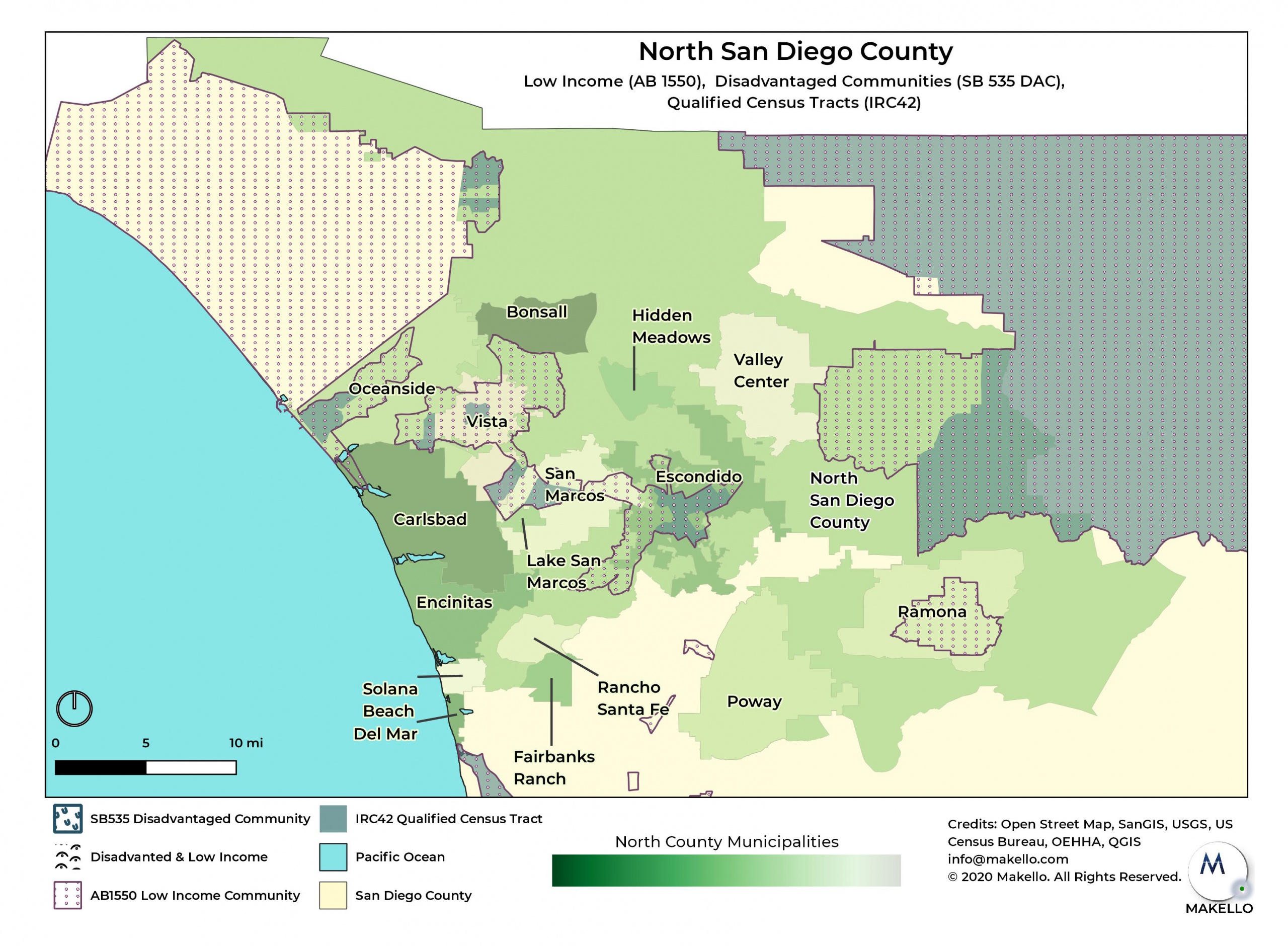
North County San Diego DAC LIC
Disadvantaged Communities (SB535 DAC) and Low Income Communities (AB 1550) in North County San Diego are eligible for additional SGIP Rebates.

A 6 Month Emergency Fund, Right Now?

In Case of Emergency, An “Energy Upgrades Lifeline” Pays For Itself

Recently, a solar powered homeowner inquired about adding a Level 2 charger for a 2013 Nissan Leaf, typically a $400 installation. Most solar companies would refuse the job due to low profit.

In Case of Emergency, An “Energy Upgrades Lifeline” Pays For Itself
In Case of Emergency, An “Energy Upgrades Lifeline” Pays For Itself.

Makello rose to the challenge and used our Energy Analysis tool to present an “Energy Upgrades Lifeline” option that improves the homeowner’s cash flow and can provides a “6 Month Emergency Fund”.

Parcel level GIS mapping software made by Makello, is used to determine eligibility qualifications for a wide variety of energy upgrade grants, rebates, discounts, credits and deductions.

Makello works with non profits and other agencies to create maps for Environmental Justice initiatives.

The rooftop solar on the home was installed for free in 2012 by Grid Alternatives through the SASH program, for qualified low-income residential California homes. An Energy Upgrade Lifeline can work even if the property already has solar.

One of the homeowners was temporarily laid off due to the pandemic. An Energy Upgrade Lifeline can qualify for financing by the State of California based on prior year tax return.

Makello’s Ethical Energy & Cost Savings Analysis provides $23,448 Incentives upfront for adding more solar, energy storage, a 2nd EV and a Level 2 charger.

What makes the solution possible is a Property Assessed Clean Energy (PACE) financing method that does not appear on the credit report, is not a loan, does not trigger a property reassessment and can transfer to the next home buyer.

CA Property Assessed Clean Energy program (PACE) financing

PACE financing ranges from 5 to 30 years term for solar, 10 years for energy storage, and can be used for other energy efficiency improvements.  PACE can be as low as $0 down, it provides tax deductible interest, there are no pre-payment fees, and no credit minimum.

The PACE program is intended for use by those that can demonstrate the ability to pay. There are safeguards to protect against abuse, such as a soft pull credit check, income verification from a recent paycheck or tax return, and a requirement that the energy efficiency project is cash flow positive, as it is here:

Makello Energy Analysis. LIFELINE Cash Flow Positive
Click to Enlarge

What makes the solution a “Lifeline” is that the incentives payments can be used as a reserve. In an emergency, the basic expenses such as mortgage payment, food, and medicine are met.  The system is designed to be cash flow positive, meaning lower cost monthly and annually, than the baseline status quo.  

Makello’s “Lifeline” Incentive Payment timing gives the homeowner flexibility to make decisions on what to do with the money and when to put the reserve to use.  In this case, after 6 months, the homeowner can decide to use some or all of the Incentives to purchase a Plug-In Vehicle to further increase energy cost savings, or for another important use.

Simple Payback is possible in 3.7 years through Annual Energy Cost Savings.  That means it’s a good deal for a cash purchase or loan. For those on a fixed income, traditional loans might not be a viable option. In the cases where PACE financing is Cash Flow Positive, we can present the PACE option as an alternative.

Makello Energy Analysis. LIFELINE Cost Savings Over Time
(Click to enlarge) As you can see in the savings over time graph, the system is cash flow positive every year through the 10 year PACE financing and then savings accelerates.

Book a FREE 15 minute appointment to: 1) Find out how Makello can help you. 2) Discuss your energy needs. 3) Get a FREE Energy Savings Estimate.

Makello’s Optimal Cost Savings Plan has other benefits for California in 2020, such as emergency backup power for home and vehicles, water pumps, air-conditioning, air-purifying and fire-fighting equipment.

Makello is ethical in our approach, offering full disclosure about PACE terms and program information, bank and credit union loan alternatives.

CA Property Assessed Clean Energy program (PACE) financing

Californians need microgrids.

Californians need microgrids. Emergency back up power

With frequent fires and Santa Ana winds setting California ablaze we are in desperate need of emergency power supplies. The fires are coming dangerously close to our sources of electricity and threatening grid shut downs.

2 million Californians were left without power last week and this week that number could get even bigger. It is anticipated that up to 3 million California residents will be without power due to the fires north of LA and the Bay Area.

Having solar on your roof paired with energy storage gives you the freedom to have electricity in the event of an energy crisis or natural disaster.

Are you ready to save money on solar power, EV charging or Energy Storage? Get an instant quote from Makello!

Bypass Hurdles with the HOA and Landlord

Bypass Hurdles with HOAs and Landlord for Solar in San Diego
Tame the HOA with the Solar Rights Act!

Homeowners or tenants in HOAs, apartment dwellers and condo owners are often discouraged from energy upgrades like solar panels, Plug-In Vehicle charging, LED lighting and energy storage.  With a little research, anyone can take steps towards energy independence.

California’s “Solar Rights Act” defends your right to produce power in California.  The HOA may restrict, deny or challenge solar installations, but there is a path to follow to win: 

1. Find a neighbor that installed solar power or filed an application with the HOA to install solar power, and ask them about their experience. (If there are no previous applications, it may be helpful to find a neighbor that installed EV charging, solar water heating, energy storage and/or LED lighting.)

2. Request and review the HOA rules and regulations regarding solar power systems.

>Are there any covenants that apply to solar photovoltaic energy systems? ​

>>If there is a restrictive covenant, is it specific (mentions solar energy systems) or generic?

>Is an Architectural Review Committee involved?

>>Do they have a specific set of criteria to evaluate solar energy systems?

>Is the HOA a public entity?

3. Request HOA permission to install, in writing, by submitting the solar electrical design permit application package to the HOA and wait for response 45 days.  

4. Once approved, carefully read any agreements that the HOA requires as a condition of permission to install.  (i.e., “Maintenance/Indemnity Agreement”).

Are you ready to save money on solar power, EV charging or Energy Storage? Get an instant quote from Makello!

5. Negotiate the terms of an agreement or sign the agreement.  

6. Installation company submits design drawings to the Authority Having Jurisdiction (permit office).

7. System is installed.

Makello and Green Energy EPC; no roof leaks, no problems!

The HOA can advise you where to put your solar power, so long as it does not increase the cost to a certain extent, however they cannot stop you from getting solar.

The HOA can influence your decision about the color of the modules or the trim, or the height of the array over the roof, or the roofing method, or they may require a trim strip at the front or the sides of the array to enhance the aesthetics in keeping with the aesthetics in the community.

The law provides the ability to install solar despite an HOA not wanting it.  See California Civil Codes 714  and new for 2018  714.1:

“b) An association shall not:
​(1) Establish a general policy prohibiting the installation or use of a rooftop solar energy system for household purposes on the roof of the building in which the owner resides, or a garage or carport adjacent to the building that has been assigned to the owner for exclusive use.

Book an appointment to receive Makello’s Ethical Energy Savings Report, which is the result of a detailed trade-off study of discount utility rates, grants, rebates, tax credits, and equipment options, to determine the fastest payback and highest return on investment to meet your home, business and vehicle energy needs.

The fee for the Ethical Energy Savings Report is refundable (less the 3rd-Party $15 utility data access charge) or credited towards our installation services, after you attend the presentation meeting and complete a 5 minute survey after permission to operate.

Includes up to 5 hours research by the Makello team, and 1 hour Q&A, by Makello’s Ethical Energy Efficiency Expert.

(2) Require approval by a vote of members owning separate interests in the common interest development, including that specified by Section 4600, for installation of a solar energy system for household purposes on the roof of the building in which the owner resides, or a garage or carport adjacent to the building that has been assigned to the owner for exclusive use.”

California’s Solar Rights Act protects your interests in energy efficiency upgrades.  The recommended path is to complete the system design drawings and submit them to the HOA, thus starting a 45 day review period.  Until a tenant submits the drawings to the HOA, the HOA may continue to delay the project indefinitely, with exploratory meetings, changes of plans, excuses, misinformation, etc.

California AB2180 of 2008 provided even more consumer protections under the Civil Code by providing that any homeowners’ association that is not a public entity that willfully violates the Solar Rights Act must pay the solar system owner a civil penalty not to exceed $1,000. AB 2180 further provides that the approval or denial of any application submitted to authorize the installation of a system must be made in writing within 60 days. If the application is not denied within 60 days it will be deemed approved unless the delay is the result of a reasonable request for additional information.”

If the HOA does not reply to your request within 60 days, your request is automatically approved, according to this link that seems to have an easy to follow guide for what to do:
https://solartown.com/learning/solar-policy-and-incentives/homeowners-duke-it-out-with-their-homeowners-association-how-best-to-solve-the-problem-part-2/

If you find that the HOA rules and regulations are in conflict with provisions in California Solar Right’s Act, then see below for a draft of a letter to the HOA, to include with your submission: 

The purpose of this letter is to inform the HOA of relevant laws, policies, and regulations that govern the installation of solar energy systems in California, and to describe the potential repercussions for improper denial of solar projects.
​
California’s Solar Rights Act protects the homeowner and tenant’s rights to energy efficiency upgrades by limiting covenants, conditions, and restrictions on solar installations, and by requiring timely review.  
HOAs are prohibiting from:

(1) prohibiting outright installation of solar energy systems, 
(2) imposing restrictions that significantly increase the cost of installation, 
(3) imposing restrictions that significantly reduce the efficiency of a system.

https://leginfo.legislature.ca.gov/faces/codes_displaySection.xhtml?sectionNum=714.&lawCode=CIV

https://leginfo.legislature.ca.gov/faces/codes_displaySection.xhtml?sectionNum=714.1.&lawCode=CIV

An association shall not:

(1) Establish a general policy prohibiting the installation or use of a rooftop solar energy system for household purposes on the roof of the building in which the owner resides, or a garage or carport adjacent to the building that has been assigned to the owner for exclusive use.
   
(2) Require approval by a vote of members owning separate interests in the common interest development, including that specified by Section 4600, for installation of a solar energy system for household purposes on the roof of the building in which the owner resides, or a garage or carport adjacent to the building that has been assigned to the owner for exclusive use.

California Civil Code consumer protections provides that:

(1) any homeowners’ association that is not a public entity that willfully violates the Solar Rights Act must pay the solar system owner a civil penalty not to exceed $1,000. ​
​
(2) the approval or denial of any application submitted to authorize the installation of a system must be made in writing within 45 days. If the application is not denied within 45 days it will be deemed approved unless the delay is the result of a reasonable request for additional information.


Examples of suspicious clauses in a Maintenance/Indemnity Agreement, that you may want REMOVED or MODIFIED before signing, because they leave the original HOA homeowner on the hook for repair costs indefinitely, even after the system is removed, even after the property is sold to future HOA homeowners:

F. The parties agree and acknowledge that installation, use and/or maintenance of the Photovoltaic Solar System by the Owner will, or may, cause additional and/or increase maintenance or repair burdens or costs on the Association, may adversely affect or impair any roof or other warranties which the Association has or may have been able to obtain, and cause damage or the potential for damage to common area, the extend and/or potential for which cannot readily be determined. The Parties therefore agree that the entire burden of the cost of all future maintenance, repair, and replacement relating to the Photovoltaic Solar System and to common area affected by the Photovoltaic Solar System, shall be borne by the Owner.

​H. Owner and Association intend that this Covenant be made and entered into pursuant to the provisions of California Civil Code Section 1468, and that this Covenant shall run with the land of Owner and that it shall be binding upon each successive owner of the Subject Property during their ownership of any portion of the land affected hereby, and upon each person having any interest in the land derived through any owner thereof.

Book a FREE 15 minute appointment to: 1) Find out how Makello can help you. 2) Discuss your energy needs. 3) Get a FREE Energy Savings Estimate.

Examples of clauses in a Maintenance/Indemnity Agreement, that you may want INCLUDED before signing:

(F) Association has approved Owner’s Application on certain terms and conditions including that Owner enter into the following Agreement;

TERMINATION OF AGREEMENT
This Agreement shall only terminate if any of the following occurs:

​A.  Alteration/Destruction. This Agreement shall automatically terminate if the existing structure, which is legally described in Exhibit “A,” is removed or destroyed. This Agreement shall also automatically terminate if the Solar Energy System is removed from the Residence and after the time period under which any legal claims may be brought relating to the installation, maintenance and removal of the Solar Energy System. ​

​B. Mutual Agreement. This Agreement shall terminate upon mutual agreement between Association and Owner or Owner’s successors in interest. For the purpose of this Agreement, the term “Owner” shall mean the then-existing owner of the property set forth in Exhibit “A.”

CONVEYANCE OF TITLE
In the event Owner conveys title of the property described in Exhibit “A,” this Agreement shall automatically transfer to the new owner and all subsequent owners, and current Owner shall have no further responsibility under this Agreement.
For more information, visit www.cleantechlaw.com
James Birkelund, jbirkelund@cleantechlaw.com
Jack Jacobs, jjacobs@cleantechlaw.com

If you are interested in learning more about Makello, click on the videos below.

solar power, energy storage, electric vehicles
Welcome to Makello!
utility black out battery back up power
Where Will You Be In The Next Blackout?
battery backup power 2020
Get On The Road To Energy Independence!

Wipomo Powers Trucks at Qualcomm Stadium

Mobile Energy Ecosystem provides power to food vendors
The Mobile Energy Ecosystem provides power to food vendors at Qualcomm Stadium

Wipomo’s Mobile Energy Ecosystem provided off-grid solar power to the Food Truck vendors at the Qualcomm Stadium Swap Meet, while the crowds of visitors enjoyed their meals without the noisy gas generator emissions. 

During the day, while the sun was shining, the sun provided power to the food truck vendors.  After the sun went down, the on-board batteries provided the stored solar energy.  When the batteries were depleted, electric vehicles exported power through the micro-grid to keep the party going.

Here an update-pictures from the event

By Liza Roocroft, Wipomo Social Media, Marketing, Video

Wipomo’s Mobile Energy Ecosystem

Off-grid Plug-In Vehicle & small electronic charging station
Representatives from the CCSE, Wipomo, Dave Roberts (County Supervisor, 3rd District), SDRES, ESW, and Butler Sun Solutions celebrate Wipomo’s Mobile Energy Ecosystem during the residential 13th San Diego Sustainability Tour.

Our off-grid, Plug-In Vehicle & personal electronics charging station delivers “Power when you want it, where you want it, day or night, even during a utility blackout”.

The Wipomo Mobile Energy Ecosystem at the home showcase during SDRES Sustainability Tour 2013. People from left to right: Skip Fralick- California Center for Sustainable Energy (CCSE), Juergen Zierler- Architect Wipomo, Hubbell and Hubbell, Jorge Perez- Landscape Designer, Charlie Johnson- Wipomo, CCSE, SDRES, Dave Roberts- County Supervisor of District 3, Stephen Johnston- Chair SDRES, Guest, Chad Castler- Engineers for a Sustainable World (ESW), Roger Davenport- Co-Owner Butler Sun Solutions, Cindy Davenport- Co-Owner Butler Sun Solutions, Glenn Siman-Engineers for a Sustainable World, Barry Butler- Co-Owner Butler Sun Solutions, Derek Chung- Engineers for a Sustainable World

You can save with Wipomo’s Energy Ecosystem, and now we’re bringing it to you so you can see for yourself. The Wipomo Mobile Energy Ecosystem is an on-grid and off-grid charging station that demonstrates the versatility of Wipomo’s Ecosystem. Wipomo saw the potential for a mobile demonstration unit in the first iteration of the then called Solar Slider. Two versions later, the Mobile Energy Ecosystem now has an advanced energy management system that accepts energy from solar photovoltaic modules, batteries, grid connection via a standard 120V outlet and input from an electric vehicle. The electricity flows through the whole system, recharging the batteries, powering loads and sending excess energy back to the utility, if available.

Upgrading the unit started and ended in August and Setember of 2013. Wipomo supplied the electronics that make the Energy Ecosystem possible while Roger Davenport, an advisor, designed and installed the system. The Wipomo team took the Mobile Energy Ecosystem to the Sustainability Tour at UC San Diego for the commercial tour and then to Wipomo’s Home Showcase for the residential tour (pictured above). After another round of improvements for safety and display, the Mobile Energy Ecosystem is ready for more events.

The Wipomo Mobile Energy Ecosystem

Basic (Entry Level) system:
8 x 240w PhonoSolar PV Modules = 1.92kW DC (nominal)
4 x 10⁵Ah Trojan 27TMX 12v Batteries @ 48v = 5.04kWh capacity (nominal)
1 x SunnyBoy 2500 watt inverter at 220v
1 x SunnyIsland 4500 watt inverter / charger
1 x Wipomo EV Export Power 1kW = 2 x 500 watt power supplies @ 210-375VDC input voltage (nominal)