NeoVolta’s AC and DC coupled solutions work with existing residential solar systems. NeoVolta (San Diego, CA) has lithium iron phosphate (LiFePO4) chemistry ‘safer by design’. https://www.pv-magazine.com/2021/09/23/residential-battery-inverter-from-the-united-states
New Self-Generation Incentive Program (SGIP) Rebate application for Step 7 – Small Residential Energy Storage funding, becomes available starting Monday, Sept 27, 2021, at a rebate value of $0.15/wH.
Caller: “Quick question. I already have solar, so which Battery is right for me? I need an answer ASAP, because SGIP Rebates are back and who knows for how long.” Response: “If you already have a solar, then NeoVolta battery can work with just about any existing system, and is lowest cost to integrate as an AC Coupled solution, for up to 9.2kW solar. There are exceptions to the rule, if the existing solar is landing on a Renewable Meter Adapter (RMA), but we have custom solutions in that case. And, the NeoVolta battery can be DC coupled to solar as well, up to 8.448kW DC, using Tigo TS4-A-O Power Optimizers.
Californian’s reaped over $1B in SGIP Rebates. Don’t miss out! It is possible to qualify for up to 100% incentives for your solar battery in the Equity Resiliency $1/wH category and up to 85% in the Equity $0.85/wH category.
$1,000 to Reserve Solar Battery & SGIP Rebate Preparation by Makello (Don’t wait until the SGIP Rebate is gone!)
*Makello, as an authorized distributor for Green Energy EPC (CA Lic 978836), cannot guarantee SGIP acceptance, funds availability, and rebate amount. Only the Center for Sustainable Energy (CSE), the SGIP program administrator, can approve the Rebate Reservation Form application. When the CSE accepts our application on your behalf, you’ll be approved – and you’ll have up to 12 months to decide when to install, or request an extension..
A $1,000 refundable fee reserves your Solar Battery and SGIP Rebate Preparation, which includes the required site survey, Energy Analysis and purchase contract to sign, prior to the SGIP Rebate Reservation Form (RRF) submission. (The refundable fee terms are in the “Addendum-to-the-Green-Energy-EPC-contract-1” reference section below.)
Enphase’s AC Coupled solutions are eligible for SGIP Rebates. The Encharge’s lithium iron phosphate (LiFePO4) chemistry is safer by design and is 2021 EES Award Winner! https://enphase.com/blog/encharger-battery-wins-2021-ees-award
The SGIP Program may become wait-listed, it may be funded again, and it may run out of funds at any time, so it is critical to proceed quickly to process your SGIP Rebate.*
Makello Helps You Save Even More, With Energy Storage Solutions
Makello will help you: 1 – Qualify for rebates, incentives and discount utility rates. 2 – Suggest Energy Efficiency measures, to right-size of the solar and battery system. 3 – Determine if an existing electric panel can qualify for solar and battery. 4 – Provide an Ethical Energy Savings Report. 5 – Provide a purchase and installation contract for a solar and battery system to meet your goals and the site conditions.
LG Chem’s DC Coupled solutions are eligible for SGIP Rebates. LG Chem is one of the world’s top battery suppliers since 2016, with RESU Lithium-Ion batteries.
Makello offers NeoVolta, Enphase and LG Chem Advanced Energy Storage for residential solar and battery installations in our SDG&E territory for 2021 Reservations. (We are experienced with Outback and Sonnen battery systems as well.)
Reference:
Green Energy EPC and State of California Required Documents:
Enphase Documents: (For an existing Enphase microinverter solar panel system; M215, M250, S280, IQ7X, IQ8X). Note: S280 must be replaced with IQ8X inverters at extra cost $250/solar module installed. Note: M215 and M250 existing Enphase microinverters adds $900 to Gross Cost.
Did you know that, whether or not you have an existing solar energy system, you can tap into a combination of up-front incentives, financing, to build up your savings into a 6-Month Emergency Fund and lower monthly costs?
Once-considered luxury items, such as Solar Power, Plug-In Vehicles, and Energy Storage, now payback quickly for cash purchases and are within reach for most homeowners, due to up-front incentives and lower total monthly costs from loan or Property Assessed Clean Energy financing.
Makello can provide you with a FREE Energy Savings Estimate! If you share your utility data with us we can create a solar energy system that is specific to your needs. We will NOT share your data.
Our model can also show the cost saving benefits of a Plug-In Vehicle or Energy Storage system, or both, in addition to your solar system. All of our team works to get you the most comprehensive, thorough Energy Analysis in the San Diego area as quickly as possible.
The software engineers are constantly updating our computer model to reflect the most current utility rates and product costs. We have a dedicated GIS analyst who can qualify you for as many rebates and incentives possible. Our Energy Efficiency experts can also provide other solutions to reduce energy costs such as appliance changes or switching utility rates. Press one of the buttons to see how much you can save!
Synopsis: An EV “Ride N Drive” event takes a supernatural detour, when riders temporarily, uncontrollably and inexplicably become “Energy Zombies”, smitten by the overpowering experience of driving electric for the 1st time, with instant torque, no noise and zero emissions.
Click to watch Joyrider “Fozzy’s Makello Story”. Do you think Joyrider should be a series? Leave a comment in YouTube, Like, and Share!
Actors: William May-Kidd: Charlie Johnson; Ping “Tek” Han: Songxuan Liu; Flint “Fozzy” Bjorn: Jarod Donahue.
Mythology
In 1916, Camille Jenatzy, a race car driver known for his red beard as “the Red Devil”, reportedly contacted an unknown driver-mechanic named Otto Stiggler by Telegraph. The message requested for Otto to take his place for hire, in the first race to the top of “Pike’s Peak” Colorado Springs, Colorado, driving a “La Jamais Contente”, the first Electric Vehicle to break the 100km/hr speed record, modified to improve driver position aerodynamics.
Illustration of the original “La Jamais Contente”, first automobile and Electric Vehicle to reach 100 km/h, in 1899.
Photo of Camille Jenatzy and his wife riding in the “La Jamais Contente”
While the vehicle was “in transit from Belgium”, Otto was instructed to practice often at Pike’s Peak, to learn the dirt race course’s hairpin turns, dips and ruts, while using his preferred selection of many gas powered vehicles of the day.
”La Jamais Contente” arrived 2 days before the 1st Pike’s Peak Race, and was transported by carrier truck directly to the starting line to preserve battery charge for the course. By the time the prototype vehicle was unpacked, the 1916 Pike’s Peak course access was about to close.
The condition of this 1943 road is a significant improvement to the early Pikes Peak races.
Otto managed to convince a departing race attendant, Ali Madohan, to allow him to drive the course. Ali gave Otto a signal flare to use when he reached the finish line at the top of Pike’s Peak, or in case of emergency.
According to Ali, with help from a Good Samaritan, Otto struggled to squeeze his lower body into the recessed cockpit. The shape of the cockpit required the upper body to be reclined in an almost supine position, below a nearly fully enclosed canopy that reporters described as “a metal coffin with a “cupola” shaped protrusion for the driver’s head”.
After pushing the vehicle to the starting line, Ali received a “ready sign” hand signal through the “cupola” opening slit, and the attendant waved the starting flag.
“La Jamais Contente” leapt from the Start Line quickly and silently, but within seconds, according to Ali’s statement, “there was a simultaneous flash of light and a crack of thunder,” which reportedly knocked several birds to the ground, temporarily stunned, and sent Ali ducking for cover with his hands over his ears.
This mysterious nearby object was found to transmit wireless power.
These three lights in a nearby field are pictured receiving wireless power.
Ali was quoted as saying, “I heard a mixture of barking and laughing. The barking seemed to come from the trees above and below both sides of the road. The laughing sounded like it came from inside a big metal drum, and it reverberated off the canyon rock walls, until the car disappeared into the hills beyond the 3rd turn.” Any objective observer would have assumed Otto was howling with laughter.
Upon witnessing a flare that originated from the finish line area, Ali recorded an unofficial pre-trial time of 20:45.90.
Otto and “La Jamais Contente” did not return to the Start Line to qualify for the 1916 Pike’s Peak race. The first Penrose Trophy was awarded to Rea Lentz with an official record time of 20:55.60, driving an internal combustion engine vehicle.
After several days missing, and at the request of Otto’s family, local officials formed a search party. The carrier truck was reportedly found near the former site of the Tesla Experimental Station, which was a wireless power transmission test facility.
Nikola Tesla sitting under his transmitter in his Colorado Springs lab surrounded by millions of volts.
Nikola Tesla created an experimental station outside of Colorado Springs to test wireless transmission of electric power.
A printed telegram transmission from Jenatzy was located in the truck and detectives contacted authorities in Belgium for more information. The truck was found to have been purchased anonymously at auction from the lot of decommissioned assets originating from Tesla’s Experimental Station.
Colorado detectives learned that the unidentified carrier truck who called himself “Dino” had fled the area. A rambling note in the vehicle, alleged that Otto was not the race driver of the modified “La Jamais Contente”, and that a man who identified himself as ‘Camille’ was seen near Otto before the race, assisting with preparations.
The family of Camille Jenatzy was interviewed and they reported to authorities in a sworn statement, that Camille Jenatzy died in 1913, and that the original “La Jamais Contente”, was in Belgium, and that no one had contacted them from the United States about shipping Camille’s prize winning, record setting electric race car.
The vehicle was never recovered and the circumstances surrounding Otto’s disappearance remains a mystery, as to who was the driver, Otto, “Dino”, “Ali”, “Camille”, or as some believed, Camille’s ghost, or possibly Nikola Tesla himself.
What some attribute to folk lore, others say is conspiracy, yet others say is fact. But is it possible that wireless power was part of “La Jamais Contente” unofficial Pike’s Peak record? Tesla had recently designed, tested and de-commissioned the preliminary version of the “Wardenclyffe Tower” nearby in Colorado Springs. Tesla’s invention later proved capable of transmitting power wirelessly through the atmosphere, via a propagating wave through the Earth’s mantle, as he claimed, to any location around the world.
Nikola Tesla designed and built the Wardenclyffe Tower in Long Beach, New York between 1901 and 1902 to experiment with wireless power transmission. Click on the photo to learn more.
About The Creators
Joyrider is a fictional story loosely based on actual events, for the purpose of entertainment, sharing and exploring the concept of the “EV Grin”, which is the infectious joy and smile that instantly takes over a person when they first experience driving electric.
Makello is a diverse team with backgrounds in software engineering, environmental science, management, GIS, and home and business energy services. We are committed to help reduce greenhouse gas pollution and work with non-profit and community organizations to help educate the public about Solar Panels, Plug-In Vehicles, & Energy Storage benefits. If you are interested in any of these technologies in your home, contact us for a FREE Energy Savings Estimate! With rebates and incentives they can be cheaper than you may think!
Pandemic stressing out the family finances? Turn your home and vehicle into a clean energy emergency fund!
Getting laid-off is stressful even in the best of times. In the midst of a pandemic, job loss and financial surprises can drain your savings account fast. Did you know that whether or not you have an existing solar energy system, you can tap into a combination of upgrade incentives and financing that can return money to you. A Solar, Plug-In Vehicle and Energy Storage lifeline!
Recently, a solar-powered homeowner asked Makello to quote adding a Level 2 electric car charger for their Nissan Leaf, an installation often priced at $500 or less. Most solar companies refuse to take these small jobs as they are unprofitable for the installer.
But at Makello, we look at things differently. We know from experience that with the dizzying array of Solar Power, Plug-In vehicle, and Energy Storage incentives and energy cost savings, energy upgrades can pay for themselves. When the homeowner shared that their rooftop solar was installed for free under a low-income residential solar program (SASH), and that they had been laid off due to the pandemic, we started crunching numbers to see what we could do.
We offered a plan to improve the homeowner’s cash flow and create a 6-month emergency reserve fund out of available incentives.
As you can see in the savings over time graph, the system is cash flow positive every year, meaning lower annual cost, through the term of the PACE financing, and then savings accelerates.
Incentive Finder – Makello’s own GIS mapping database uses the home’s geographic location to determine eligibility for a wide variety of energy upgrade grants, rebates, discounts and tax credits.
Optimize Upgrade – Makello’s own Energy Analysis software shows the optimal Solar, EV, and Energy Storage upgrade plan, for the eligible incentives. In California, benefits such as emergency backup power for home and vehicles, water pumps, air-conditioning, air-purifying and fire-fighting equipment can all be worked into the upgrade plan. In this case, Makello showed that a larger upgrade would tap into $23,448 in incentives, and give the homeowner more solar, energy storage, a second EV and Level 2 charger.
PACE program financing – The State of California offers a Property Assessed Clean Energy (PACE) financing plan. Homeowners can qualify based on a recent tax return or pay stubs. The financing does not appear on a credit report, is not considered a loan, does not trigger a property reassessment, and can transfer to the next home buyer.
Create a 6-month financial ‘lifeline’ – Makello’s “Lifeline” incentive payment program tracks the incentives and requirements, and allows the homeowner to choose the best time to draw on their earned incentives. In the example used here, a homeowner can decide after receiving the up front incentives to purchase a new or used Plug-In Vehicle, further reducing their monthly costs, or pay their most urgent bills, such as mortgage, food, and medical.
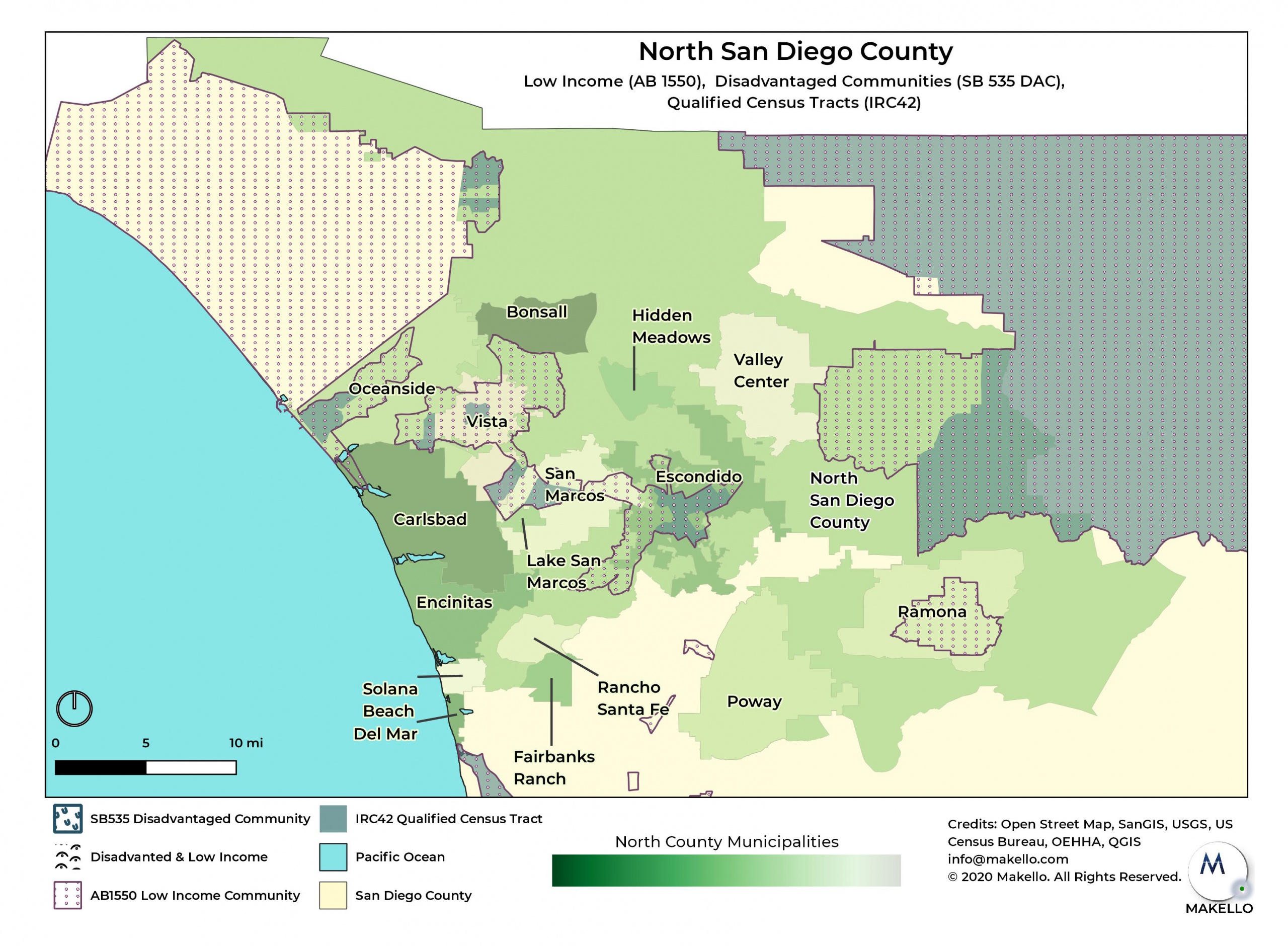
Makello’s GIS mapping database, uses county parcel location to help homeowners determine eligibility for a wide variety of solar programs. We also use mapping to help non-profit organizations to design programs in disadvantaged communities that promote solar energy and electric vehicle incentives for economic and environmental benefit.
Makello works with non profits and other agencies to create maps for Environmental Justice initiatives.
How the PACE Program works:
The PACE program is intended for those that can demonstrate the ability to pay. Homeowners provide a recent tax return or a pay stubs for income verification, and credit check, and Makello provides the Energy Analysis to show that the energy efficiency project will be cash flow positive.
Book a FREE 15 minute appointment to: 1) Find out how Makello can help you. 2) Discuss your energy needs. 3) Get a FREE Energy Savings Estimate.
PACE financing ranges from 5 to 30 years term for solar, 10 years for Energy Storage, and can be used for other energy efficiency improvements, such as electric panel upgrade, EV Charging, and a long list of energy efficiency upgrades. PACE can be as low as $0 down. It provides tax deductible interest.
For our homeowner in this example, Simple Payback is possible in 3.7 years through Annual Energy Cost Savings. That means it’s a good deal for a cash purchase or loan. For those on a fixed income, traditional loans might not be a viable option. In the cases where PACE financing is Cash Flow Positive, we can present the PACE option as an alternative to traditional loans and leases.
Makello provides full disclosure about PACE terms and program information, as well as programs offered through banks and credit unions. Please contact us and we’ll be happy to discuss the alternatives.
Extreme competition in the solar industry and falling prices has resulted in poor quality workmanship, electrical problems, roof leaks, gimmicks, and unethical behavior. Who can you trust to upgrade your most valuable asset, your home?
Book a FREE 15 minute appointment to: 1) Find out how Makello can help you. 2) Discuss your energy needs. 3) Get a FREE Energy Savings Estimate.
Makello aims to fix the broken solar industry with a full-disclosure report by an Ethical Energy Efficiency Expert, and documentation of the highest quality workmanship and components, to protect the budget and the home warranty.
Makello’s Mission is to tackle climate change by delivering clean energy solutions to improve social and environmental justice.
Why? Because Disadvantaged Communities, often located downstream and downwind of pollution, are extremely costly to rebuild after increasingly frequent weather disasters, and are impractical to relocate to escape sea level rise.
The Makello Team (left to right) Agustin, Ola, Linda, Charlie
Makello’s Vision is for you to join the Energy Ecosystem in a way that fits your life. We can help you use incentive programs to afford a Plug-In Vehicle and Solar Power to charge your car and your home, and we can help you create a back-up clean Energy Storage system for emergencies.
CEO and founder of Makello, Charlie Quux Johnson, receiving a North County Climate Change Alliance award at the NCCCA’s “EV Show Kicks Gas”
The choice is yours. Make your energy costs and emissions low with Makello, to get “On the Road to Energy Independence!”
Public access to EV Charging Stations is unevenly distributed. Makello’s mapping can show the inequity that may inhibit green technology adoption in some communities.
If you caIf you can’t find a conveniently located public EV Charger, then click on “Request A Public EV Charger” to suggest a location for future consideration, to be built with up to 100% Federal and State of California incentives.
Makello’s display at the entrance of the KRA San Diego Career Centers career fair. Credit: KRA
Skyline showcases are difficult to manage. At the September 18, 2019 “Job-I-Con” Hiring Event, held at the San Diego Library, 9th floor, the window walls stand 25’ tall, on 3 sides. The east wall and roof shade cast the entire room into heavy contrast between 10 AM and 12 PM.
Companies arriving early secure perimeter tables, leaving shaded tables close to the entrance unoccupied.
Book a FREE 15 minute appointment to: 1) Find out how Makello can help you. 2) Discuss your energy needs. 3) Get a FREE Energy Savings Estimate.
Makello understands what daily solar progression, heat gain, glare and backlighting issues from floor to ceiling windows can do to participation at a trade show. For greatest exposure to candidates before they break a sweat, sometimes a good location choice is near the entrance.
The aisles surrounding our table pass by Makello video displays, where “Why Makello?” and “What We Do” plays on repeat, next to our job postings. Engineers drawn to the videos of Solar Power, Plug-In Vehicles, and Energy Storage soon create noise and crowding in front of our table.
Makello reaches out into the aisle to welcome potential candidates as they pass the video introduction, to join us in a face to face conversation behind the table display.
If pictures are worth a thousand words, it makes sense why our visitors often arrive with a good understanding about our mission, our vision and our purpose. When job seekers are able to relate their goals and experiences to the company as a whole, it is possible to go beyond the currently open positions and find added value or new opportunities.
Despite her initial reservations about the match between a solar company and her interest in GIS Maps, Linda Boisvert stands out among the 60 visitors. Makello Research Assistant position adapts to a GIS mapping focus. An On-The-Job training program by San Diego Workforce Partnership makes it possible for Makello to invest in Linda’s skill development, using her Associates degree and lab work, to solve business technological challenges. Linda’s background in Anthropology and Drafting/CAD, along with 11 years of HOA Management experience, helps Makello discover new potential revenue streams.
Linda’s mapping accomplishments shine in Makello’s Service Areas and in blog articles, such as “African Americans Concentrated in Diverse Redlined San Diego”, which highlight issues of Environmental and Social Justice, Transportation, and Health. Makello receives recognition from several non-profit organizations for our educational webinars and board presentation of the map and analysis. We look forward to continuing to support community development programs and hospitals throughout San Diego with valuable interactive research maps.
Linda’s demographic and incentives maps uncovers an “Energy Upgrade LIFELINE” program for low income and medical care qualified residents, and for fire-threat communities. Thousands of San Diego homes and businesses can qualify for up to 100% incentives on Solar Power, Plug-In Vehicles, and Energy Storage. Affordable Energy Independence!
Metro Career Centers and the San Diego Workforce Partnership empowers the San Diego community by connecting jobs to qualified applicants. Makello encourages San Diego companies to get outside of the bubble and make valuable connections at workforce.org.
Recently, a solar powered homeowner inquired about adding a Level 2 charger for a 2013 Nissan Leaf, typically a $400 installation. Most solar companies would refuse the job due to low profit.
In Case of Emergency, An “Energy Upgrades Lifeline” Pays For Itself.
Makello rose to the challenge and used our Energy Analysis tool to present an “Energy Upgrades Lifeline” option that improves the homeowner’s cash flow and can provides a “6 Month Emergency Fund”.
Parcel level GIS mapping software made by Makello, is used to determine eligibility qualifications for a wide variety of energy upgrade grants, rebates, discounts, credits and deductions.
Makello works with non profits and other agencies to create maps for Environmental Justice initiatives.
The rooftop solar on the home was installed for free in 2012 by Grid Alternatives through the SASH program, for qualified low-income residential California homes. An Energy Upgrade Lifeline can work even if the property already has solar.
One of the homeowners was temporarily laid off due to the pandemic. An Energy Upgrade Lifeline can qualify for financing by the State of California based on prior year tax return.
Makello’s Ethical Energy & Cost Savings Analysis provides $23,448 Incentives upfront for adding more solar, energy storage, a 2nd EV and a Level 2 charger.
What makes the solution possible is a Property Assessed Clean Energy (PACE) financing method that does not appear on the credit report, is not a loan, does not trigger a property reassessment and can transfer to the next home buyer.
PACE financing ranges from 5 to 30 years term for solar, 10 years for energy storage, and can be used for other energy efficiency improvements. PACE can be as low as $0 down, it provides tax deductible interest, there are no pre-payment fees, and no credit minimum.
The PACE program is intended for use by those that can demonstrate the ability to pay. There are safeguards to protect against abuse, such as a soft pull credit check, income verification from a recent paycheck or tax return, and a requirement that the energy efficiency project is cash flow positive, as it is here:
Click to Enlarge
What makes the solution a “Lifeline” is that the incentives payments can be used as a reserve. In an emergency, the basic expenses such as mortgage payment, food, and medicine are met. The system is designed to be cash flow positive, meaning lower cost monthly and annually, than the baseline status quo.
Makello’s “Lifeline” Incentive Payment timing gives the homeowner flexibility to make decisions on what to do with the money and when to put the reserve to use. In this case, after 6 months, the homeowner can decide to use some or all of the Incentives to purchase a Plug-In Vehicle to further increase energy cost savings, or for another important use.
Simple Payback is possible in 3.7 years through Annual Energy Cost Savings. That means it’s a good deal for a cash purchase or loan. For those on a fixed income, traditional loans might not be a viable option. In the cases where PACE financing is Cash Flow Positive, we can present the PACE option as an alternative.
(Click to enlarge) As you can see in the savings over time graph, the system is cash flow positive every year through the 10 year PACE financing and then savings accelerates.
Book a FREE 15 minute appointment to: 1) Find out how Makello can help you. 2) Discuss your energy needs. 3) Get a FREE Energy Savings Estimate.
Makello’s Optimal Cost Savings Plan has other benefits for California in 2020, such as emergency backup power for home and vehicles, water pumps, air-conditioning, air-purifying and fire-fighting equipment.
Makello is ethical in our approach, offering full disclosure about PACE terms and program information, bank and credit union loan alternatives.
Editors Note: Click to view Makello’s commitment to finding words and methods to accurately represent data while conveying inclusion of the appropriate demographic.
Makello began using maps to analyze data and learn about our community in 2019. From time to time, we intend to share some of the maps we’ve developed but there are challenges to presenting the data accurately and transparently, especially with regards to designations for Race, Identity and Ethnicity.
The US Census counts all people living within the Boundaries of the United States and Territories. The data collected is by Race, not citizenship status. The Census data uses terminology that can easily be misunderstood because of common usage of terms vs. the Census Bureau definition. The Census Bureau meaning of the term is often lost as the data filters down to the public through agencies and businesses.
The Census Bureau uses the terms African American, Asian American, Native American, Hispanic, White and Other to define Race. Citizenship or immigration status is not counted. The loss of context of these words may prevent accurate and full understanding of data. People may feel invisible or may be unintentionally misled.
You may have noted a few potential difficulties in the short list of the terms presented. That is where the struggle lies when attempting to represent residents without being US-Centric or Ethno-centric. Acceptable terminology changes through time, is understood differently in separate regions and countries, by different cultures and ethnicities. Individuals infuse meaning in words based on their life experiences, making classifications difficult.
Maps may focus on a specific demographic for any number of reasons including it can be difficult to adequately portray diversity on the map with charts or graphs. Please refer to the two examples below.
Makello is committed to the difficult task of finding words and methods to accurately represent data while conveying inclusion of the appropriate demographic. We make great effort to research and vet language. Language and identities change. Unfortunately, there is no all encompassing, perfect language for describing people. What one person thinks is a great label and strongly identifies with, the next person may reject or find offensive. We accept open and honest feedback and hope you enjoy the information we present.
African Americans in San Diego are concentrated in southwestern San Diego County. Click to enlarge.
Book a FREE 15 minute appointment to: 1) Find out how Makello can help you. 2) Discuss your energy needs. 3) Get a FREE Energy Savings Estimate.
The California fires air quality issues in 2020 are severe in large areas for PM2.5 and hazardous chemicals with winds carrying the smoke plume coast to coast and across international borders. Scenes from many cities show smoke so severe the city looks like a sci-fi movie. The fires are historic in scale but this pollution will stop in most areas when the wildfires are contained. For many though, the pollution will be ongoing because of man made factors such as traffic and vehicle emissions, air traffic or industry.
Normally, traffic in San Diego is notoriously bad with thousands stuck in traffic five days a week. Engines idling, burning fuel, emitting pollution. Pollution is temporarily down due to the State of California’s pandemic Stay-At-Home order. But will it last? Have you ever wondered what impact your vehicle emissions have on the communities you pass through on your daily commute and who the emissions impact? Let’s take a look.
Particulate matter can be harmful for many respiratory processes. The problems are exacerbated for children when their school lies in a high pollution zone because of idling. Click to enlarge.
Using the particulate matter (PM2.5) data from CalEnviroscreen 3.0, the map above shows the area with high concentrations of particulate matter (PM2.5) outlined in grey and Census Tracts with higher density of African Americans. A 500 ft. buffer symbolized in green for the sections of the freeways where bottlenecks continually occur. The 500 foot buffer indicates the zone where the particulate matter from exhaust, diesel and passenger vehicles, is the highest. The red shapes are the portions of school parcels that are within 500 feet of the freeway and within the zone where the particulate matter coming from the freeway is the highest. Why is this important?
Cars along with trucks, and SUVs emit 42% of the pollutants that contribute to ozone (smog). Big rigs and passenger vehicles with diesel engines contribute diesel particulate matter. Particulate matter (PM2.5) is a mixture of aerosolized solid and liquid particles. Particulate Matter contains substances such as organic chemicals, dust, allergens and metals. The ability for the particles to trigger adverse health effects is directly related to particle size. The smaller the particle, the deeper the particle is able to penetrate into a person’s lungs. The finest particles have been shown to enter the bloodstream.
The most susceptible populations to PM2.5 exposure are the elderly, children, persons who suffer from diseases such as cardiopulmonary disease, asthma and chronic illnesses. CalEnviroScreen utilizes PM2.5 to evaluate particulate matter. 2.5 refers to the diameter of the particles measured in microns. California studies have shown high ambient levels of PM2.5 have adverse effects on lung development or increased hospitalizations for several childhood respiratory diseases.
Makello works with non profits and other agencies to create maps for Environmental Justice initiatives.
A study published through the National Institute of Health (NIH) indicated children in schools within 500 feet from a freeway receive daily exposure to high concentrations of PM2.5 which may have adverse health effects increasing absences from school due to illness. When you are idling your car near a school or a daycare facility, children are being exposed to many chemical pollutants in addition to particulate matter. Children breathe 50% more air per pound than adults making their developing lungs susceptible to damage. According to Cleanearth4kids.org, pollutants from 1 minute of engine idling is greater than smoking 3 packs of cigarettes. If you are idling near a school, you can be idle free and help protect young lungs.
Particulate matter can be harmful for many respiratory processes. The problems are exacerbated for children when their school lies in a high pollution zone because of idling. Click to enlarge.
Diesel particulate matter also has health impacts and the schools within the 500 foot buffer are adversely impacted by Diesel PM as well asPM2.5. In the map above, the areas outlined in white show the Census Tracts with the highest concentrations of Diesel PM impacting schools in communities with African American populations greater than 10% of the Census Tract total population.
Are you ready to save money on solar power, EV charging or Energy Storage? Get an instant quote from Makello!
Diesel exhaust contains known carcinogens benzene and formaldehyde. Diesel exhaust, as with PM2.5, the finer the particle, the greater the ability to penetrate deeply into the lungs. According to the US EPA, 50% or more of the Diesel PM are in the ultrafine range, increasing the potential for the particles to deposit in the lung.
Similar to PM2.5, children and those with existing respiratory diseases appear to be especially susceptible to the harmful effects of exposure to airborne diesel exhaust particulate matter. Persons with asthma are more likely to have increased symptoms and attacks along with decreases in lung function.
Greening your ride if you drive through this region regularly certainly can help reduce pollution and help protect the lungs of the children who live and go to school in these neighborhoods. There are many options for all electric vehicles as well as plug in hybrids, battery/energy storage, and solar. Makello can help you choose a vehicle, analyze your energy usage and help you decide the type of system is right for you. Contact us for your FREE Energy Savings Estimate today.
Welcome to Makello!
Get On The Road To Energy Independence!
Makello Makes Driving Electric as Easy as 1-2-3
References:
2008 Eight-Hour Ozone Attainment Plan for San Diego County http://www.sdapcd.org/content/dam/sdc/apcd/PDF/Air%20Quality%20Planning/2016_AttainmentPlan_Draft.pdf 2
Makello is developing GIS services and creating maps useful to the solar power, electric vehicle, and energy storage industries, as well as for our teaming companies, including several non-profit organizations. Maps are an important method for analyzing and presenting data.
We will examine redlining and clean-air technology access by the San Diego African American community in this blog. See the editor’s note below on how we will be using the Census Bureau term African American as defined by the Census Bureau: Race for Residents of African ancestry or birth including both US Citizens and non-US Citizens. For more info on data sources and terminology, references are provided at the end of this article.
Makello works with non profits and other agencies to create maps for Environmental Justice initiatives.
Editors Note: Click to view Makello’s commitment to finding words and methods to accurately represent data while conveying inclusion of the appropriate demographic.
Makello began using maps to analyze data and learn about our community in 2019. From time to time, we intend to share some of the maps we’ve developed but there are challenges to presenting the data accurately and transparently, especially with regards to designations for Race, Identity and Ethnicity.
The US Census counts all people living within the Boundaries of the United States and Territories. The data collected is by Race, not citizenship status. The Census data uses terminology that can easily be misunderstood because of common usage of terms vs. the Census Bureau definition. The Census Bureau meaning of the term is often lost as the data filters down to the public through agencies and businesses.
The Census Bureau uses the terms African American, Asian American, Native American, Hispanic, White and Other to define Race. Citizenship or immigration status is not counted. The loss of context of these words may prevent accurate and full understanding of data. People may feel invisible or may be unintentionally misled.
You may have noted a few potential difficulties in the short list of the terms presented. That is where the struggle lies when attempting to represent residents without being US-Centric or Ethno-centric. Acceptable terminology changes through time, is understood differently in separate regions and countries, by different cultures and ethnicities. Individuals infuse meaning in words based on their life experiences, making classifications difficult.
Maps may focus on a specific demographic for any number of reasons. It can be difficult to adequately portray diversity on the map with charts or graphs. Please refer to the two examples below.
Makello is committed to the difficult task of finding words and methods to accurately represent data while conveying inclusion of the appropriate demographic. We make great effort to research and vet language. Language and identities change. Unfortunately, there is no all encompassing, perfect language for describing people. What one person thinks is a great label and strongly identifies with, the next person may reject or find offensive. We accept open and honest feedback and hope you enjoy the information we present.
African Americans in San Diego are concentrated in southwestern San Diego County.
The first question to answer is where are the communities with 10% or more of the African American residents? A map of the demographic data from the CalEnviroscreen 3.0 is the simplest method of discovery. CalEnviroscreen obtained demographic data from the US Census Bureau and retained the US Census Bureau demographic descriptors in their report. Our map above shows the population is largely concentrated in the area to the east of Downtown San Diego which will be the area we focus on for the purpose of this blog.
Why is the population so heavily concentrated in this area? With a special thanks to University of Richmond’s Digital Scholarship Lab, a look at the 1930s New Deal Era Home Owners’ Loan Corporation Redline Maps may help to answer this question.
The Home Owners’ Loan Corporation (H.O.L.C.) was created during the Great Depression New Deal Era and the program trained many home appraisers in the 1930s. The H.O.L.C. created a neighborhood ranking system known today as redlining. Grades were assigned to residential neighborhoods by local real estate developers and appraisers in over 200 cities. These maps and neighborhood ratings set the rules for decades of real estate practices. The grades ranged from A to D.
The Green Area- Grade A = Best: Always upper-middle-class to upper class White neighborhoods defined as posing minimal risk for banks and other mortgage lenders, as they were “ethnically homogeneous” and had room to be further developed.
The Blue Area- Grade B= Still Desirable: Neighborhoods with all or mostly White, U.S. born residents were defined as sound investments for mortgage lenders.
The Yellow Area- Grade C =Declining: Residential neighborhoods with working class and/or first or second generation immigrants from Europe. The housing stock was typically older and often lacking the current utilities of the day.
The Red Area- Grade D= Hazardous: These neighborhoods were considered to be “infiltrated” with “undesirable populations” such as Jewish, Asian, Mexican, and Black families. The neighborhoods were more likely to be located near industrial areas and the housing stock consisted of older, less well maintained buildings.
Are you ready to save money on solar power, EV charging or Energy Storage? Get an instant quote from Makello!
These grades formed the basis for federally backed mortgages. Many banks refused to lend to areas with the lowest grade, making it impossible for people in these neighborhoods to become homeowners and preventing them from building generational wealth.
As you can see from the map, many of the areas that were labeled undesirable in the 1930s are still the areas where African Americans are concentrated. The practice of redlining has had a long term impact on segments of our community that has yet to be resolved.
1930s redlining still impacts African American communities 90 years later.
Makello is an advocate of green transportation options, providing FREE Energy Savings Estimate services including an analysis of potential electric vehicles to fit your needs, so it was only natural we take a look access to public charging stations African Americans have in the former redlined areas. The results were………….. well, see for yourself.
Less than 10 public electric vehicle charging stations are located within the African American communities.
The data from the US Dept. of Energy Alternative Fuels Data Center may be mapped and compared to the CalEnviroscreen Demographic Data. The neighborhoods with the highest concentrations of African American Residents do not have easy access to public electric vehicle charging stations. One consequence is this discourages San Diegans with electric vehicles living outside these communities from driving to businesses in these neighborhoods and spending money. The lack of access to public charging stations also discourages the residents of these neighborhoods from purchasing electric vehicles because they don’t have the ability to conveniently charge their vehicle. This is especially true for multi-unit dwellers where there are structural and parking challenges to overcome when installing EV charging stations. This creates additional barriers to EV ownership, keeping the community from reducing pollution, developing business opportunities, and creating jobs in their neighborhoods.
Book an appointment to receive Makello’s Ethical Energy Savings Report, which is the result of a detailed trade-off study of discount utility rates, grants, rebates, tax credits, and equipment options, to determine the fastest payback and highest return on investment to meet your home, business and vehicle energy needs.
The fee for the Ethical Energy Savings Report is refundable (less the 3rd-Party $15 utility data access charge) or credited towards our installation services, after you attend the presentation meeting and complete a 5 minute survey after permission to operate.
Includes up to 5 hours research by the Makello team, and 1 hour Q&A, by Makello’s Ethical Energy Efficiency Expert.
We’re shifting gears now and will be examining the energy cost burden in the City of San Diego. The energy cost burden data was obtained from the 2019 San Diego Climate Equity Report and overlaid the demographic data from the CalEnviroscreen 3.0. Generally speaking, the energy cost burden was calculated as a weighted average for each census tract and divided by the median household income for each census tract to obtain the energy cost burden score. For more detailed explanation of the energy cost burden, please visit the San Diego Climate Equity Report page.
The white outlined areas in the map posted below have the lowest energy cost as a percentage of Median Household Income and the dark green areas have the highest energy cost burden. Most of the African American San Diegans are in the minty green areas and have an energy cost burden of 1.3%- 2.7%. There is one area with 18-28% of the African American residents and a 4-5.4% energy cost burden.
This cost puts an additional financial strain on those residents with more modest incomes and often prevents the residents from using air conditioning or heaters in bad weather, increasing some health risks especially for elderly and health challenged individuals. Or the residents may use older, less energy efficient equipment, increasing energy cost and pollution.
Energy cost impacting African American communities.
One potential solution for reducing the energy cost burden and pollution is solar energy and battery storage. We mapped solar adoption rates from the San Diego 2019 Climate Equity Index report and again, overlaid the demographic data from CalEnviroscreen 3.0. The areas outlined in white have the least access to solar energy. Many African Americans are living in areas where at best, there are per capita 0.05 solar photovoltaic systems resulting in these residents having a low ability to decrease pollution due to electricity production and consumption in the home, reducing overall energy cost, and protecting against power outages.
African American communities in San Diego have low access to solar energy systems.
Returning to redlining, banks’ historical unwillingness to loan money in these communities have left many residents underbanked and underserved. Solar Systems, Electric Vehicles, Battery Storage Systems are investments that can improve personal finances and the quality of life for anyone that can afford a purchase, or qualify for financing. Beyond traditional loans or leases, community members can use the State of California’s Property Assessed Clean Energy (PACE) financing for home upgrades and energy upgrades. PACE is not a loan and does not appear on an individual’s credit report. PACE funds are repaid on the annual property tax bill.
This concludes our discussion for now. Please stay tuned for additional articles where we take a look at other issues and demographic segments of San Diego Residents.
The value homeowners realize from having solar panels installed varies from state to state in the U.S. This value is most often measured as a solar payback or investment return. The solar payback period refers to the length of time it takes to realize enough electricity savings from a solar system to pay for the cost of installing it. The shorter the payback period, the greater the return on investment.
Book a FREE 15 minute appointment to: 1) Find out how Makello can help you. 2) Discuss your energy needs. 3) Get a FREE Energy Savings Estimate.
Any size solar array reduces the electric bill and provides access to discount utility rates. Makello’s Optimal Cost Savings determines the fastest payback and lowest upfront cost for the site characteristics and owner goals.
What is the typical payback period for residential solar installations in San Diego?
To determine a typical payback period and return on investment for a residential solar installation in San Diego two factors must be considered: 1) the cost of installing the solar panels; 2) the revenue earned by the solar system. The costs are typically easy to determine. A solar company will usually quote one fee that includes the cost of the solar panels and all approvals, permits and inspections for the authority of jurisdiction and SDG&E.
The revenue produced by a solar system is a function of the amount of energy it produces each year compared to what would have been paid to the utility if the same amount of energy had been purchased from the utility without the installation of solar panels.
Book an appointment to receive Makello’s Ethical Energy Savings Report, which is the result of a detailed trade-off study of discount utility rates, grants, rebates, tax credits, and equipment options, to determine the fastest payback and highest return on investment to meet your home, business and vehicle energy needs.
The fee for the Ethical Energy Savings Report is refundable (less the 3rd-Party $15 utility data access charge) or credited towards our installation services, after you attend the presentation meeting and complete a 5 minute survey after permission to operate.
Includes up to 5 hours research by the Makello team, and 1 hour Q&A, by Makello’s Ethical Energy Efficiency Expert.
Fundamentally, the amount of solar energy a residential PV system produces depends on weather conditions and climate. And most importantly, the amount of sunshine (the incident solar radiation or solar insolation in a given location). No surprises here that Southern California hits it out of the park on energy generation from solar panels. You can go weeks without seeing a cloud in San Diego. Electricity generation of up to 1,650 kWh per year per 1 kW of peak DC solar panels installed makes San Diego a very attractive location for solar panels.
Open air flow under carports can cool the modules and increase annual production. Beware of solar companies that tout extra short roof jacks and stylish tapered bumper edges that restrict airflow, causing overheating and reduced production.
Moving down to the bottom line, the financial incentives available for residential solar energy systems can make or break an investment decision. These vary widely across the US. In California, the most important incentives are the 26% federal solar tax credit and the NEM 2 net metering law passed by the California PUC. If we run numbers for a typical household, in San Diego, with a $250 per month SDG&E electric bill, through the “solar panels cost and savings calculator” we see the recent average cost of installed solar systems in San Diego and SDG&E electric rates, for all site location types, including clay tile, flat roof and ground mount systems that are more costly.
To what extent do high SDG&E electricity rates contribute to return on investment for solar users in San Diego?
San Diego topped a ranking of installed solar energy capacity and ranked second in installed solar energy capacity per capita in major US cities, according to a report from the California Environment Research & Policy Center. In so doing, San Diego surpassed Los Angeles, the previous first place holder, and trailed only Honolulu, Hawaii in the per capita ranking.
Let’s dig a little deeper and look at whether it’s actually worthwhile for a San Diego resident to invest in a solar PV system. To do so, we’ll make use of residential solar information resources of utility energy costs in major cities and metro areas across the country. To zoom in on the likely cost of actually having a residential PV system installed in San Diego, we’ll also make use of our tried and true, local guide to solar installation companies and residential solar cost calculator.
What we note from this is that SDG&E, the electric utility serving San Diego, has some of the highest electric rates in the nation. This, along with the exceptional amount of sunshine in Southern California, is why San Diego has the shortest payback times in the nation (and therefore the highest return on investment) for residential solar panels in California.
What incentives are available, in San Diego, to help with the cost of installing solar panels?
There are a variety of residential solar incentives available across the US. As the Solar Energy Industries Association explains: “Effective direct incentives can take a variety of forms depending on the particular situation and administrative abilities of a given state. Some states have chosen to offer tax credits, others to offer up-front rebates administered by state agencies or utilities, and still others offer performance-based incentives that are paid by an agency or utility over time based on kilowatt-hour production.”
Are you ready to save money on solar power, EV charging or Energy Storage? Get an instant quote from Makello!
Sorting through all these incentive programs, much less doing all the paperwork required to qualify for them, can be daunting. In all likelihood, you will be able to find and work with a solar finance/installation company that will assume much of the bureaucratic burden. Make it a point to include this on your checklist when shopping for the right provider.
For certain Low-Income qualified homes, it may be possible to have a solar system installed for free, through subsidies. Makello will tell you if you qualify, even if it means there is no sale opportunity. That is one of the ways we contribute to making solar accessible to everyone!
California continues to be a nationwide, and worldwide, leader when it comes to solar and “green” energy policies and programs. The most important incentive, by far, is the 26% federal solar tax credit and the NEM 2 net metering law that gives you almost full retail value for excess solar power exported into the grid during the day.
How much does San Diego’s high degree of sunshine contribute to the attractiveness of solar there?
Although we have touched on this topic, measuring the amount of solar energy a residential PV system is likely to generate over any given period of time is not as simple or straightforward as it might appear at first glance. It’s important to be sure you’re comparing apples to apples here.
By scientific convention, the amount of solar radiation available per unit area in a specific location is measured in kilowatt-hours per square foot per day, or for those more physics-minded, in megajoules per square meter per year. Other variables come into play, such as whether or not “direct” radiation, aka “direct-beam” radiation, or “diffuse” radiation is being measured. The former, as the term suggests, only measures the light that hits the earth’s surface directly, not any scattered or reflected sunlight. Diffuse radiation is a measurement of scattered sunlight while “albedo” radiation measures light reflected by the earth’s surface. As we have seen, 1 kW DC of solar panels installed in San Diego produces up to 1,650 kWh of energy per year. In comparison, many places in the north-east of America produce around 1,200 kWh per year. Using these numbers, San Diego produces up to 37% more power than the same panels would if they were installed in the north-east. This is a major contributor to making San Diego one of the most profitable cities in America for utilization of solar panels.
In San Diego, peak annual solar production is achieved by optimal orientation (180 degree south at 32.5 degree tilt), no near object and low horizon shading, with excellent air-flow underneath the modules and frequent module washing. Summer peak production is 17 degree tilt at 180 degrees south. Winter peak production is 47 degree tilt at 180 degrees south. If your south facing roof is shaded, Makello can install on the north roof with reverse tilt to the south. East tilt is 12% less than south and west facing tilt is 10% less than south.
There are a lot of variables surrounding the use of a solar power system, and you may have wondered if solar is a better option for your home. While a lot of talk has circulated in regards to the supposed benefits and value of solar, as well as overall function, there is good news for anyone residing within the San Diego, California area – we have calculated the variables of solar power for you.
Book a FREE 15 minute appointment to: 1) Find out how Makello can help you. 2) Discuss your energy needs. 3) Get a FREE Energy Savings Estimate.
Would you buy 25 years of solar power based on your Last Year Use, knowing that lower cost energy efficiency solutions to replace the inefficient water pumps, A/C, incandescent lighting and 10 year old appliances can cut the system size in half? The up front cost savings of energy efficiency can pay for emergency backup power.
The power source of your entire household is one of the most important considerations of home ownership. And, rather than hanging you out to dry, we have resolved to answering the most important, nagging questions: “is solar worth it” and “what is it going to cost”. Rather than wasting hours upon hours playing detective, we have summed up the most important information you need in order to make an informed decision about solar, for your family.
The Initial Cost
For the average residential system, typically purchased within the San Diego area, a 6 kilowatt installation is recommended. For this article, we are going to utilize the available data in order to provide an initial overview of cost for as many curious people as possible. With this in mind, the upfront cost of installation generally starts around $19,200 before incentives. The total price is based on an average cost of $3.20 per watt.
Are you ready to save money on solar power, EV charging or Energy Storage? Get an instant quote from Makello!
Incentives of Solar
Once you take available federal tax credits into consideration, the total cost drops considerably – once the 26% discount is taken into account. The initial quote immediately drops to $14,200 with the aforementioned savings. The most important detail to take note of, is that the credit is for individuals who actually purchase their own solar system.
No doubt you have heard or seen advertisements from a variety of solar companies, offering leases, in addition to Power Purchase Agreements, if you find yourself in the market. The issue surrounding promotions such as these is that, because a separate company owns the solar system, the consumer will not receive the tax credit if they are leasing – the solar company does. These types of agreements typically mean, however, that the developer is solely responsible for the overall upkeep of the system, in addition to the financing arrangement and installation. The consumer is simply charged a fixed rate for their consumption of solar power.
Many leasing companies do not install reverse tilt modules, pole mount, awning, carport or ground mount.
Because, realistically, families do not have $19,200 in cash at their disposal for the purchase of a new solar system, loan or leasing may be a viable option. The leasing situation isn’t much different when compared to that of a utility company, aside from the fact that the rates are a bit more affordable. Aside from the benefit of lower rates, the savings from leasing are consistently lower once compared to the outright purchase of your own solar power system by cash or loan. However, when a lease is your only option, it is worth time spent researching solar companies that offer a lease-to-own alternative to leasing. Benefits might include lower payments, in addition to benefits beyond the 26% federal tax credit, such as additional tax incentives.
Differences in Solar Energy Systems
When analyzing a typical solar system, the monthly average is 800 kWh (kilowatt hours). This number is based off of a 6kW system producing an annual average of 9,600 kWh in the first year. While these rates can change significantly with more advanced solar systems, which offer higher installed system capacity, these systems are able to produce 8% to 20% more kWh per watt. Along with the long-term savings increase, and a higher initial investment, homeowners will observe an overall decrease in length of pay off.
San Diego Utility Pricing System
As we watch rates continuing to climb throughout the San Diego area, the pricing system has integrated a slew of fundamental alterations. Even the way utility companies price power overall has faced significant changes, at least up until 2016. Before 2016, homes were based on a 4-tier pricing system in order to classify homes in a more affordable manner. Prior to 2017 it was changed to a 3-tier system and, currently, we stand at a 2-tier cost structure as rates continue to rise. “Super user” surcharges have also been imposed for households deemed beyond tier 2.
Annual Savings
Solar offers a significant advantage over tiered pricing systems, and assists in saving money on subsequent monthly bills. Considering how they are San Diego’s largest coastal and inland electricity providers; we have based our calculations on SDG&E’s residential pricing system.
Book an appointment to receive Makello’s Ethical Energy Savings Report, which is the result of a detailed trade-off study of discount utility rates, grants, rebates, tax credits, and equipment options, to determine the fastest payback and highest return on investment to meet your home, business and vehicle energy needs.
The fee for the Ethical Energy Savings Report is refundable (less the 3rd-Party $15 utility data access charge) or credited towards our installation services, after you attend the presentation meeting and complete a 5 minute survey after permission to operate.
Includes up to 5 hours research by the Makello team, and 1 hour Q&A, by Makello’s Ethical Energy Efficiency Expert.
Before installing a solar system, households typically consume an average of 800kWh per month, or an annual 9,600kWh. Because a residence generally consumes more power after installation, potential savings tend to range from 9,600 to 12,000kWh. Homeowners living within inland San Diego can expect, by our calculations, to save upwards of $4,000 each year. However, in coastal San Diego, the savings decreases a tad with the moderate coastal climate, topping out at $3,000 annually. Essentially, your solar system would pay for itself in around 3-4 years, assuming a 6% annual average increase in SDG&E utility rates.
A Bit More Consideration
Although this brief rundown only begins to illustrate the feasible savings presented by a new solar power system, savings may be influenced by additional factors. The size of your system, requiring a larger installation, offers further annual savings, and enables the system to make recompense for itself. Every homeowner, interested in solar, should take it upon themselves to study the topic further, before deciding to opt for a solar system.
Overheated attic lofts and bedrooms can cool off under the shade of a solar array, reducing A/C and fan loads.
I was going into my last quarter of undergrad at UCSD when I started interning at Makello. The internship was part of my Senior Project, and I enjoyed working with a diversely skilled team. I worked with people with experience in many fields including software/electrical engineering, solar installation, non-profit organizations, management experience, and GIS systems all united by a common goal: clean energy.
I recently completed my B.S. in Environmental Systems and Earth Sciences with a minor in Marine Sciences. I am pursuing a career to combat climate change to preserve our planet as we know it, but there is also a part of me that feels a societal obligation to help elevate the standard of living (if they want it) for people who do not have equal access to opportunities such as education, community resources, healthy foods, etc. I believe we live in a society to take care of each other, and generally, disadvantaged communities could use additional resources, so I was excited to work with a company that works closely with non-profit organizations, especially non-profits in disadvantaged communities, such as Groundwork San Diego. I am thrilled to be in a position, right out of college, where I can help combat both social and environmental justice.
The Makello Team (left to right) Agustin, Ola, Linda, Charlie
During my internship, we attended many events as both attendees and presenters, sometimes with Groundwork San Diego or our solar installation team. Examples of events were community activities, such as organized runs or home and garden shows, where we would provide information about electric vehicles and solar. We also attended car shows and electric vehicle focused events to stay current with new electric vehicle technology and to help explain their benefits to the public.
Book a FREE 15 minute appointment to: 1) Find out how Makello can help you. 2) Discuss your energy needs. 3) Get a FREE Energy Savings Estimate.
Part of my initial training was how to use solar design and cash flow analysis software, the site survey measurements and the customer’s goals to determine the Optimal System Size. I grew up doing home remodels and renovations during summers, so I enjoyed visiting different homes and seeing different styles of architecture and landscaping throughout San Diego. It was cool to see some existing solar arrays that customers had already installed too. It was also nice to be able to put a face to the customers whose proposals we were working on.
To estimate the production of a designed solar energy system, we used an online program, Aurora Solar. The program allows users to create 3D models of the house and surrounding area . Obstructions like trees or taller buildings could contribute to shading and loss of production. After the site is created, it is then possible to determine the optimal location for the modules, and the system can be designed with different module and inverter combinations and arrays. Then the model can be simulated to estimate the solar production for the first year.
Working on customer proposals and site surveys was my favorite part of the internship because it was a combination of computer design and modeling, hands on physical labor, and critical and analytical thinking. I still enjoy the same work, but now my Research Assistant position is 100% remote because we follow CDC guidelines to keep ourselves and our community safe. We used Makello’s software model to create the custom trade-off study proposals for each customer and automatically generate the correct price, ethically, without sales gimmicks.
Makello’s honesty and knowledge of energy efficiency, utility rates, solar power, electric vehicles, and battery storage, as well as assessing the needs of individual customers and their families, is what drives the high win rate with customer proposals. On more than one occasion, customers wanted to purchase more solar than they needed, or wanted a battery because they believed it would increase cost savings. Using Makello’s model, our team showed that, in fact, a smaller solar system is needed if replacing inefficient appliances, or changing the times the appliances are in use.
It was cool to meet customers and see awesome, unique solar arrays while on site surveys. We took measurements of the site area and roof slopes and evaluated the integrity of the roof, electric panel, and other necessary requirements to install solar. We also observed appliances and lighting and would make suggestions for appliance or behavioral changes to reduce energy consumption and costs.
I was excited to work on a diversely skilled team to create community pages for our website. We ended up creating a valuable tool with important information and graphics for San Diego communities. The pages had GIS Maps that displayed information on a variety of issues such as air quality, electric vehicle charging station locations, rebate eligibility, etc. We also included a list of different rebates and incentives for solar, electric vehicles and battery storage as well as information as to why they are beneficial to the environment and how they can save money. Click here to view the community pages.
With frequent fires and Santa Ana winds setting California ablaze we are in desperate need of emergency power supplies. The fires are coming dangerously close to our sources of electricity and threatening grid shut downs.
2 million Californians were left without power last week and this week that number could get even bigger. It is anticipated that up to 3 million California residents will be without power due to the fires north of LA and the Bay Area.
Having solar on your roof paired with energy storage gives you the freedom to have electricity in the event of an energy crisis or natural disaster.
Homeowners or tenants in HOAs, apartment dwellers and condo owners are often discouraged from energy upgrades like solar panels, Plug-In Vehicle charging, LED lighting and energy storage. With a little research, anyone can take steps towards energy independence.
California’s “Solar Rights Act” defends your right to produce power in California. The HOA may restrict, deny or challenge solar installations, but there is a path to follow to win:
1. Find a neighbor that installed solar power or filed an application with the HOA to install solar power, and ask them about their experience. (If there are no previous applications, it may be helpful to find a neighbor that installed EV charging, solar water heating, energy storage and/or LED lighting.)
2. Request and review the HOA rules and regulations regarding solar power systems.
>Are there any covenants that apply to solar photovoltaic energy systems?
>>If there is a restrictive covenant, is it specific (mentions solar energy systems) or generic?
>Is an Architectural Review Committee involved?
>>Do they have a specific set of criteria to evaluate solar energy systems?
>Is the HOA a public entity?
3. Request HOA permission to install, in writing, by submitting the solar electrical design permit application package to the HOA and wait for response 45 days.
4.
Once approved, carefully read any agreements that the HOA requires as a
condition of permission to install. (i.e., “Maintenance/Indemnity
Agreement”).
Are you ready to save money on solar power, EV charging or Energy Storage? Get an instant quote from Makello!
5. Negotiate the terms of an agreement or sign the agreement.
6. Installation company submits design drawings to the Authority Having Jurisdiction (permit office).
7. System is installed.
Makello and Green Energy EPC; no roof leaks, no problems!
The HOA can advise you where to put your solar power, so long as it does not increase the cost to a certain extent, however they cannot stop you from getting solar.
The HOA can influence your decision about the color of the modules or the trim, or the height of the array over the roof, or the roofing method, or they may require a trim strip at the front or the sides of the array to enhance the aesthetics in keeping with the aesthetics in the community.
The law provides the ability to install solar despite an HOA not wanting it. See California Civil Codes 714 and new for 2018 714.1:
“b) An association shall not: (1) Establish a general policy prohibiting the installation or use of a rooftop solar energy system for household purposes on the roof of the building in which the owner resides, or a garage or carport adjacent to the building that has been assigned to the owner for exclusive use.
Book an appointment to receive Makello’s Ethical Energy Savings Report, which is the result of a detailed trade-off study of discount utility rates, grants, rebates, tax credits, and equipment options, to determine the fastest payback and highest return on investment to meet your home, business and vehicle energy needs.
The fee for the Ethical Energy Savings Report is refundable (less the 3rd-Party $15 utility data access charge) or credited towards our installation services, after you attend the presentation meeting and complete a 5 minute survey after permission to operate.
Includes up to 5 hours research by the Makello team, and 1 hour Q&A, by Makello’s Ethical Energy Efficiency Expert.
(2) Require approval by a vote of members owning separate interests in the common interest development, including that specified by Section 4600, for installation of a solar energy system for household purposes on the roof of the building in which the owner resides, or a garage or carport adjacent to the building that has been assigned to the owner for exclusive use.”
California’s Solar Rights Act protects your interests in energy efficiency upgrades. The recommended path is to complete the system design drawings and submit them to the HOA, thus starting a 45 day review period. Until a tenant submits the drawings to the HOA, the HOA may continue to delay the project indefinitely, with exploratory meetings, changes of plans, excuses, misinformation, etc.
California AB2180 of 2008 provided even more consumer protections under the Civil Code by providing that any homeowners’ association that is not a public entity that willfully violates the Solar Rights Act must pay the solar system owner a civil penalty not to exceed $1,000. AB 2180 further provides that the approval or denial of any application submitted to authorize the installation of a system must be made in writing within 60 days. If the application is not denied within 60 days it will be deemed approved unless the delay is the result of a reasonable request for additional information.”
If you find that the HOA rules and regulations are in conflict with provisions in California Solar Right’s Act, then see below for a draft of a letter to the HOA, to include with your submission:
The purpose of this letter is to inform the HOA of relevant laws, policies, and regulations that govern the installation of solar energy systems in California, and to describe the potential repercussions for improper denial of solar projects. California’s Solar Rights Act protects the homeowner and tenant’s rights to energy efficiency upgrades by limiting covenants, conditions, and restrictions on solar installations, and by requiring timely review. HOAs are prohibiting from:
(1) prohibiting outright installation of solar energy systems, (2) imposing restrictions that significantly increase the cost of installation, (3) imposing restrictions that significantly reduce the efficiency of a system.
(1) Establish a
general policy prohibiting the installation or use of a rooftop solar
energy system for household purposes on the roof of the building in
which the owner resides, or a garage or carport adjacent to the building
that has been assigned to the owner for exclusive use.
(2)
Require approval by a vote of members owning separate interests in the
common interest development, including that specified by Section 4600,
for installation of a solar energy system for household purposes on the
roof of the building in which the owner resides, or a garage or carport
adjacent to the building that has been assigned to the owner for
exclusive use.
California Civil Code consumer protections provides that:
(1) any
homeowners’ association that is not a public entity that willfully
violates the Solar Rights Act must pay the solar system owner a civil
penalty not to exceed $1,000. (2)
the approval or denial of any application submitted to authorize the
installation of a system must be made in writing within 45 days. If the
application is not denied within 45 days it will be deemed approved
unless the delay is the result of a reasonable request for additional
information.
Examples of suspicious clauses in a Maintenance/Indemnity Agreement, that you may want REMOVED or MODIFIED before signing, because they leave the original HOA homeowner on the hook for repair costs indefinitely, even after the system is removed, even after the property is sold to future HOA homeowners:
F. The parties agree and acknowledge that installation, use and/or maintenance of the Photovoltaic Solar System by the Owner will, or may, cause additional and/or increase maintenance or repair burdens or costs on the Association, may adversely affect or impair any roof or other warranties which the Association has or may have been able to obtain, and cause damage or the potential for damage to common area, the extend and/or potential for which cannot readily be determined. The Parties therefore agree that the entire burden of the cost of all future maintenance, repair, and replacement relating to the Photovoltaic Solar System and to common area affected by the Photovoltaic Solar System, shall be borne by the Owner.
H. Owner and Association intend that this Covenant be made and entered into pursuant to the provisions of California Civil Code Section 1468, and that this Covenant shall run with the land of Owner and that it shall be binding upon each successive owner of the Subject Property during their ownership of any portion of the land affected hereby, and upon each person having any interest in the land derived through any owner thereof.
Book a FREE 15 minute appointment to: 1) Find out how Makello can help you. 2) Discuss your energy needs. 3) Get a FREE Energy Savings Estimate.
Examples of clauses in a Maintenance/Indemnity Agreement, that you may want INCLUDED before signing:
(F)
Association has approved Owner’s Application on certain terms and
conditions including that Owner enter into the following Agreement;
TERMINATION OF AGREEMENT This Agreement shall only terminate if any of the following occurs:
A.
Alteration/Destruction. This Agreement shall automatically terminate if
the existing structure, which is legally described in Exhibit “A,” is
removed or destroyed. This Agreement shall also automatically terminate
if the Solar Energy System is removed from the Residence and after the
time period under which any legal claims may be brought relating to the
installation, maintenance and removal of the Solar Energy System.
B.
Mutual Agreement. This Agreement shall terminate upon mutual agreement
between Association and Owner or Owner’s successors in interest. For the
purpose of this Agreement, the term “Owner” shall mean the
then-existing owner of the property set forth in Exhibit “A.”
CONVEYANCE OF TITLE In the event Owner conveys title of the property described in Exhibit “A,” this Agreement shall automatically transfer to the new owner and all subsequent owners, and current Owner shall have no further responsibility under this Agreement. For more information, visit www.cleantechlaw.com James Birkelund, jbirkelund@cleantechlaw.com Jack Jacobs, jjacobs@cleantechlaw.com
If you are interested in learning more about Makello, click on the videos below.