Safe Harbor for Solar & Battery Incentives in 2026: What Owners Need to Know
If you’ve been thinking about adding solar or battery storage to your property, 2026 brings a mix of opportunity and urgency. The landscape has shifted significantly over the past two years, and understanding what’s changed could make a substantial difference in your long-term savings.
The Big Change: Tax Credits in 2026
● Residential personal-use 30% solar and battery tax credits ended in 2025.
This means both commercial properties, and residential properties where homeowners who can legitimately classify part of their energy usage as business-related, such as a home office, rental activity, or EV used for business, may still qualify for meaningful incentives.
Why Timing Matters
There is a critical window to act. Contracts signed and a minimum of 5% Safe Harbor fee received before July 4, 2026 may still qualify for incentives, even if adjustments are made later through change orders. This gives owners flexibility while locking in potential financial benefits.
Exploring Your Options in Residential Business Use
Every home and energy setup is different, but most scenarios fall into a few categories:
● NEM Expansion (e.g., 3-module add-ons) Ideal for homeowners looking to expand an existing system without losing the cost savings from a grandfathered utility rate.
● Solar + battery combinations Increasingly popular due to rising electricity rates and grid instability.
● Battery-only installations A strong option for homes already equipped with solar.
Within each of these, eligibility and savings can vary due to several factors.
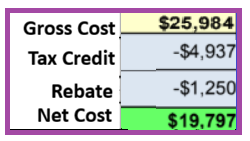
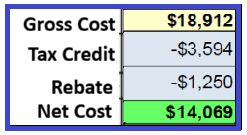
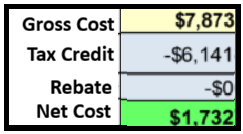
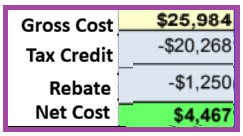
Here are some examples of common scenarios for comparison:
● Whether the system is designed for backup power vs. cost savings
Battery Systems: A Growing Trend
While the solar market has slowed, battery adoption is accelerating. Homeowners are prioritizing energy independence and protection against outages.
It’s also worth noting:
● A battery designed purely for cost savings can be $4,000–$6,000 less expensive than a full backup system.
● Battery installations are more complex, requiring more labor, which affects pricing and margins.
Market Reality: A Volatile Few Years
The solar industry has experienced major turbulence:
● Equipment prices have fluctuated due to tariffs, inflation, and supply chain disruptions
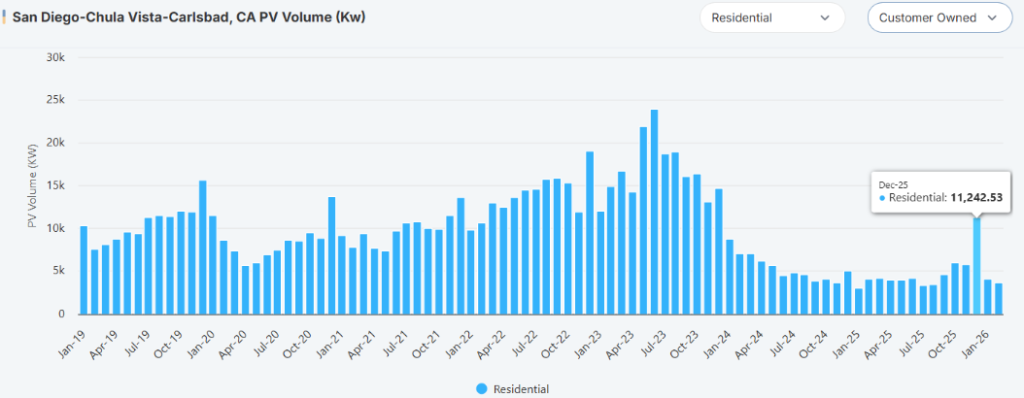
● The market saw a sharp contraction in 2024–2025, with many companies shrinking or exiting
● 2026 is shaping up to be one of the lowest-volume solar installation years in recent history
Credit: Ohm Analytics dashboard marketplace
At the same time:
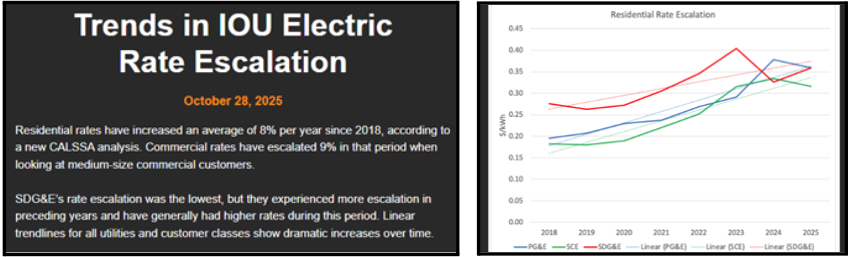
● Electricity rates have increased ~8% annually since 2018, doubling roughly every 7–9 years depending on rate structures
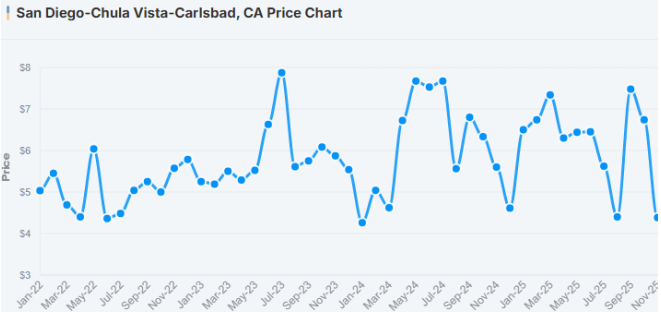
● The average solar PV cost/watt in 2025 ranged from $4.50 to $7.50 per watt, with regional averages around $6/watt, due to the 1kW CEC-AC add-on NEM Expansion limit.
Credit: CALSSA member newsletter. Click to become a CALSSA MemberCredit: Ohm Analytics dashboard marketplace
What This Means for You
Despite market uncertainty, the fundamentals still favor energy investment:
● Utility rates continue to rise steadily and SDG&E is already the highest cost utility power in the U.S., at $0.91/kWh Peak Rate (EV-TOU).
● Battery adoption is increasing due to real-world reliability needs
● Incentives still exist—but are now more nuanced and tied to usage type
The key question is no longer just “Should I go solar?” but rather: “How can I structure my system to maximize savings under current rules?”
Final Thoughts
2026 isn’t the easiest year to navigate solar decisions—but it may be one of the most strategic.
If you’re considering solar or battery:
● Evaluate whether any portion qualifies as business use
● Understand your rate plan and energy consumption patterns
● Act before key deadlines to preserve eligibility
The opportunity hasn’t disappeared—it’s just become more tailored.
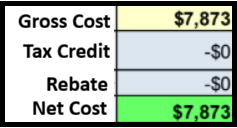
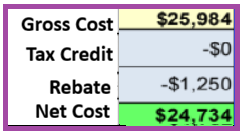
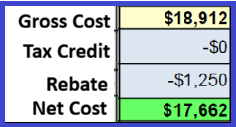
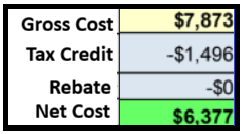
There’s a variety of options available for Residential Business Use NEM Expansion, for existing solar. Green Energy EPC by Makello, Inc has many hundreds of Current Customers with Net Energy Metering registrations that are eligible for an Alumni Discount. Click on the option that best matches your add-on Solar Only, Solar-Battery, or Battery Only NEM Expansion cost summary, to see a contract that is available for you to fill out, sign and return by May 1, 2027. Of course, Makello.com will be glad to help you through the process.
Solar Only
Solar & Battery
Battery Only
0% Business Use
25 % Business Use
100 % Business Use
Remember you have until 2030 to build. You only need to pay a minimum of 5% before July 4, 2026 to Reserve your Solar Tax Credit and Depreciation incentives!
Synopsis: An EV “Ride N Drive” event takes a supernatural detour, when riders temporarily, uncontrollably and inexplicably become “Energy Zombies”, smitten by the overpowering experience of driving electric for the 1st time, with instant torque, no noise and zero emissions.
Click to watch Joyrider “Fozzy’s Makello Story”. Do you think Joyrider should be a series? Leave a comment in YouTube, Like, and Share!
Actors: William May-Kidd: Charlie Johnson; Ping “Tek” Han: Songxuan Liu; Flint “Fozzy” Bjorn: Jarod Donahue.
Mythology
In 1916, Camille Jenatzy, a race car driver known for his red beard as “the Red Devil”, reportedly contacted an unknown driver-mechanic named Otto Stiggler by Telegraph. The message requested for Otto to take his place for hire, in the first race to the top of “Pike’s Peak” Colorado Springs, Colorado, driving a “La Jamais Contente”, the first Electric Vehicle to break the 100km/hr speed record, modified to improve driver position aerodynamics.
Illustration of the original “La Jamais Contente”, first automobile and Electric Vehicle to reach 100 km/h, in 1899.
Photo of Camille Jenatzy and his wife riding in the “La Jamais Contente”
While the vehicle was “in transit from Belgium”, Otto was instructed to practice often at Pike’s Peak, to learn the dirt race course’s hairpin turns, dips and ruts, while using his preferred selection of many gas powered vehicles of the day.
”La Jamais Contente” arrived 2 days before the 1st Pike’s Peak Race, and was transported by carrier truck directly to the starting line to preserve battery charge for the course. By the time the prototype vehicle was unpacked, the 1916 Pike’s Peak course access was about to close.
The condition of this 1943 road is a significant improvement to the early Pikes Peak races.
Otto managed to convince a departing race attendant, Ali Madohan, to allow him to drive the course. Ali gave Otto a signal flare to use when he reached the finish line at the top of Pike’s Peak, or in case of emergency.
According to Ali, with help from a Good Samaritan, Otto struggled to squeeze his lower body into the recessed cockpit. The shape of the cockpit required the upper body to be reclined in an almost supine position, below a nearly fully enclosed canopy that reporters described as “a metal coffin with a “cupola” shaped protrusion for the driver’s head”.
After pushing the vehicle to the starting line, Ali received a “ready sign” hand signal through the “cupola” opening slit, and the attendant waved the starting flag.
“La Jamais Contente” leapt from the Start Line quickly and silently, but within seconds, according to Ali’s statement, “there was a simultaneous flash of light and a crack of thunder,” which reportedly knocked several birds to the ground, temporarily stunned, and sent Ali ducking for cover with his hands over his ears.
This mysterious nearby object was found to transmit wireless power.
These three lights in a nearby field are pictured receiving wireless power.
Ali was quoted as saying, “I heard a mixture of barking and laughing. The barking seemed to come from the trees above and below both sides of the road. The laughing sounded like it came from inside a big metal drum, and it reverberated off the canyon rock walls, until the car disappeared into the hills beyond the 3rd turn.” Any objective observer would have assumed Otto was howling with laughter.
Upon witnessing a flare that originated from the finish line area, Ali recorded an unofficial pre-trial time of 20:45.90.
Otto and “La Jamais Contente” did not return to the Start Line to qualify for the 1916 Pike’s Peak race. The first Penrose Trophy was awarded to Rea Lentz with an official record time of 20:55.60, driving an internal combustion engine vehicle.
After several days missing, and at the request of Otto’s family, local officials formed a search party. The carrier truck was reportedly found near the former site of the Tesla Experimental Station, which was a wireless power transmission test facility.
Nikola Tesla sitting under his transmitter in his Colorado Springs lab surrounded by millions of volts.
Nikola Tesla created an experimental station outside of Colorado Springs to test wireless transmission of electric power.
A printed telegram transmission from Jenatzy was located in the truck and detectives contacted authorities in Belgium for more information. The truck was found to have been purchased anonymously at auction from the lot of decommissioned assets originating from Tesla’s Experimental Station.
Colorado detectives learned that the unidentified carrier truck who called himself “Dino” had fled the area. A rambling note in the vehicle, alleged that Otto was not the race driver of the modified “La Jamais Contente”, and that a man who identified himself as ‘Camille’ was seen near Otto before the race, assisting with preparations.
The family of Camille Jenatzy was interviewed and they reported to authorities in a sworn statement, that Camille Jenatzy died in 1913, and that the original “La Jamais Contente”, was in Belgium, and that no one had contacted them from the United States about shipping Camille’s prize winning, record setting electric race car.
The vehicle was never recovered and the circumstances surrounding Otto’s disappearance remains a mystery, as to who was the driver, Otto, “Dino”, “Ali”, “Camille”, or as some believed, Camille’s ghost, or possibly Nikola Tesla himself.
What some attribute to folk lore, others say is conspiracy, yet others say is fact. But is it possible that wireless power was part of “La Jamais Contente” unofficial Pike’s Peak record? Tesla had recently designed, tested and de-commissioned the preliminary version of the “Wardenclyffe Tower” nearby in Colorado Springs. Tesla’s invention later proved capable of transmitting power wirelessly through the atmosphere, via a propagating wave through the Earth’s mantle, as he claimed, to any location around the world.
Nikola Tesla designed and built the Wardenclyffe Tower in Long Beach, New York between 1901 and 1902 to experiment with wireless power transmission. Click on the photo to learn more.
About The Creators
Joyrider is a fictional story loosely based on actual events, for the purpose of entertainment, sharing and exploring the concept of the “EV Grin”, which is the infectious joy and smile that instantly takes over a person when they first experience driving electric.
Makello is a diverse team with backgrounds in software engineering, environmental science, management, GIS, and home and business energy services. We are committed to help reduce greenhouse gas pollution and work with non-profit and community organizations to help educate the public about Solar Panels, Plug-In Vehicles, & Energy Storage benefits. If you are interested in any of these technologies in your home, contact us for a FREE Energy Savings Estimate! With rebates and incentives they can be cheaper than you may think!
Makello is developing GIS services and creating maps useful to the solar power, electric vehicle, and energy storage industries, as well as for our teaming companies, including several non-profit organizations. Maps are an important method for analyzing and presenting data.
We will examine redlining and clean-air technology access by the San Diego African American community in this blog. See the editor’s note below on how we will be using the Census Bureau term African American as defined by the Census Bureau: Race for Residents of African ancestry or birth including both US Citizens and non-US Citizens. For more info on data sources and terminology, references are provided at the end of this article.
Makello works with non profits and other agencies to create maps for Environmental Justice initiatives.
Editors Note: Click to view Makello’s commitment to finding words and methods to accurately represent data while conveying inclusion of the appropriate demographic.
Makello began using maps to analyze data and learn about our community in 2019. From time to time, we intend to share some of the maps we’ve developed but there are challenges to presenting the data accurately and transparently, especially with regards to designations for Race, Identity and Ethnicity.
The US Census counts all people living within the Boundaries of the United States and Territories. The data collected is by Race, not citizenship status. The Census data uses terminology that can easily be misunderstood because of common usage of terms vs. the Census Bureau definition. The Census Bureau meaning of the term is often lost as the data filters down to the public through agencies and businesses.
The Census Bureau uses the terms African American, Asian American, Native American, Hispanic, White and Other to define Race. Citizenship or immigration status is not counted. The loss of context of these words may prevent accurate and full understanding of data. People may feel invisible or may be unintentionally misled.
You may have noted a few potential difficulties in the short list of the terms presented. That is where the struggle lies when attempting to represent residents without being US-Centric or Ethno-centric. Acceptable terminology changes through time, is understood differently in separate regions and countries, by different cultures and ethnicities. Individuals infuse meaning in words based on their life experiences, making classifications difficult.
Maps may focus on a specific demographic for any number of reasons. It can be difficult to adequately portray diversity on the map with charts or graphs. Please refer to the two examples below.
Makello is committed to the difficult task of finding words and methods to accurately represent data while conveying inclusion of the appropriate demographic. We make great effort to research and vet language. Language and identities change. Unfortunately, there is no all encompassing, perfect language for describing people. What one person thinks is a great label and strongly identifies with, the next person may reject or find offensive. We accept open and honest feedback and hope you enjoy the information we present.
African Americans in San Diego are concentrated in southwestern San Diego County.
The first question to answer is where are the communities with 10% or more of the African American residents? A map of the demographic data from the CalEnviroscreen 3.0 is the simplest method of discovery. CalEnviroscreen obtained demographic data from the US Census Bureau and retained the US Census Bureau demographic descriptors in their report. Our map above shows the population is largely concentrated in the area to the east of Downtown San Diego which will be the area we focus on for the purpose of this blog.
Why is the population so heavily concentrated in this area? With a special thanks to University of Richmond’s Digital Scholarship Lab, a look at the 1930s New Deal Era Home Owners’ Loan Corporation Redline Maps may help to answer this question.
The Home Owners’ Loan Corporation (H.O.L.C.) was created during the Great Depression New Deal Era and the program trained many home appraisers in the 1930s. The H.O.L.C. created a neighborhood ranking system known today as redlining. Grades were assigned to residential neighborhoods by local real estate developers and appraisers in over 200 cities. These maps and neighborhood ratings set the rules for decades of real estate practices. The grades ranged from A to D.
The Green Area- Grade A = Best: Always upper-middle-class to upper class White neighborhoods defined as posing minimal risk for banks and other mortgage lenders, as they were “ethnically homogeneous” and had room to be further developed.
The Blue Area- Grade B= Still Desirable: Neighborhoods with all or mostly White, U.S. born residents were defined as sound investments for mortgage lenders.
The Yellow Area- Grade C =Declining: Residential neighborhoods with working class and/or first or second generation immigrants from Europe. The housing stock was typically older and often lacking the current utilities of the day.
The Red Area- Grade D= Hazardous: These neighborhoods were considered to be “infiltrated” with “undesirable populations” such as Jewish, Asian, Mexican, and Black families. The neighborhoods were more likely to be located near industrial areas and the housing stock consisted of older, less well maintained buildings.
Are you ready to save money on solar power, EV charging or Energy Storage? Get an instant quote from Makello!
These grades formed the basis for federally backed mortgages. Many banks refused to lend to areas with the lowest grade, making it impossible for people in these neighborhoods to become homeowners and preventing them from building generational wealth.
As you can see from the map, many of the areas that were labeled undesirable in the 1930s are still the areas where African Americans are concentrated. The practice of redlining has had a long term impact on segments of our community that has yet to be resolved.
1930s redlining still impacts African American communities 90 years later.
Makello is an advocate of green transportation options, providing FREE Energy Savings Estimate services including an analysis of potential electric vehicles to fit your needs, so it was only natural we take a look access to public charging stations African Americans have in the former redlined areas. The results were………….. well, see for yourself.
Less than 10 public electric vehicle charging stations are located within the African American communities.
The data from the US Dept. of Energy Alternative Fuels Data Center may be mapped and compared to the CalEnviroscreen Demographic Data. The neighborhoods with the highest concentrations of African American Residents do not have easy access to public electric vehicle charging stations. One consequence is this discourages San Diegans with electric vehicles living outside these communities from driving to businesses in these neighborhoods and spending money. The lack of access to public charging stations also discourages the residents of these neighborhoods from purchasing electric vehicles because they don’t have the ability to conveniently charge their vehicle. This is especially true for multi-unit dwellers where there are structural and parking challenges to overcome when installing EV charging stations. This creates additional barriers to EV ownership, keeping the community from reducing pollution, developing business opportunities, and creating jobs in their neighborhoods.
Book an appointment to receive Makello’s Ethical Energy Savings Report, which is the result of a detailed trade-off study of discount utility rates, grants, rebates, tax credits, and equipment options, to determine the fastest payback and highest return on investment to meet your home, business and vehicle energy needs.
The fee for the Ethical Energy Savings Report is refundable (less the 3rd-Party $15 utility data access charge) or credited towards our installation services, after you attend the presentation meeting and complete a 5 minute survey after permission to operate.
Includes up to 5 hours research by the Makello team, and 1 hour Q&A, by Makello’s Ethical Energy Efficiency Expert.
We’re shifting gears now and will be examining the energy cost burden in the City of San Diego. The energy cost burden data was obtained from the 2019 San Diego Climate Equity Report and overlaid the demographic data from the CalEnviroscreen 3.0. Generally speaking, the energy cost burden was calculated as a weighted average for each census tract and divided by the median household income for each census tract to obtain the energy cost burden score. For more detailed explanation of the energy cost burden, please visit the San Diego Climate Equity Report page.
The white outlined areas in the map posted below have the lowest energy cost as a percentage of Median Household Income and the dark green areas have the highest energy cost burden. Most of the African American San Diegans are in the minty green areas and have an energy cost burden of 1.3%- 2.7%. There is one area with 18-28% of the African American residents and a 4-5.4% energy cost burden.
This cost puts an additional financial strain on those residents with more modest incomes and often prevents the residents from using air conditioning or heaters in bad weather, increasing some health risks especially for elderly and health challenged individuals. Or the residents may use older, less energy efficient equipment, increasing energy cost and pollution.
Energy cost impacting African American communities.
One potential solution for reducing the energy cost burden and pollution is solar energy and battery storage. We mapped solar adoption rates from the San Diego 2019 Climate Equity Index report and again, overlaid the demographic data from CalEnviroscreen 3.0. The areas outlined in white have the least access to solar energy. Many African Americans are living in areas where at best, there are per capita 0.05 solar photovoltaic systems resulting in these residents having a low ability to decrease pollution due to electricity production and consumption in the home, reducing overall energy cost, and protecting against power outages.
African American communities in San Diego have low access to solar energy systems.
Returning to redlining, banks’ historical unwillingness to loan money in these communities have left many residents underbanked and underserved. Solar Systems, Electric Vehicles, Battery Storage Systems are investments that can improve personal finances and the quality of life for anyone that can afford a purchase, or qualify for financing. Beyond traditional loans or leases, community members can use the State of California’s Property Assessed Clean Energy (PACE) financing for home upgrades and energy upgrades. PACE is not a loan and does not appear on an individual’s credit report. PACE funds are repaid on the annual property tax bill.
This concludes our discussion for now. Please stay tuned for additional articles where we take a look at other issues and demographic segments of San Diego Residents.
Apple, under Steve Jobs’s leadership, revolutionized the cell phone industry and defined the smart phone as we know it today. Tesla is positioned to do the same for the automotive industry.
A gold Tesla Model 3 symbolizes the new standard for modern day vehicles.
In 2012, Tesla reinvented the electric vehicle with the Model S and captured people’s desire for clean, sexy, and powerful.
Book an appointment to receive Makello’s Ethical Energy Savings Report, which is the result of a detailed trade-off study of discount utility rates, grants, rebates, tax credits, and equipment options, to determine the fastest payback and highest return on investment to meet your home, business and vehicle energy needs.
The fee for the Ethical Energy Savings Report is refundable (less the 3rd-Party $15 utility data access charge) or credited towards our installation services, after you attend the presentation meeting and complete a 5 minute survey after permission to operate.
Includes up to 5 hours research by the Makello team, and 1 hour Q&A, by Makello’s Ethical Energy Efficiency Expert.
Electric vehicles existed over a hundred years ago, but they failed to succeed in the consumer market. There were also electric cars in the market in the early 2000s, but they sacrificed speed and range to be environmentally-friendly. What Tesla did differently, was create a battery electric vehicle with a futuristic design. The speed and versatile functionality made simple by advanced technology, the durability that you can depend on, and the potential to improve with time. In a way, this is roughly the recipe for the first iPhone, but on wheels instead.
In 2008, a Tesla Roadster was ruthlessly mocked on Top Gear, the world’s most popular car show. Yet today, if you look at the Monthly Plug-In EV Sales Scorecard [2], you will find that more Teslas are sold in the U.S. than all other (42) Plug-In Vehicles combined. With Tesla finally becoming profitable in Q3 of 2018, Tesla’s stock has become one of those investments that many people wish they had made. However, deep down, I have always had doubts toward Tesla’s success.
In February, I decided to visit the “Meet – Greet – Share” event hosted by the San Diego Tesla Club at the Fashion Valley Mall Superchargers, to see if Tesla really is a challenger for the ICE (Internal Combustion Engine) car industry. The gathering of over fifty Teslas and over one hundred Tesla owners, employees, and supporters was impressive.
EV enthusiasts and interested community members gather at the San Diego Tesla Club’s “Meet-Greet- Share” Event at Fashion Valley to enjoy no emission, no noise driving.
Book a FREE 15 minute appointment to: 1) Find out how Makello can help you. 2) Discuss your energy needs. 3) Get a FREE Energy Savings Estimate.
I enjoyed seeing a Roadster up close, even more than the one sent to space (see that one here).
Tesla Roadster. I guess the people at Top Gear weren’t impressed with the paint job? Well, a fast car should look fast!
It’s funny how dozens of Tesla owners just came here to plug into the Superchargers, but then found out about the meeting and stayed! And these Tesla owners, unlike how some are portrayed on the internet, are great people too. They welcomed a non-owner, like me, and were happy to share how their Teslas impacted their lives. Tesla owners are passionate; many said, “Once you got a Tesla, you can never go back [to any other Internal Combustion Engine cars].”
Contrary to what some harsh comments suggest on the internet, many of the Tesla owners are interested in seeing what the EV market has to offer and how various products have improved ever since Tesla helped to grow the EV market.
Tesla Employees and EV Enthusiasts come together to appreciate technological advancements.
The Tesla employees were friendly, too. Signing up to test drive a Model 3 was quick and easy. Bobby, the Tesla representative, was very thorough and professional in his explanation of the Model 3’s features.
The credit card-like car key means you can slip it easily in your wallet or purse instead of getting it scratched on the key chain. The Model 3 achieves efficient usability through the 15 inch touchscreen and the two sphere controls on the steering wheel that provide all of the customization for the driving experience.
The experience enters a new dimension once you start driving. The lack of engine noise provides a sense of peace and calm. The car starts instantly and can drive immediately, without needing to warm up. On a hot day, the cabin cools within seconds due to the seamless full width vent.
Once we got to the open road, Bobby encouraged me to put my foot down on the accelerator pedal. After stepping gently on the pedal several times, I said to him, “I am gonna give it the beans, you ready?” Bobby said, “Yeah.” I floored the accelerator pedal. Within 3 seconds, the silence of the sudden acceleration was interrupted by a warning beep for going over the 40 mph speed limit. In the process, Bobby almost spilled his coffee (good thing there was a lid). When the light turned green at the next intersection, I did it again. None of the other cars had moved by the time we were through the intersection.
Are you ready to save money on solar power, EV charging or Energy Storage? Get an instant quote from Makello!
Now, following the launch of the Model Y, there really is something “S-3-X-Y” in Tesla’s lineup. The excitement and innovation that Tesla products offer makes those of us who love cars, love them even more, and for those who never cared, can now find driving more enjoyable than ever.
Progress works in unique ways, even when it doesn’t happen easily or overnight. Not all of us can recognize the next big thing when it comes along, and some of us might even reject it at first. That’s why despite the challenges laid ahead of Tesla by profitability, layoffs, the stock market, and even the SEC, Tesla’s role in the history of automobile development is undeniable.
Today, we are at a turning point of automotive history, similar to when the early cars displaced the use of horses for transportation. It is our job to embrace the future that belongs to electric vehicles. When we face our grandchildren decades from today, we can proudly tell them, “We weren’t the ones crushed by the giant wheel of history. We were the ones who rode on it. In fact, we were in ludicrous mode on a Tesla.”
After the event ended, I test drove the MINI Countryman SE All4 featured in my last blog article (which you can read more here). The Countryman’s 0 – 60 mph time of 6.7 seconds isn’t slow at all, but it was not even close to the acceleration and thrill of driving the Model 3. Click on the videos below to learn more about EVs and how you can afford to get one for yourself!