How Do You Download Your 15 Minute Interval Data?


You are working a solar company and they have a lot of questions to determine the optimal system size that best matches your energy goals. Now you’ve been asked to download your SDGE Energy Usage data. There’s Green Button Data, Utility API Authorization, Two-Factor Verification or any other number of options. What do you need to do and how do you do it?

At Makello, we request either downloading Green Button data in 15 minute intervals from your SDGE account or to authorize Utility API collection of data on your behalf and this article will focus on those methods.

SDGE My Energy Center Login

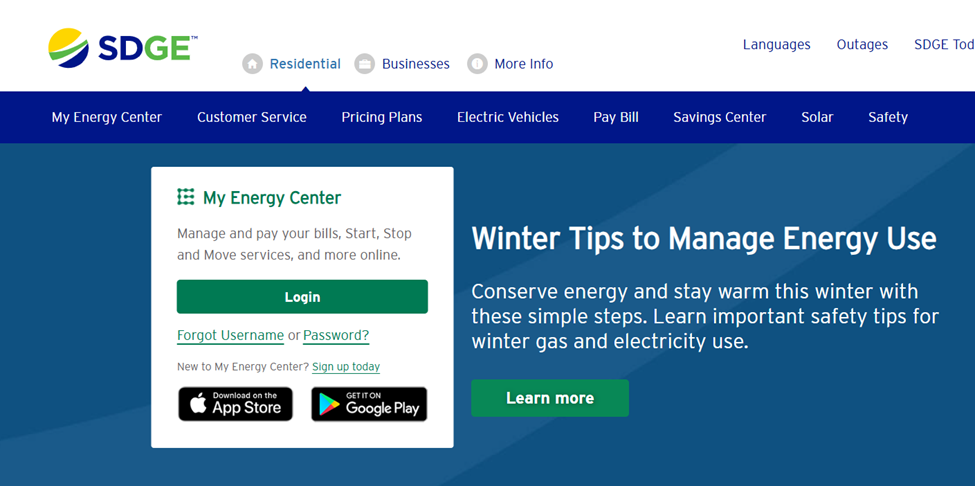
The first step to downloading your interval data from SDGE My Energy Center is to navigate to https://www.sdge.com/

Click on Login in the home page if you have already set up an online account to view your SDGE bills. First Time Users of SDGE My Energy Center should click on Set Up Today and follow the steps to register. You may have to login after registration. If you have two factor authentication activated, you will be asked to enter in a code that is sent to the email or phone number you have on file.
Green Button Data Download

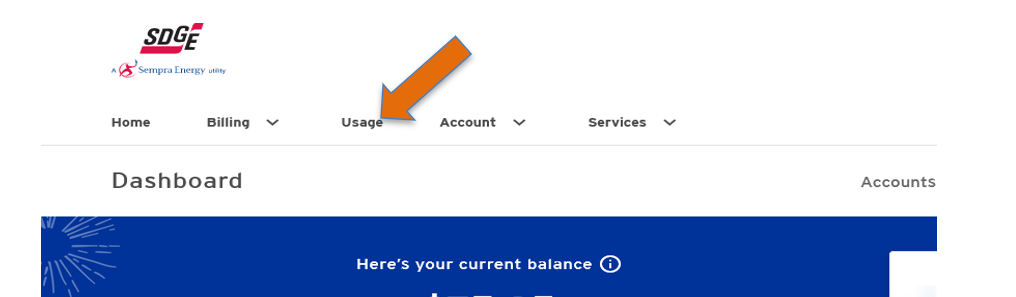
After successful log in, you will see your dashboard. The dashboard design may vary due to your enrollment in a Community Choice Aggregator or not.

Click on the Usage tab at the top of the dashboard.
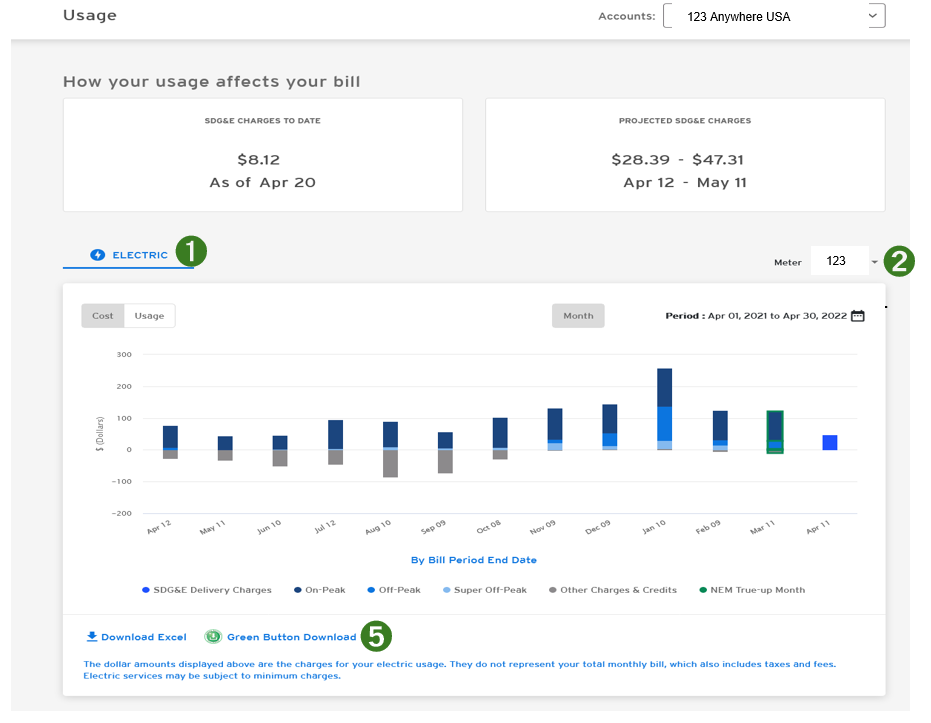
You can download your data from your Usage page.
1. Select Usage from the drop down menu in the Usage Tab.
2. Select your electric Meter from the drop down menu on the right side of the page.
3. Scroll down to the bottom of the page.
4. In the bottom left corner, you will see button for Download Excel and Green Button Download.
5. Click on Green Button Download to download data.  
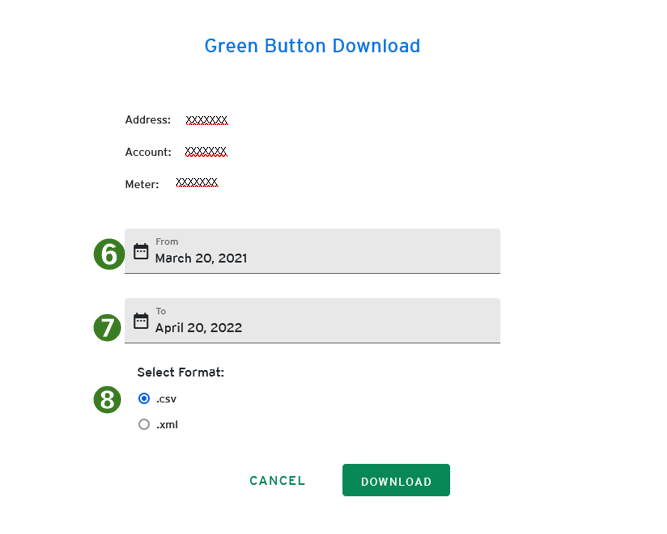
6. Set the date in the drop-down tab to download as many months of data as possible. Twelve (12) full months of data is preferred but one month of usage data is needed if  available.  
7. Under the Select Format heading, click .csv button (this step applies to electric meters only), then click download.
8. Under the Select Format heading, click .xml button, then click download (this step applies to both gas and electric meters for customers with both types of meters).
9. Repeat steps 1-8 for each meter that services the property, gas and electric.


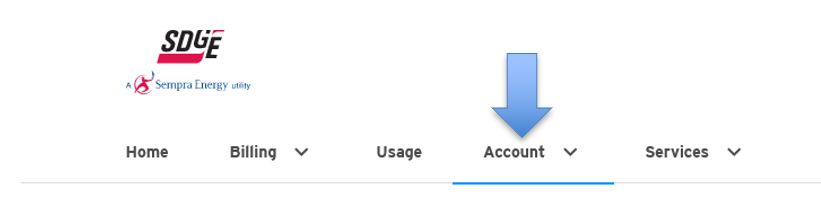
Turning SDGE Two Step Verification Off or On

Turn 2 Step Verification off or on by clicking on Account in menu bar.
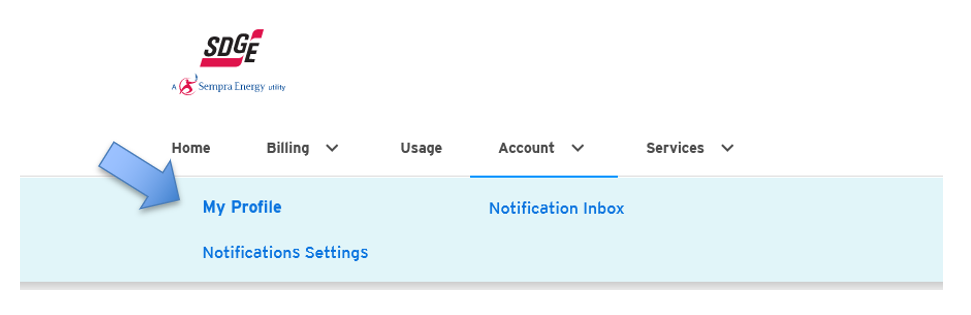
Then select My Profile from the drop down menu.
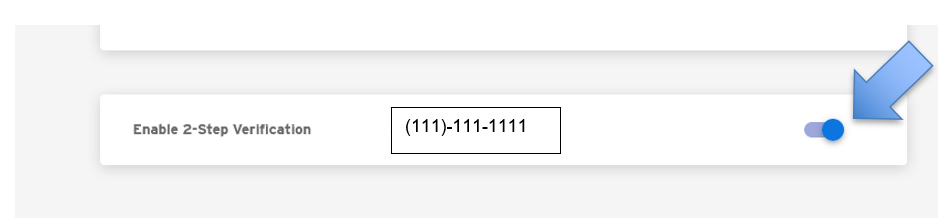
Scroll to the Enable 2-Step Verification section and click on the blue button on the right side of the screen to turn off the 2 Step Verification.
Click on Confirm in the pop up menu.
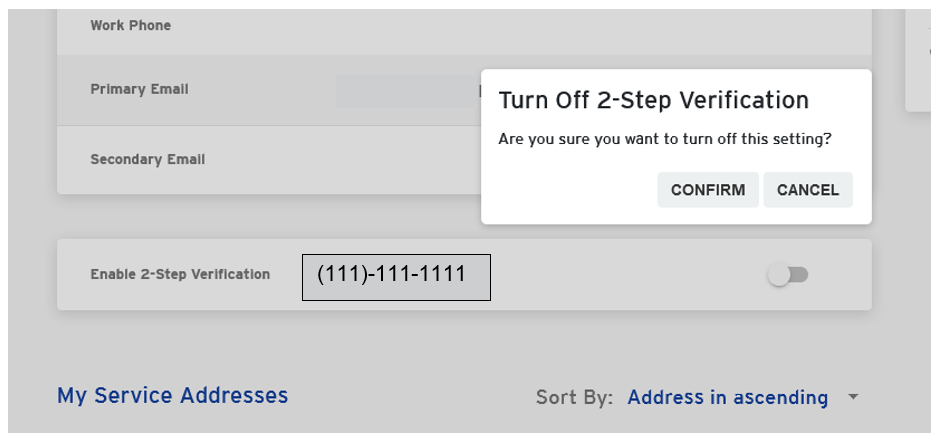
You have turned off the 2 Step Verification. Please note: 2 Step Verification must be completed prior to authorizing Utility API data collection.

To Turn 2 Step Verification back on, simply return to your Account, select My Profile, scroll down to Enable 2-Step Verification and click on the grey button on the right side of the screen, click on Confirm.  

Authorization of Utility API Data Request via Link


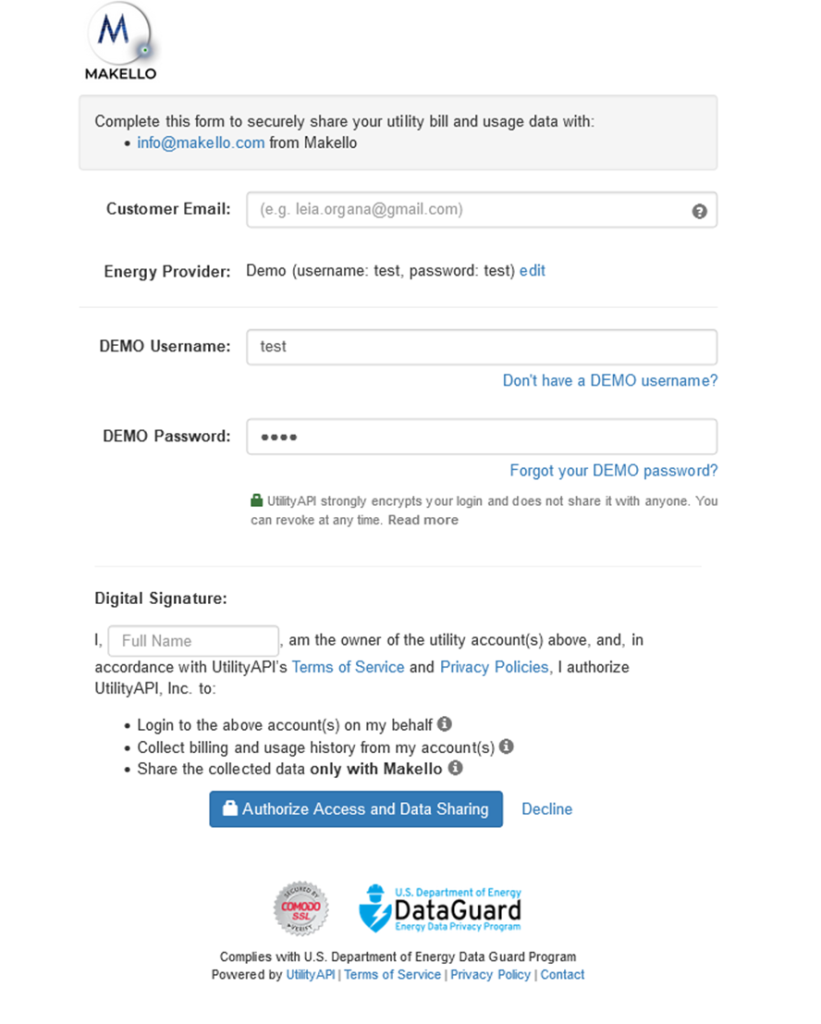
Please click on the Utility API Authorization link provided by Makello in the email you received.

You should be brought to a screen similar to the picture below. Please provide the requested information and click Authorize Access and Data Sharing.
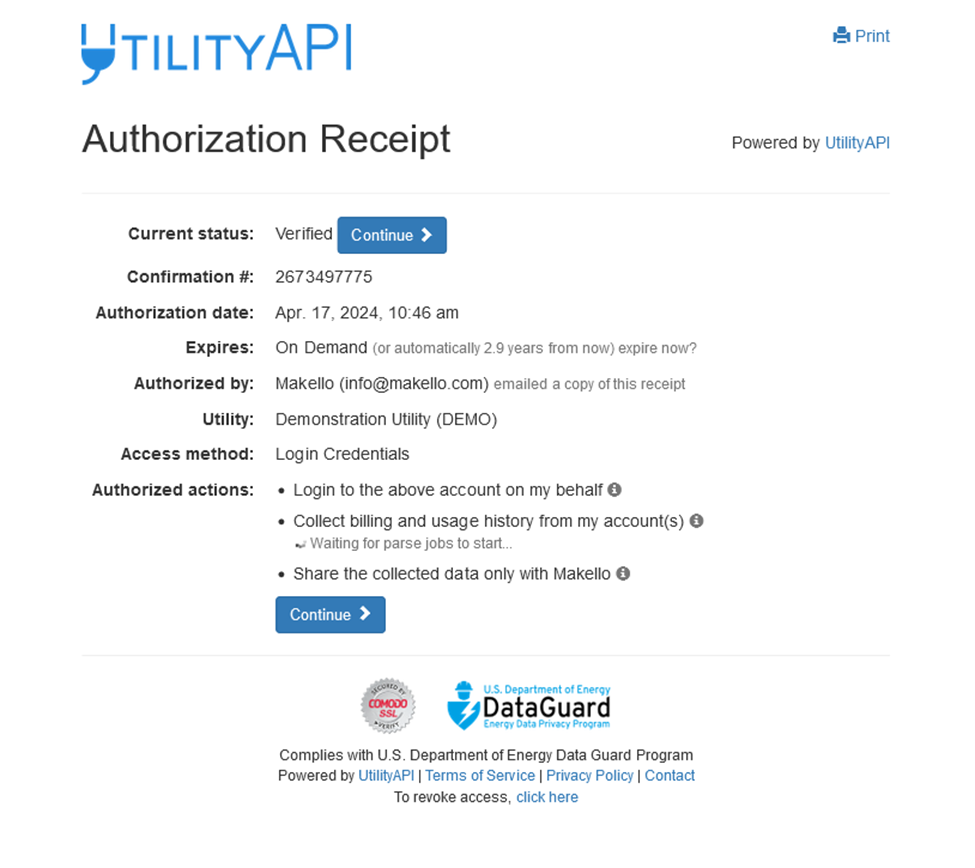
You should receive an authorization receipt similar to the picture below after authorization has been completed.
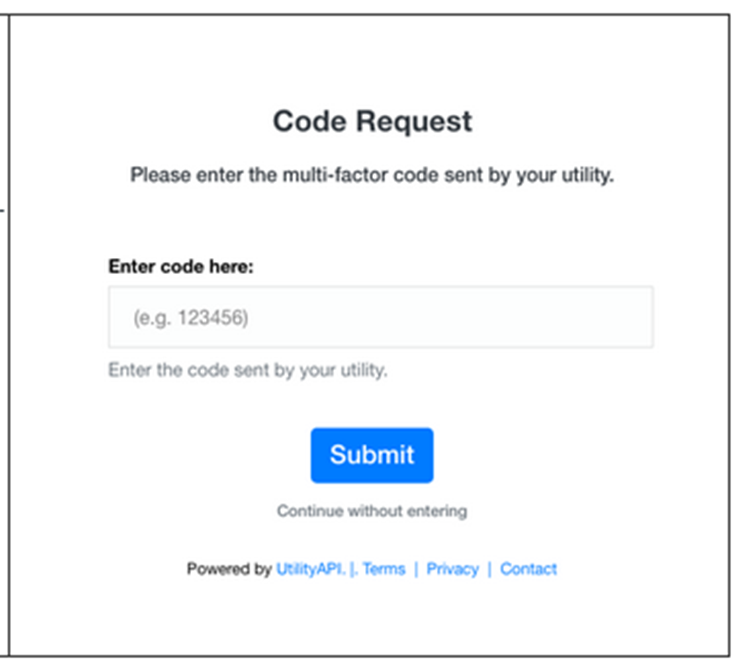
If your SDGE account has  two-step verification, you should then receive a two-step verification code from SDGE sent via text message.  Please enter the code in the space provided.  An example of  the screen  where you enter the two-step verification code provided in the image below.
Alternatively, you may manually deactivate and reactivate the multi-step verification for your SDGE by following the steps previously outlined.

Please note: 2 Step Verification must be completed prior to authorizing Utility API data collection.

Utility API Data Collection Refresh Historical Data

When Utility API Refreshes Data via a new collection, you may receive a message informing you of the activity on your account.
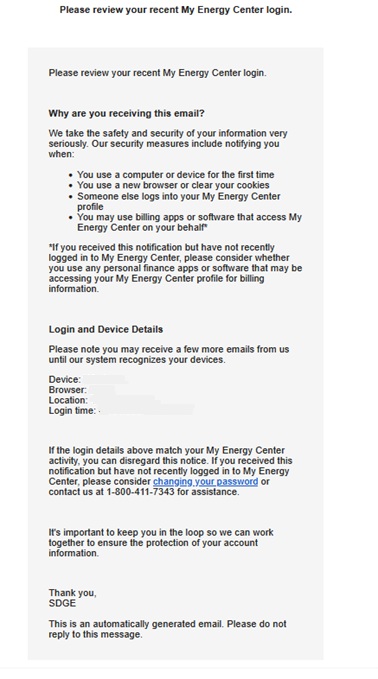
You may find out more about Utility API https://utilityapi.com/

SDGE Utility Bill Download Instructions

Next document needed is a .pdf copy of your bills

A. Click on Billing drop down menu at the top right of your dashboard.
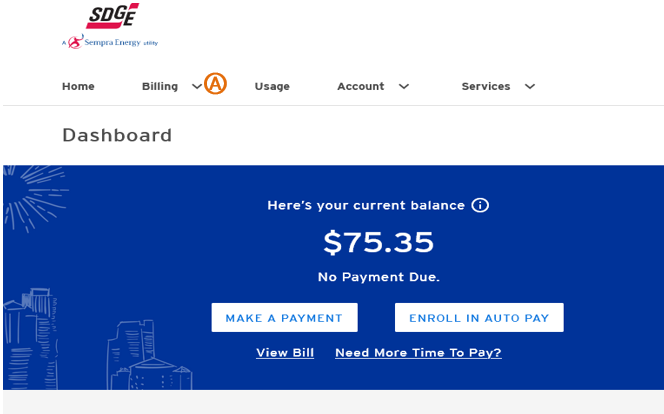
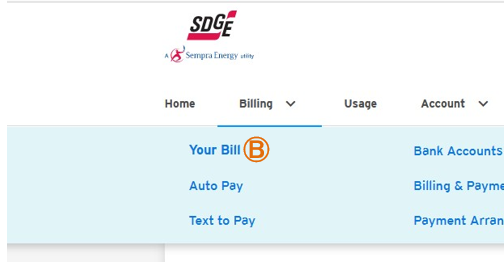
B. Click on Your Bill from the Billing drop down menu.
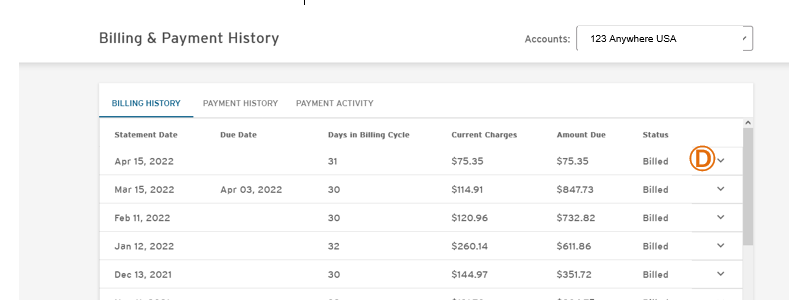
C. Click on the link for Billing & Payment History from the menu on the right side  of the menu.
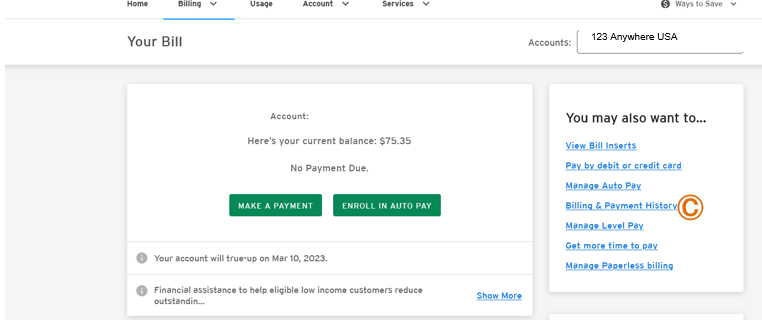
D. Click on the drop down menu arrow on the right side of the screen to display your bill.
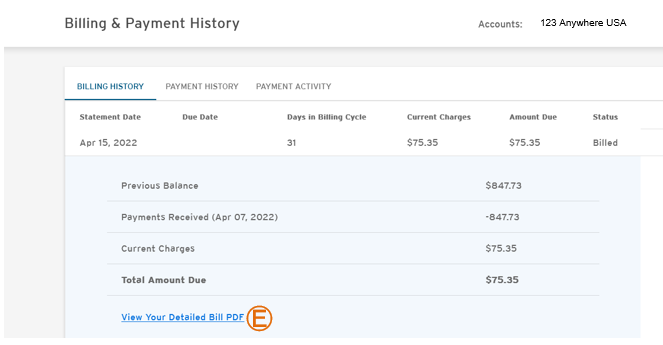
E. Click on the View Your Bill PDF link.
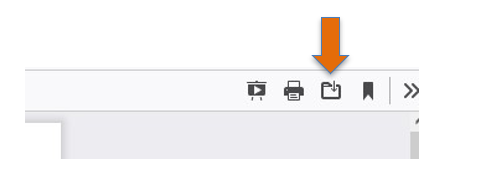
F. Click on the folder icon on your computer’s menu bar to download the file. Save the .pdf file to the folder of your choice.
G. Return to the Billing & Payment History Screen and repeat the download process detailed in steps D-F for as many of the most recent months of Bills available, up to twelve (12) months of Bills.

    Green Energy EPC by Makello CA Lic # 1110498

Community Choice is Here!

Map showing the service areas for Community Choice Aggregration Service Providers as of February 2022

Community Choice is coming to electric customers of San Diego County but what is Community Choice and what does it mean for you as a customer?

Community Choice Aggregation (CCA) is a locally run not-for-profit organization that was enabled by the California Legislature in 2002 AB117. The first CCA in San Diego County began operation in June 2018 and Community Choice Aggregation (CCA) continues to grow.

Community Choice Aggregation (CCA) does not generate electricity. Community Choice Aggregation (CCA) enables communities to pool ( i.e. aggregate) their electric load and purchase clean energy on the open market at competitive rates as well as develop local programs that benefit the community. The existing Investor-Owned Utility (IOU) continues to deliver power and maintain the grid. 

The goals and benefits of Community Choice Aggregation (CCA) are:

  • Accountability, transparency, local control and consumer choice
  • Assist communities with reaching their climate and economic goals
  • Promote transition to a cleaner energy supply
  • Reinvest revenues in the community instead of distributing to shareholders
  • Allow communities to develop renewable energy projects
  • Act as a tool for establishing local energy resources and programs

Since Community Choice Aggregation (CCA) works with local Investor Owned Utilities (IOU), customers are billed through their local Investor Owned Utility (IOU). Utility Customers are automatically enrolled in the Community Choice Aggregation (CCA) per State Mandate but can opt out of the program by contacting your local CCA. Terms and conditions may apply to opting out of Community Choice Aggregation (CCA). 

You still call your local Investor Owned Utility such as SDGE, SolCal Edison, or PG&E, if you have questions about your account or issues with your utility service such as downed power lines or power outages.

There are some programs offered through the Investor Owned Utilities (IOUs) that are impacted by the switch to Community Choice Aggregation (CCA).

For SDGE customers, the following programs are not offered to Community Choice Aggregation (CCA) participants: 

  • EcoChoice
  • EcoShare
  • Reduce Your Use Rewards (ended for all SDGE customers on 2-31-2018)
  • Direct Access

SDGE customers enrolled in any of these programs who choose to stay enrolled in Community Choice Aggregation (CCA) will be removed from the above listed SDGE programs. 

Makello’s Ethical Energy Savings Report is the result of a detailed trade-off study of discount utility rates, Community Choice Aggregation options, grants, rebates, tax credits, and equipment options, to determine the fastest payback and highest return on investment, to meet your home, business and vehicle energy needs.

SDGE customers receiving California Alternate Rates for Energy (CARE), Family Electric Rate Assistance Program (FERA), and Medical Baseline discount within their San Diego Gas & Electric (SDGE) energy delivery charges will continue to receive the discount after switching to Community Choice Aggregation (CCA). 

SDGE Customers on Net Energy Metering (NEM) rates will still have Net Energy Metering (NEM) if offered through the Community Choice Aggregation (CCA) provider. If you are grandfathered on a NEM pricing, you will see no change in your grandfathered rates if NEM is offered through your CCA. 

Please check with your local Investor Owner Utility to find out if your program enrollment or billing will be impacted by the switch to Community Choice Aggregation (CCA). 

Service territory of the now defunct Solana Clean Energy Alliance active between June 2018- May 2021

The first CCA in San Diego County was the Solana Energy Alliance which began operation in June 2018 and merged with Clean Energy Alliance in May 2021.

The Clean Energy Alliance CCA is currently servicing Solana Beach, Carlsbad, San Marcos, Escondido, and Del Mar. Service began in May 2021 for customers in Solana Beach, Carlsbad, and Del Mar. Service roll out began in December 2021 for Escondido and San Marcos. Please visit the Clean energy Alliance for more information regarding rates and other information for this CCA. https://thecleanenergyalliance.org/ The Clean Energy Alliance currently has all the information in pdf documents and does not have an online comparison tool. 

Map showing the Clean Energy Alliance service territory as of February 2022

The Clean Energy Alliance offers rates based on 50% clean energy production, 75% clean energy production or 100% clean energy production as well as Net Energy Metering (NEM) for customers with renewable energy production systems.

The Net Energy Metering (NEM) program from Clean Energy Alliance is similar to the current program offered by SDGE. The energy usage and excess production are tracked and at the end of the 12 month relevant period, the account is trued up. If there is a net charge due, the customer will be billed. If the customer had a net excess generation, they are eligible to receive Net Surplus Compensation which is set as of February 2022 at $0.06 per kilowatt-hour for Net Excess Generation.

SDGE customers enrolled in Net Energy Metering (NEM) will automatically be enrolled in the Clean Energy Alliance Net Energy Metering (NEM) Rate. Customers who install a solar, wind or other self-generation system after switching to services provided by Clean Energy Alliance can sign up for Net Energy Metering (NEM) with SDGE and be automatically enrolled in the Clean Energy Alliance Personal Impact Net Energy Metering (NEM) rate.

Map showing San Diego Community Power service territory.

The largest CCA in San Diego County is San Diego Community Power. This organization covers the majority of the County. The organization is initially offering two rates tiers, PowerOn and Power100 as well as Net Energy Metering (NEM). 

The City of Encinitas has opted for automatic enrollment of residents in Power100 rate and Imperial Beach, La Mesa, Chula Vista, and San Diego will be enrolled in the standard PowerOn rate. The Net Energy Metering (NEM) program is similar to the current SDGE program except San Diego Community Power bills monthly instead of issuing a potentially large bill at the annual true up. If you prefer to true up annually, you may contact San Diego Community Power and sign up for that option. 

San Diego Community Power has an incentive for customers that have energy generation systems producing an excess of electricity as measured in annual net kilowatt-hours at the end of their 12 month relevant period. Those customers will be compensated at the Net Surplus Compensation rate which is based on SDGE’s True Up Monthly rate plus a $0.0075/kWh adder. More information on SDGEs excess generation compensation may be found here https://www.sdge.com/residential/savings-center/solar-power-renewable-energy/net-energy-metering/billing-information/excess-generation

San Diego Community Power has a tool to help customers in their service territory estimate their bill with the different rates. The button for the Bill Comparison Calculator for residential and commercial rates is located at the bottom of the page.  Please click this link to access the tool. https://sdcommunitypower.org/your-choice/compare-service-plans/

Since the service territory is so large with such a large number of customers, San Diego Community Power service has been rolled out in steps. The dates are as listed in the chart below. 

 San Diego Community Power Service Territory Eligibility Dates

LocationResidential Eligibility DateCommercial Eligibility DateMunicipal Eligibility Date
Unincorporated Areas of San Diego County202320232023
City of San DiegoMay 2022June 2021May 2021
Chula VistaMay 2022June 2021May 2021
EncinitasApril 2022June 2021May 2021
Imperial BeachFebruary 2022June 2021May 2021
La MesaMarch 2022June 2021May 2021
National City202320232023

For those who prefer a picture, here is a map showing the Cities with residential roll out in 2022 for San Diego Community Power and the dates noted in the legend. 

San Diego Community Power Service Territory with Eligibility Dates for residential customers enrolling in 2022

Here is a map showing the communities that are scheduled to be eligible for service from San Diego Community Power some time in 2023. Stay tuned for more information on service roll out as it becomes available. 

Map showing San Diego Community Power service territory for customers with a 2023 enrollment date.


Makello is an authorized distributor for Green Energy EPC CA Lic #978836

Reference:

https://cal-cca.org/powered/https://

www.sdge.com/customer-choice/community-choice-aggregation/active-ccas

https://thecleanenergyalliance.org/

https://sdcommunitypower.org/

https://bill-compare.communityenergysolutions.com/ui-https://sdcommunitypower.org/v2/home/4/1/1

Joyrider Changes Everything (2021)

Electric vehicle. Ride and drive Liberty Station
3.96 minutes Sci-Fi 1/25/2021 (USA)
Electric Vehicle EV Grin Joyrider
Joyrider EV Grin drive electric now
Get your own EV Grin. Joyrider

Synopsis: An EV “Ride N Drive” event takes a supernatural detour, when riders temporarily, uncontrollably and inexplicably become “Energy Zombies”, smitten by the overpowering experience of driving electric for the 1st time, with instant torque, no noise and zero emissions.

Click to watch Joyrider “Fozzy’s Makello Story”. Do you think Joyrider should be a series? Leave a comment in YouTube, Like, and Share!

Director: Patrick Canler.

Writers: Charlie Johnson, Agustin Mata.

Editors: Patrick Canler, Christina Morales Hemenway.

Actors: William May-Kidd: Charlie Johnson; Ping “Tek” Han: Songxuan Liu; Flint “Fozzy” Bjorn: Jarod Donahue.

Mythology

In 1916, Camille Jenatzy, a race car driver known for his red beard as “the Red Devil”, reportedly contacted an unknown driver-mechanic named Otto Stiggler by Telegraph. The message requested for Otto to take his place for hire, in the first race to the top of “Pike’s Peak” Colorado Springs, Colorado, driving a “La Jamais Contente”, the first Electric Vehicle to break the 100km/hr speed record, modified to improve driver position aerodynamics.

first electric vehicle jamais contente
Illustration of the original “La Jamais Contente”, first automobile and Electric Vehicle to reach 100 km/h, in 1899.
Electric Vehicle Jamais Contente
Photo of Camille Jenatzy and his wife riding in the “La Jamais Contente”

While the vehicle was “in transit from Belgium”, Otto was instructed to practice often at Pike’s Peak, to learn the dirt race course’s hairpin turns, dips and ruts, while using his preferred selection of many gas powered vehicles of the day.

”La Jamais Contente” arrived 2 days before the 1st Pike’s Peak Race, and was transported by carrier truck directly to the starting line to preserve battery charge for the course. By the time the prototype vehicle was unpacked, the 1916 Pike’s Peak course access was about to close.

Pikes Peak Colorado Springs
The condition of this 1943 road is a significant improvement to the early Pikes Peak races.

Otto managed to convince a departing race attendant, Ali Madohan, to allow him to drive the course. Ali gave Otto a signal flare to use when he reached the finish line at the top of Pike’s Peak, or in case of emergency.

According to Ali, with help from a Good Samaritan, Otto struggled to squeeze his lower body into the recessed cockpit. The shape of the cockpit required the upper body to be reclined in an almost supine position, below a nearly fully enclosed canopy that reporters described as “a metal coffin with a “cupola” shaped protrusion for the driver’s head”.

After pushing the vehicle to the starting line, Ali received a “ready sign” hand signal through the “cupola” opening slit, and the attendant waved the starting flag.

“La Jamais Contente” leapt from the Start Line quickly and silently, but within seconds, according to Ali’s statement, “there was a simultaneous flash of light and a crack of thunder,” which reportedly knocked several birds to the ground, temporarily stunned, and sent Ali ducking for cover with his hands over his ears.

This mysterious nearby object was found to transmit wireless power.
Tesla wireless power transmission
These three lights in a nearby field are pictured receiving wireless power.

Ali was quoted as saying, “I heard a mixture of barking and laughing. The barking seemed to come from the trees above and below both sides of the road. The laughing sounded like it came from inside a big metal drum, and it reverberated off the canyon rock walls, until the car disappeared into the hills beyond the 3rd turn.” Any objective observer would have assumed Otto was howling with laughter.

Upon witnessing a flare that originated from the finish line area, Ali recorded an unofficial pre-trial time of 20:45.90.

Otto and “La Jamais Contente” did not return to the Start Line to qualify for the 1916 Pike’s Peak race. The first Penrose Trophy was awarded to Rea Lentz with an official record time of 20:55.60, driving an internal combustion engine vehicle.

After several days missing, and at the request of Otto’s family, local officials formed a search party. The carrier truck was reportedly found near the former site of the Tesla Experimental Station, which was a wireless power transmission test facility.

Nikola Tesla Colorado Springs Pike Peak
Nikola Tesla sitting under his transmitter in his Colorado Springs lab surrounded by millions of volts.
Nikola Tesla Colorado Springs lab
Nikola Tesla created an experimental station outside of Colorado Springs to test wireless transmission of electric power.

A printed telegram transmission from Jenatzy was located in the truck and detectives contacted authorities in Belgium for more information. The truck was found to have been purchased anonymously at auction from the lot of decommissioned assets originating from Tesla’s Experimental Station.

Colorado detectives learned that the unidentified carrier truck who called himself “Dino” had fled the area. A rambling note in the vehicle, alleged that Otto was not the race driver of the modified “La Jamais Contente”, and that a man who identified himself as ‘Camille’ was seen near Otto before the race, assisting with preparations.

The family of Camille Jenatzy was interviewed and they reported to authorities in a sworn statement, that Camille Jenatzy died in 1913, and that the original “La Jamais Contente”, was in Belgium, and that no one had contacted them from the United States about shipping Camille’s prize winning, record setting electric race car.

The vehicle was never recovered and the circumstances surrounding Otto’s disappearance remains a mystery, as to who was the driver, Otto, “Dino”, “Ali”, “Camille”, or as some believed, Camille’s ghost, or possibly Nikola Tesla himself.

What some attribute to folk lore, others say is conspiracy, yet others say is fact. But is it possible that wireless power was part of “La Jamais Contente” unofficial Pike’s Peak record? Tesla had recently designed, tested and de-commissioned the preliminary version of the “Wardenclyffe Tower” nearby in Colorado Springs. Tesla’s invention later proved capable of transmitting power wirelessly through the atmosphere, via a propagating wave through the Earth’s mantle, as he claimed, to any location around the world.

Wardenclyffe Tower Nikola Tesla New York wireless power
Nikola Tesla designed and built the Wardenclyffe Tower in Long Beach, New York between 1901 and 1902 to experiment with wireless power transmission. Click on the photo to learn more.

About The Creators

Joyrider is a fictional story loosely based on actual events, for the purpose of entertainment, sharing and exploring the concept of the “EV Grin”, which is the infectious joy and smile that instantly takes over a person when they first experience driving electric.

Makello is a diverse team with backgrounds in software engineering, environmental science, management, GIS, and home and business energy services. We are committed to help reduce greenhouse gas pollution and work with non-profit and community organizations to help educate the public about Solar Panels, Plug-In Vehicles, & Energy Storage benefits. If you are interested in any of these technologies in your home, contact us for a FREE Energy Savings Estimate! With rebates and incentives they can be cheaper than you may think!

Click on the videos below to learn more.

solar power, energy storage, electric vehicles
Welcome to Makello!
battery backup power 2020
Get On The Road To Energy Independence!
utility black out battery back up power
Where Will You Be In The Next Blackout?

San Diego Residential Solar: Just How Worthwhile Is It?

Makello determine fastest payback and lowest cost for solar.

The value homeowners realize from having solar panels installed varies from state to state in the U.S. This value is most often measured as a solar payback or investment return. The solar payback period refers to the length of time it takes to realize enough electricity savings from a solar system to pay for the cost of installing it. The shorter the payback period, the greater the return on investment.

https://www.youtube.com/watch?v=UsTqvgC_xaI&list=PLrHVPFynJo112gIIoavaCwlnz6n-2Z6Z0
Get on the road to Energy Independence!

Book a FREE 15 minute appointment to: 1) Find out how Makello can help you. 2) Discuss your energy needs. 3) Get a FREE Energy Savings Estimate.

Makello determine fastest payback and lowest cost for solar.
Any size solar array reduces the electric bill and provides access to discount utility rates. Makello’s Optimal Cost Savings determines the fastest payback and lowest upfront cost for the site characteristics and owner goals.

What is the typical payback period for residential solar installations in San Diego?

To determine a typical payback period and return on investment for a residential solar installation in San Diego two factors must be considered: 1) the cost of installing the solar panels; 2) the revenue earned by the solar system. The costs are typically easy to determine. A solar company will usually quote one fee that includes the cost of the solar panels and all approvals, permits and inspections for the authority of jurisdiction and SDG&E.

The revenue produced by a solar system is a function of the amount of energy it produces each year compared to what would have been paid to the utility if the same amount of energy had been purchased from the utility without the installation of solar panels.

Book an appointment to receive Makello’s Ethical Energy Savings Report, which is the result of a detailed trade-off study of discount utility rates, grants, rebates, tax credits, and equipment options, to determine the fastest payback and highest return on investment to meet your home, business and vehicle energy needs.

The fee for the Ethical Energy Savings Report is refundable (less the 3rd-Party $15 utility data access charge) or credited towards our installation services, after you attend the presentation meeting and complete a 5 minute survey after permission to operate.

Includes up to 5 hours research by the Makello team, and 1 hour Q&A, by Makello’s Ethical Energy Efficiency Expert.

Fundamentally, the amount of solar energy a residential PV system produces depends on weather conditions and climate. And most importantly, the amount of sunshine (the incident solar radiation or solar insolation in a given location). No surprises here that Southern California hits it out of the park on energy generation from solar panels. You can go weeks without seeing a cloud in San Diego. Electricity generation of up to 1,650 kWh per year per 1 kW of peak DC solar panels installed makes San Diego a very attractive location for solar panels.

Air flow can cool modules and increase annual production.
Open air flow under carports can cool the modules and increase annual production. Beware of solar companies that tout extra short roof jacks and stylish tapered bumper edges that restrict airflow, causing overheating and reduced production.

Moving down to the bottom line, the financial incentives available for residential solar energy systems can make or break an investment decision. These vary widely across the US. In California, the most important incentives are the 26% federal solar tax credit and the NEM 2 net metering law passed by the California PUC. If we run numbers for a typical household, in San Diego, with a $250 per month SDG&E electric bill, through the “solar panels cost and savings calculator” we see the recent average cost of installed solar systems in San Diego and SDG&E electric rates, for all site location types, including clay tile, flat roof and ground mount systems that are more costly.

To what extent do high SDG&E electricity rates contribute to return on investment for solar users in San Diego?

San Diego topped a ranking of installed solar energy capacity and ranked second in installed solar energy capacity per capita in major US cities, according to a report from the California Environment Research & Policy Center. In so doing, San Diego surpassed Los Angeles, the previous first place holder, and trailed only Honolulu, Hawaii in the per capita ranking.

Let’s dig a little deeper and look at whether it’s actually worthwhile for a San Diego resident to invest in a solar PV system. To do so, we’ll make use of residential solar information resources of utility energy costs in major cities and metro areas across the country. To zoom in on the likely cost of actually having a residential PV system installed in San Diego, we’ll also make use of our tried and true, local guide to solar installation companies and residential solar cost calculator.

What we note from this is that SDG&E, the electric utility serving San Diego, has some of the highest electric rates in the nation. This, along with the exceptional amount of sunshine in Southern California, is why San Diego has the shortest payback times in the nation (and therefore the highest return on investment) for residential solar panels in California.

What incentives are available, in San Diego, to help with the cost of installing solar panels?

There are a variety of residential solar incentives available across the US. As the Solar Energy Industries Association explains: “Effective direct incentives can take a variety of forms depending on the particular situation and administrative abilities of a given state. Some states have chosen to offer tax credits, others to offer up-front rebates administered by state agencies or utilities, and still others offer performance-based incentives that are paid by an agency or utility over time based on kilowatt-hour production.”

Are you ready to save money on solar power, EV charging or Energy Storage? Get an instant quote from Makello!

Sorting through all these incentive programs, much less doing all the paperwork required to qualify for them, can be daunting. In all likelihood, you will be able to find and work with a solar finance/installation company that will assume much of the bureaucratic burden. Make it a point to include this on your checklist when shopping for the right provider.

Up to 100% subsidies are available for solar installations.
For certain Low-Income qualified homes, it may be possible to have a solar system installed for free, through subsidies. Makello will tell you if you qualify, even if it means there is no sale opportunity. That is one of the ways we contribute to making solar accessible to everyone!

California continues to be a nationwide, and worldwide, leader when it comes to solar and “green” energy policies and programs. The most important incentive, by far, is the 26% federal solar tax credit and the NEM 2 net metering law that gives you almost full retail value for excess solar power exported into the grid during the day.

How much does San Diego’s high degree of sunshine contribute to the attractiveness of solar there?

Although we have touched on this topic, measuring the amount of solar energy a residential PV system is likely to generate over any given period of time is not as simple or straightforward as it might appear at first glance. It’s important to be sure you’re comparing apples to apples here.

By scientific convention, the amount of solar radiation available per unit area in a specific location is measured in kilowatt-hours per square foot per day, or for those more physics-minded, in megajoules per square meter per year. Other variables come into play, such as whether or not “direct” radiation, aka “direct-beam” radiation, or “diffuse” radiation is being measured. The former, as the term suggests, only measures the light that hits the earth’s surface directly, not any scattered or reflected sunlight. Diffuse radiation is a measurement of scattered sunlight while “albedo” radiation measures light reflected by the earth’s surface. As we have seen, 1 kW DC of solar panels installed in San Diego produces up to 1,650 kWh of energy per year. In comparison, many places in the north-east of America produce around 1,200 kWh per year. Using these numbers, San Diego produces up to 37% more power than the same panels would if they were installed in the north-east. This is a major contributor to making San Diego one of the most profitable cities in America for utilization of solar panels.

Makello position solar panels to maximize energy production.
In San Diego, peak annual solar production is achieved by optimal orientation (180 degree south at 32.5 degree tilt), no near object and low horizon shading, with excellent air-flow underneath the modules and frequent module washing. Summer peak production is 17 degree tilt at 180 degrees south. Winter peak production is 47 degree tilt at 180 degrees south. If your south facing roof is shaded, Makello can install on the north roof with reverse tilt to the south. East tilt is 12% less than south and west facing tilt is 10% less than south.
Makello makes driving easy as 123
Makello Makes Driving Electric as Easy as 1-2-3
utility black out battery back up power
Where Will You Be In The Next Blackout?
battery backup power 2020
Get On The Road To Energy Independence!