Equity, Electric Vehicle Sales and Public Charging Stations

Map showing the distribution of public electric vehicle charging stations in San Diego County

What comes to mind when you think of the average electric vehicle owner? Where do they live and what is their economic status? These are excellent questions to ask when assessing where to build EV charging infrastructure, but are impressions correct and rooted in reality? Are community resources being distributed equitably or are misconceptions leaving communities under served?

Makello decided to look at the data. We downloaded the City of San Diego 2019 Climate Equity Report, California Energy Commission 2020 ZEV and Infrastructure Stats for Vehicle Population, and the US Dept. of Energy Alternative Fuels Data Center CSV Alternative Fuels Data Center: Alternative Fueling Station Locator data, and we used the data to create some maps.

First, we reviewed the Median Household Income data from the City of San Diego 2019 Climate Equity Report to get an idea about income levels of residents within the City. The City of San Diego 2019 Climate Equity Report used the Census Tract as the smallest area to determine report indicators. The vehicle sales data uses zip codes as the unit for determining area of sales so we have overlaid the zip code outline over the map of Census Tract Median Income data for easier comparison. 

Median household income as reported in the San Diego 2019 Climate Equity Report. Median Household Income data reported by US Census Block with an outline of zip codes overlaid data. Click on map to view larger in another window.

Are there unexpected communities purchasing EV and PHEV vehicles? We sorted the 2020 vehicle sales data by fuel type to select the Battery Electric Vehicle (EV) and Plug in Hybrid Electric Vehicle (PHEV) sales and joined the resulting tables with the zip code shapefile downloaded from the SanDAG Data Warehouse. This enabled us to show the 2020 vehicle sales by zip code on a map. The map of median income was then compared to EV and PHEV sales. Starting with EV sales, we looked at four zip codes with census tracts identified as higher income areas and four zip codes in an area identified in the San Diego 2019 Climate Equity Report as communities with less access to opportunities.  Those zip codes are 92037, 92102, 92105, 92113, 9211, 92127, 92129, 92130.

Find out how much you can save with Electric Vehicles and discount utility rates.

This map is showing the zip codes chosen for comparison, 92037, 92102, 92105, 92113, 9211, 92127, 92129, 92130, including zip codes in Chollas Creek, Logan Heights, La Jolla, Carmel Valley, Rancho Penasquitos, Black Mountain Ranch, Encanto, City Heights, Barrio Logan. Click on map to view larger in another window.

Now that we have determined which areas we wished to compare, we created a map by sorting the 2020 vehicle sales data by fuel type to select the Battery Electric Vehicle (EV) and Plug in Hybrid Electric Vehicle (PHEV) sales and joined the resulting tables with the zip code shapefile downloaded from the SanDAG Data Warehouse. This enabled us to show the 2020 EV vehicle sales by zip code on a map as indicated by the symbol showing the number of vehicles sold  shown here   

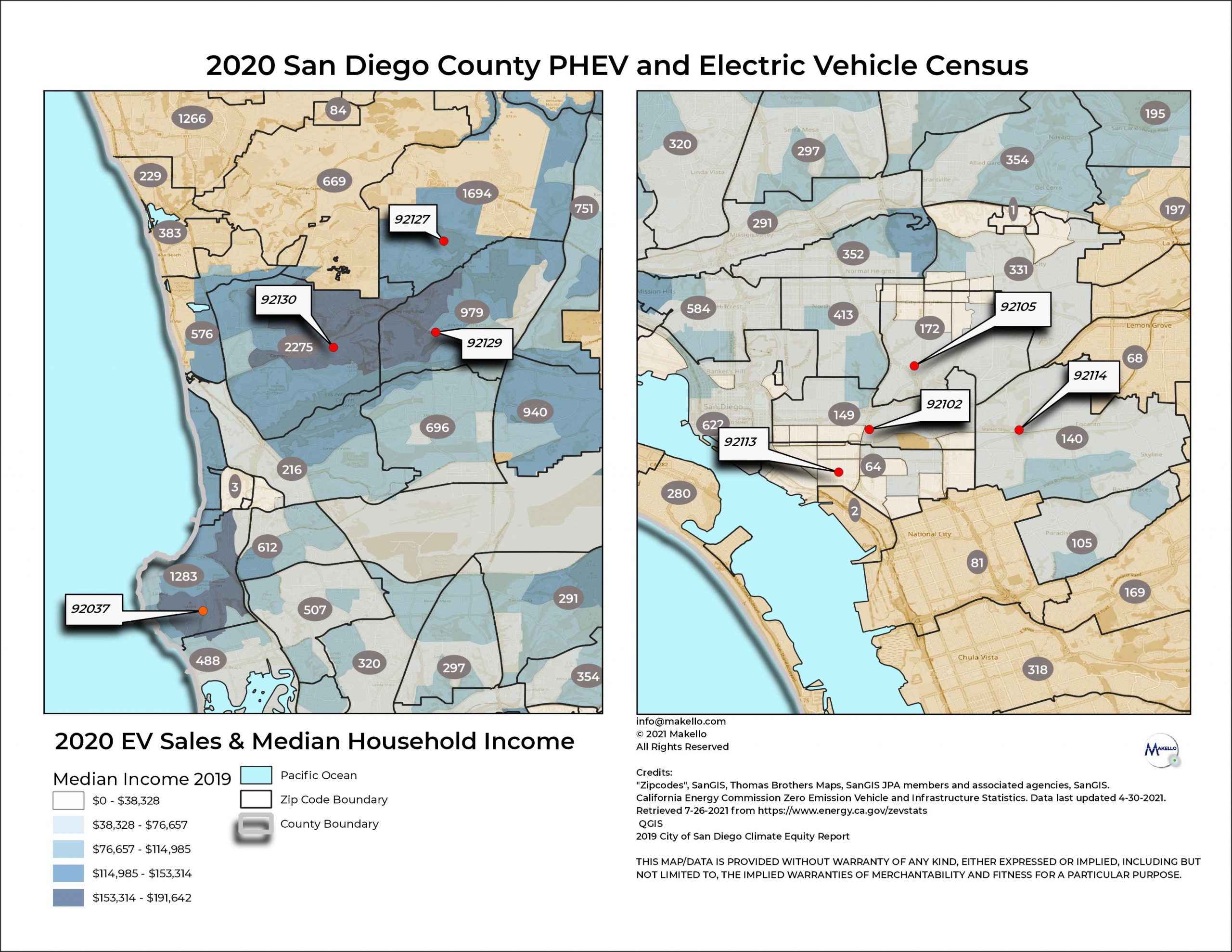
These two maps show a closer view of the median household income and the number of new battery electric vehicle (BEV, EV) sales in 2020. Click on map to view larger in another window.


As you can see from the map, the highest EV sales are in and around the neighborhoods with the top range for median income. The top three EV purchasers in San Diego County are living in 92130, 92129 and 92037 respectively. Surprisingly, and more interestingly, the zip codes we chose to look at that are in areas identified as having less access to equity in San Diego show residents in these areas are purchasing electric vehicles in fair quantities.

The other 3 zip codes near 92113 have double the EV sales with 92114 residents purchasing 140 EV, 92102 residents purchasing 149 EV and 92105 residents purchasing 172 EV. The median income for the nearby residents are overall in the next higher income bracket. This shows that as vehicles become available that are priced attractively to the residents in these neighborhoods, they will make the purchase. There is an interest in greener options and a willingness to adopt technology at the right price point and feature package.  

What about Plug-in Hybrid Electric Vehicle (PHEV) Sales? Makello mapped 2020 PHEV sales using the same procedure for 2020 EV Sales.

These two maps show a closer view of the median household income and the number of new plug-in electric hybrid vehicle (PHEV) sales in 2020.

The map indicates PHEV purchases are more level across the City but there is one very unexpected find. PHEV sales are half as many as the EV sales in the 92113 zip code. Plug-in Hybrid Electric Vehicles are generally considered to be the more affordable option but they do not seem to be as enticing as the full battery electric vehicles for the residents in the 92113 zip code. This is contrary to conventional wisdom especially considering 2020 was a Pandemic Year and large numbers of the population were facing additional income stressors.


The final question is how are the public charging stations distributed and how does the distribution compare to the vehicle purchases? Are communities under served? Makello created a map of the public charging stations using data downloaded from the US Dept. of Energy Fuel Stations locator map https://afdc.energy.gov/stations/#/find/nearest. Station data is imported daily directly from the networks of Blink, ChargePoint, Electrify America, EVgo, FLO, Greenlots, OpConnect, SemaConnect, and Webasto into the Station Locator.

Red markers showing the distribution of public electric vehicle charging stations and the zip codes chosen for comparison. Click on map to view larger in another window.

Generally, it is common for someone to think public charging stations are installed where people who purchase EV and PHEV vehicles live but this is not always the case. Types of housing such as single family housing or multi-family housing, housing density, commercial properties with retail and office space, and property owner interest are all additional factors that impact where public charging stations are installed. The Makello map shows there are several of the zip codes we chose to examine that do not have good access to public charging stations. It was surprising that there are gaps in access to public charging in the more affluent zip codes we examined. Below is a chart summarizing the statistics of the eight zip codes we examined.

Zip CodeMedian Income RangeEV- 2020 SalesPHEV- 2020 SalesPublic Chargers
92102$0- $114,9851491120
92105$0- $76,6571722121
92037$76,657- $191,642128350626
92113$0- $76,65764363
92114$38,328- $114,9851401191
92127$76,657- $153,31416945786
92129$38,328- $191,6429795331
92130$38,328- $191,642227580823
Table containing the zip code, information for each zip code including medium household income range, 2020 EV and PHEV new vehicle sales and public charging stations.

As you can see from the table, the residents in only one zip code we examined showed a preference for plug-in hybrid electric vehicle. Residents in all other zip codes preferred the battery electric vehicles. It is obvious from the chart that there are very few public chargers available compared to the number of vehicles in the zip codes. Presumably, the residents in these zip codes would like to be able to use a charger while they run errands around their neighborhood and have difficulty with the current number of available public charging stations.

Public Electric Charging Station distribution in San Diego County indicated by the red markers. Heat map showing the concentration of the public electric charging stations in San Diego County. Lighter colors in the heat map equal higher density of public electric charging stations. Click on map to view larger in another window.

The final map above that Makello created is a heat map to highlight the distribution of public charging stations county wide. All of the charging stations are located in the western part of the county in the urban areas. There aren’t any charging stations listed in the data we downloaded in remote fueling stations or recreation areas.

The map of the charging station locations shows the stations tend to be clumped in proximity to other charging stations. This may be due to one commercial property owner sees neighbors installing charging stations then they decide to install. The most concentrated collection of public charging stations are located in downtown San Diego and around UC San Diego. Clearly, there are many areas of San Diego County that do not have access to public charging in their neighborhoods.

The maps Makello created show there are gaps in access to public vehicle charging stations. That lack of access may present many residents with obstacles to adoption of sustainable technology but the lack of access to public charging stations is not stopping all residents from purchasing battery electric and plug-in hybrid electric vehicles. This indicates an interest in the technology and when the opportunity presents itself to purchase EV or PHEV vheicles, many residents are making the decision to make that purchase.

Commercial property owners should use data when making the decision whether or not to install a charging station on their property rather than rely on perceptions because as we have shown, perceptions that residents in one area or another are not purchasing EV and PHEV may run counter to “common sense”.

Joyrider Changes Everything (2021)

Electric vehicle. Ride and drive Liberty Station
3.96 minutes Sci-Fi 1/25/2021 (USA)
Electric Vehicle EV Grin Joyrider
Joyrider EV Grin drive electric now
Get your own EV Grin. Joyrider

Synopsis: An EV “Ride N Drive” event takes a supernatural detour, when riders temporarily, uncontrollably and inexplicably become “Energy Zombies”, smitten by the overpowering experience of driving electric for the 1st time, with instant torque, no noise and zero emissions.

Click to watch Joyrider “Fozzy’s Makello Story”. Do you think Joyrider should be a series? Leave a comment in YouTube, Like, and Share!

Director: Patrick Canler.

Writers: Charlie Johnson, Agustin Mata.

Editors: Patrick Canler, Christina Morales Hemenway.

Actors: William May-Kidd: Charlie Johnson; Ping “Tek” Han: Songxuan Liu; Flint “Fozzy” Bjorn: Jarod Donahue.

Mythology

In 1916, Camille Jenatzy, a race car driver known for his red beard as “the Red Devil”, reportedly contacted an unknown driver-mechanic named Otto Stiggler by Telegraph. The message requested for Otto to take his place for hire, in the first race to the top of “Pike’s Peak” Colorado Springs, Colorado, driving a “La Jamais Contente”, the first Electric Vehicle to break the 100km/hr speed record, modified to improve driver position aerodynamics.

first electric vehicle jamais contente
Illustration of the original “La Jamais Contente”, first automobile and Electric Vehicle to reach 100 km/h, in 1899.
Electric Vehicle Jamais Contente
Photo of Camille Jenatzy and his wife riding in the “La Jamais Contente”

While the vehicle was “in transit from Belgium”, Otto was instructed to practice often at Pike’s Peak, to learn the dirt race course’s hairpin turns, dips and ruts, while using his preferred selection of many gas powered vehicles of the day.

”La Jamais Contente” arrived 2 days before the 1st Pike’s Peak Race, and was transported by carrier truck directly to the starting line to preserve battery charge for the course. By the time the prototype vehicle was unpacked, the 1916 Pike’s Peak course access was about to close.

Pikes Peak Colorado Springs
The condition of this 1943 road is a significant improvement to the early Pikes Peak races.

Otto managed to convince a departing race attendant, Ali Madohan, to allow him to drive the course. Ali gave Otto a signal flare to use when he reached the finish line at the top of Pike’s Peak, or in case of emergency.

According to Ali, with help from a Good Samaritan, Otto struggled to squeeze his lower body into the recessed cockpit. The shape of the cockpit required the upper body to be reclined in an almost supine position, below a nearly fully enclosed canopy that reporters described as “a metal coffin with a “cupola” shaped protrusion for the driver’s head”.

After pushing the vehicle to the starting line, Ali received a “ready sign” hand signal through the “cupola” opening slit, and the attendant waved the starting flag.

“La Jamais Contente” leapt from the Start Line quickly and silently, but within seconds, according to Ali’s statement, “there was a simultaneous flash of light and a crack of thunder,” which reportedly knocked several birds to the ground, temporarily stunned, and sent Ali ducking for cover with his hands over his ears.

This mysterious nearby object was found to transmit wireless power.
Tesla wireless power transmission
These three lights in a nearby field are pictured receiving wireless power.

Ali was quoted as saying, “I heard a mixture of barking and laughing. The barking seemed to come from the trees above and below both sides of the road. The laughing sounded like it came from inside a big metal drum, and it reverberated off the canyon rock walls, until the car disappeared into the hills beyond the 3rd turn.” Any objective observer would have assumed Otto was howling with laughter.

Upon witnessing a flare that originated from the finish line area, Ali recorded an unofficial pre-trial time of 20:45.90.

Otto and “La Jamais Contente” did not return to the Start Line to qualify for the 1916 Pike’s Peak race. The first Penrose Trophy was awarded to Rea Lentz with an official record time of 20:55.60, driving an internal combustion engine vehicle.

After several days missing, and at the request of Otto’s family, local officials formed a search party. The carrier truck was reportedly found near the former site of the Tesla Experimental Station, which was a wireless power transmission test facility.

Nikola Tesla Colorado Springs Pike Peak
Nikola Tesla sitting under his transmitter in his Colorado Springs lab surrounded by millions of volts.
Nikola Tesla Colorado Springs lab
Nikola Tesla created an experimental station outside of Colorado Springs to test wireless transmission of electric power.

A printed telegram transmission from Jenatzy was located in the truck and detectives contacted authorities in Belgium for more information. The truck was found to have been purchased anonymously at auction from the lot of decommissioned assets originating from Tesla’s Experimental Station.

Colorado detectives learned that the unidentified carrier truck who called himself “Dino” had fled the area. A rambling note in the vehicle, alleged that Otto was not the race driver of the modified “La Jamais Contente”, and that a man who identified himself as ‘Camille’ was seen near Otto before the race, assisting with preparations.

The family of Camille Jenatzy was interviewed and they reported to authorities in a sworn statement, that Camille Jenatzy died in 1913, and that the original “La Jamais Contente”, was in Belgium, and that no one had contacted them from the United States about shipping Camille’s prize winning, record setting electric race car.

The vehicle was never recovered and the circumstances surrounding Otto’s disappearance remains a mystery, as to who was the driver, Otto, “Dino”, “Ali”, “Camille”, or as some believed, Camille’s ghost, or possibly Nikola Tesla himself.

What some attribute to folk lore, others say is conspiracy, yet others say is fact. But is it possible that wireless power was part of “La Jamais Contente” unofficial Pike’s Peak record? Tesla had recently designed, tested and de-commissioned the preliminary version of the “Wardenclyffe Tower” nearby in Colorado Springs. Tesla’s invention later proved capable of transmitting power wirelessly through the atmosphere, via a propagating wave through the Earth’s mantle, as he claimed, to any location around the world.

Wardenclyffe Tower Nikola Tesla New York wireless power
Nikola Tesla designed and built the Wardenclyffe Tower in Long Beach, New York between 1901 and 1902 to experiment with wireless power transmission. Click on the photo to learn more.

About The Creators

Joyrider is a fictional story loosely based on actual events, for the purpose of entertainment, sharing and exploring the concept of the “EV Grin”, which is the infectious joy and smile that instantly takes over a person when they first experience driving electric.

Makello is a diverse team with backgrounds in software engineering, environmental science, management, GIS, and home and business energy services. We are committed to help reduce greenhouse gas pollution and work with non-profit and community organizations to help educate the public about Solar Panels, Plug-In Vehicles, & Energy Storage benefits. If you are interested in any of these technologies in your home, contact us for a FREE Energy Savings Estimate! With rebates and incentives they can be cheaper than you may think!

Click on the videos below to learn more.

solar power, energy storage, electric vehicles
Welcome to Makello!
battery backup power 2020
Get On The Road To Energy Independence!
utility black out battery back up power
Where Will You Be In The Next Blackout?