Makello and Green Energy EPC’s current customer referral leader has 15 referrals.
Referral bonuses can reduce the time to pay back by several years!
Just about everyone knows someone that is considering energy upgrades, appliance changes or plug-in vehicles, to save money on energy bills, be prepared for emergencies, and reduce their GHG emissions.
Other solar companies, especially leasing companies, offer bigger referral fees by raising prices, or by cutting corners on the balance of the system and going super fast on the installation, which can cause serious waterproofing and electrical problems later.
We are different. Makello provides an Ethical Energy Savings Report and proposes ways to use no-cost and low-cost alternative behavior change and energy efficiency, to reduce the size of the solar and battery system, and avoid electric panel upgrades, saving $1,000’s per installation. Green Energy EPC only uses the highest quality materials and workmanship, so you can trust we take the time to do the job right.
2X your $$$ in ’22!
From now through April 30th, 2022, when you recommend Makello to your trusted contact AND you Follow/Like/Share/Comment on our Social Media channels, we will double your referral payment so that you will get 2X the regular referral bonus after the Green Energy EPC installation is completed.
$400 x 2 = $800 for Commercial Solar Panel or Energy Storage.
$200 x 2 = $400 for Residential Solar Panel or Energy Storage.
$50 x 2 = $100 for Ultra-Efficient Appliance(s) or EV Charging.
Makello and Green Energy EPC’s referral offer, from now through April, is available due to a match from a generous supporter of clean-air technologies, quality workmanship, and equity.
So with Makello.com and Green Energy EPC, you can feel safe and comfortable recommending your friends, neighbors, and coworkers to speak with us about Solar Power, Plug-In Vehicles, Advanced Energy Storage, and Ultra-Efficient Appliances.
For twice the bonus, refer and friend AND
Follow/Like/Share/Comment on any of our Social Media channels below
Makello is an authorized distributor for Green Energy EPC by Makello, Inc. (CA C-10: #1110498)
Market prices are rising fast for Natural Gas, because of international and domestic natural gas supply shortages, and because damaged infrastructure is not fully operational.
Natural Gas prices doubled in 2021. Could Natural Gas prices double again in 2022? Prices spiked during the 2008 Financial Crisis. Currently, there are multiple financial crises, on-going. (Price on the left axis is in USD per MMBtu.)
Makello recommends to take the following steps, for Optimal Cost Savings, lowest GHG emissions and Energy Independence:
Solar Power + Energy Storage + Plug-In Vehicle + Replace Natural Gas Appliances
Q: What makes solar power and energy storage payback even faster? A: Plug-In Vehicles and Energy Efficient Appliances, charged from solar or from a battery.
Learn more about 400% – 700% Efficient Heat Pump Water Heater, Heat Pump Dryer and Heat Pump Air-Conditioner / Heater appliances for your home.
Makello’s Energy Analysis uncovers ways to save money in avoided utility electric cost, and avoided solar power and battery costs. Ultra efficient appliances that replace natural gas appliances, can clean up the Interior Air Quality and reduce risk in the home.
Ultra-efficient appliances, timers and controls, payback fast with savings in supplies and avoided solar, battery and electric panel integration costs. Do you really have the time to research everything yourself? Let Makello do the homework for you!
1) Find out how Makello can help you. 2) Discuss your energy needs. 3) FREE Energy Savings Estimate.
■ Outsmart the utility, by replacing natural gas appliances! □ Avoid non-bypassable charges, taxes, fees and Minimum Bill penalties that would normally occur for months of overproduction. □ Get a larger utility baseline allowance discount for electric Heat Pump Water Heating. • Add and store Thermal Energy when utility rates are lowest and when solar production is in excess of loads. • Cool / Dehumidify interior room(s). • If adding more solar for HPWH, then during a utility blackout, with a battery there is extended autonomy. □ Gain usable conditioned space in the home, currently valued at $700-$2,000/sq ft in San Diego, when replacing a gas furnace and removing ductwork, in exchange for a heat pump air-conditioner/heater. □ Reduce air pollutants and carcinogens, indoors and around the house. □ Reduce fire risk.
Welcome to Makello!
Money from Heaven
Get a heat pump water heater from Makello, today!
Once you have installed solar power and have a Net Energy Metering agreement with the utility, you may soon discover that it is advantageous to schedule loads during peak sun hours. This is because the utility charges a “loan fee” for each kWh of power used from the utility that is later replaced with solar power. Utility Cost Savings is highest when consuming solar power as it is produced or storing it in a battery for consumption during peak utility rates, rather than sending it back to the utility for credit.
50 Gal Rheem Professional Prestige ProTerra Hybrid Electric Water Heater PROUH50-T2-RU375-15 (15A) OR PROUH50-T2-RU375-30 (30A).
On December 31, 2021*, or as soon as the SDG&E Rebate program funds are exhausted, the $500 Rebate for 50 gallon Heat Pump Water Heaters expires. Makello has a wholesale supplier with access to reserve your Heat Pump Water Heater and claim your instant rebate. Your Heat Pump Water Heater will be shipped to you in as soon as 1-2 months and may be eligible for a $300 Federal Tax Credit.
$2,000 to reserve before December 31, 2021 at 12PM. (Don’t wait until the last minute! Most suppliers are sold out until 2022!)
*Makello, as an authorized distributor for Green Energy EPC (CA Lic #978836), cannot guarantee SDGE Rebate acceptance, funds availability, and rebate amount. Only the authorized SDGE Rebate Program Administrator can approve the application; program restrictions apply. We are not tax experts.
Makello Helps You Save Even More, With Energy Efficient Appliances
Makello can help you: 1 – Replace inefficient appliances to reduce the size and cost of a solar and battery system. 2 – Qualify for rebates, incentives, discount utility rates and a new larger baseline allowance. 3 – Determine if electric panel and site qualifies for energy upgrades. 4 – Make the emergency backup power last longer. 5 – Increase the value of the property and improve the quality of life.
*Prior blog posting reported that the SDGE Rebate ended on September 30, 2021, as quoted from SDG&E flyer where there was “an error” in the March 8 version downloaded from SDG&E website.
NeoVolta’s AC and DC coupled solutions work with existing residential solar systems. NeoVolta (San Diego, CA) has lithium iron phosphate (LiFePO4) chemistry ‘safer by design’. https://www.pv-magazine.com/2021/09/23/residential-battery-inverter-from-the-united-states
New Self-Generation Incentive Program (SGIP) Rebate application for Step 7 – Small Residential Energy Storage funding, becomes available starting Monday, Sept 27, 2021, at a rebate value of $0.15/wH.
Caller: “Quick question. I already have solar, so which Battery is right for me? I need an answer ASAP, because SGIP Rebates are back and who knows for how long.” Response: “If you already have a solar, then NeoVolta battery can work with just about any existing system, and is lowest cost to integrate as an AC Coupled solution, for up to 9.2kW solar. There are exceptions to the rule, if the existing solar is landing on a Renewable Meter Adapter (RMA), but we have custom solutions in that case. And, the NeoVolta battery can be DC coupled to solar as well, up to 8.448kW DC, using Tigo TS4-A-O Power Optimizers.
Californian’s reaped over $1B in SGIP Rebates. Don’t miss out! It is possible to qualify for up to 100% incentives for your solar battery in the Equity Resiliency $1/wH category and up to 85% in the Equity $0.85/wH category.
$1,000 to Reserve Solar Battery & SGIP Rebate Preparation by Makello (Don’t wait until the SGIP Rebate is gone!)
*Makello, as an authorized distributor for Green Energy EPC (CA Lic 978836), cannot guarantee SGIP acceptance, funds availability, and rebate amount. Only the Center for Sustainable Energy (CSE), the SGIP program administrator, can approve the Rebate Reservation Form application. When the CSE accepts our application on your behalf, you’ll be approved – and you’ll have up to 12 months to decide when to install, or request an extension..
A $1,000 refundable fee reserves your Solar Battery and SGIP Rebate Preparation, which includes the required site survey, Energy Analysis and purchase contract to sign, prior to the SGIP Rebate Reservation Form (RRF) submission. (The refundable fee terms are in the “Addendum-to-the-Green-Energy-EPC-contract-1” reference section below.)
Enphase’s AC Coupled solutions are eligible for SGIP Rebates. The Encharge’s lithium iron phosphate (LiFePO4) chemistry is safer by design and is 2021 EES Award Winner! https://enphase.com/blog/encharger-battery-wins-2021-ees-award
The SGIP Program may become wait-listed, it may be funded again, and it may run out of funds at any time, so it is critical to proceed quickly to process your SGIP Rebate.*
Makello Helps You Save Even More, With Energy Storage Solutions
Makello will help you: 1 – Qualify for rebates, incentives and discount utility rates. 2 – Suggest Energy Efficiency measures, to right-size of the solar and battery system. 3 – Determine if an existing electric panel can qualify for solar and battery. 4 – Provide an Ethical Energy Savings Report. 5 – Provide a purchase and installation contract for a solar and battery system to meet your goals and the site conditions.
LG Chem’s DC Coupled solutions are eligible for SGIP Rebates. LG Chem is one of the world’s top battery suppliers since 2016, with RESU Lithium-Ion batteries.
Makello offers NeoVolta, Enphase and LG Chem Advanced Energy Storage for residential solar and battery installations in our SDG&E territory for 2021 Reservations. (We are experienced with Outback and Sonnen battery systems as well.)
Reference:
Green Energy EPC and State of California Required Documents:
Enphase Documents: (For an existing Enphase microinverter solar panel system; M215, M250, S280, IQ7X, IQ8X). Note: S280 must be replaced with IQ8X inverters at extra cost $250/solar module installed. Note: M215 and M250 existing Enphase microinverters adds $900 to Gross Cost.
We hoped KPBS would help us to inform the public in a timely manner about the difficulty of navigating the PPP program especially for minority owned and small businesses. Due to other media demands, KPBS was not able to publish this at an earlier date.
After many hours of work in reaching out to SBA banks, agents, and bank VIPs, Makello was able to secure grant funds. These funds are allowing us to reach out to underserved communities with an Energy Upgrades Lifeline, that will provide solar power, plug-in vehicles, and storage solutions for eligible customers, to improve cash flow.
We know other business owners were shut out of PPP loans. We want them to know there are other funding options available such as Energy Upgrades LIFELINEs for businesses.
Includes up to 5 hours of research, modeling and processing of applications for Grants, Rebates, Tax Credits, Discounts, Promotions and Subsidies, for San Diego businesses.
For Makello’s customers, the journey may begin with solar power, however, “The Road to Energy Independence” can include plug-in vehicles and energy storage.
Includes up to 5 hours of research, modeling and processing of applications for Grants, Rebates, Tax Credits, Discounts, Promotions and Subsidies, for San Diego businesses.
Welcome to Makello
Energy Upgrades LIFELINE- Hurry Before It’s Too Late!
Did you know that, whether or not you have an existing solar energy system, you can tap into a combination of up-front incentives, financing, to build up your savings into a 6-Month Emergency Fund and lower monthly costs?
Once-considered luxury items, such as Solar Power, Plug-In Vehicles, and Energy Storage, now payback quickly for cash purchases and are within reach for most homeowners, due to up-front incentives and lower total monthly costs from loan or Property Assessed Clean Energy financing.
Makello can provide you with a FREE Energy Savings Estimate! If you share your utility data with us we can create a solar energy system that is specific to your needs. We will NOT share your data.
Our model can also show the cost saving benefits of a Plug-In Vehicle or Energy Storage system, or both, in addition to your solar system. All of our team works to get you the most comprehensive, thorough Energy Analysis in the San Diego area as quickly as possible.
The software engineers are constantly updating our computer model to reflect the most current utility rates and product costs. We have a dedicated GIS analyst who can qualify you for as many rebates and incentives possible. Our Energy Efficiency experts can also provide other solutions to reduce energy costs such as appliance changes or switching utility rates. Press one of the buttons to see how much you can save!
Synopsis: An EV “Ride N Drive” event takes a supernatural detour, when riders temporarily, uncontrollably and inexplicably become “Energy Zombies”, smitten by the overpowering experience of driving electric for the 1st time, with instant torque, no noise and zero emissions.
Click to watch Joyrider “Fozzy’s Makello Story”. Do you think Joyrider should be a series? Leave a comment in YouTube, Like, and Share!
Actors: William May-Kidd: Charlie Johnson; Ping “Tek” Han: Songxuan Liu; Flint “Fozzy” Bjorn: Jarod Donahue.
Mythology
In 1916, Camille Jenatzy, a race car driver known for his red beard as “the Red Devil”, reportedly contacted an unknown driver-mechanic named Otto Stiggler by Telegraph. The message requested for Otto to take his place for hire, in the first race to the top of “Pike’s Peak” Colorado Springs, Colorado, driving a “La Jamais Contente”, the first Electric Vehicle to break the 100km/hr speed record, modified to improve driver position aerodynamics.
Illustration of the original “La Jamais Contente”, first automobile and Electric Vehicle to reach 100 km/h, in 1899.
Photo of Camille Jenatzy and his wife riding in the “La Jamais Contente”
While the vehicle was “in transit from Belgium”, Otto was instructed to practice often at Pike’s Peak, to learn the dirt race course’s hairpin turns, dips and ruts, while using his preferred selection of many gas powered vehicles of the day.
”La Jamais Contente” arrived 2 days before the 1st Pike’s Peak Race, and was transported by carrier truck directly to the starting line to preserve battery charge for the course. By the time the prototype vehicle was unpacked, the 1916 Pike’s Peak course access was about to close.
The condition of this 1943 road is a significant improvement to the early Pikes Peak races.
Otto managed to convince a departing race attendant, Ali Madohan, to allow him to drive the course. Ali gave Otto a signal flare to use when he reached the finish line at the top of Pike’s Peak, or in case of emergency.
According to Ali, with help from a Good Samaritan, Otto struggled to squeeze his lower body into the recessed cockpit. The shape of the cockpit required the upper body to be reclined in an almost supine position, below a nearly fully enclosed canopy that reporters described as “a metal coffin with a “cupola” shaped protrusion for the driver’s head”.
After pushing the vehicle to the starting line, Ali received a “ready sign” hand signal through the “cupola” opening slit, and the attendant waved the starting flag.
“La Jamais Contente” leapt from the Start Line quickly and silently, but within seconds, according to Ali’s statement, “there was a simultaneous flash of light and a crack of thunder,” which reportedly knocked several birds to the ground, temporarily stunned, and sent Ali ducking for cover with his hands over his ears.
This mysterious nearby object was found to transmit wireless power.
These three lights in a nearby field are pictured receiving wireless power.
Ali was quoted as saying, “I heard a mixture of barking and laughing. The barking seemed to come from the trees above and below both sides of the road. The laughing sounded like it came from inside a big metal drum, and it reverberated off the canyon rock walls, until the car disappeared into the hills beyond the 3rd turn.” Any objective observer would have assumed Otto was howling with laughter.
Upon witnessing a flare that originated from the finish line area, Ali recorded an unofficial pre-trial time of 20:45.90.
Otto and “La Jamais Contente” did not return to the Start Line to qualify for the 1916 Pike’s Peak race. The first Penrose Trophy was awarded to Rea Lentz with an official record time of 20:55.60, driving an internal combustion engine vehicle.
After several days missing, and at the request of Otto’s family, local officials formed a search party. The carrier truck was reportedly found near the former site of the Tesla Experimental Station, which was a wireless power transmission test facility.
Nikola Tesla sitting under his transmitter in his Colorado Springs lab surrounded by millions of volts.
Nikola Tesla created an experimental station outside of Colorado Springs to test wireless transmission of electric power.
A printed telegram transmission from Jenatzy was located in the truck and detectives contacted authorities in Belgium for more information. The truck was found to have been purchased anonymously at auction from the lot of decommissioned assets originating from Tesla’s Experimental Station.
Colorado detectives learned that the unidentified carrier truck who called himself “Dino” had fled the area. A rambling note in the vehicle, alleged that Otto was not the race driver of the modified “La Jamais Contente”, and that a man who identified himself as ‘Camille’ was seen near Otto before the race, assisting with preparations.
The family of Camille Jenatzy was interviewed and they reported to authorities in a sworn statement, that Camille Jenatzy died in 1913, and that the original “La Jamais Contente”, was in Belgium, and that no one had contacted them from the United States about shipping Camille’s prize winning, record setting electric race car.
The vehicle was never recovered and the circumstances surrounding Otto’s disappearance remains a mystery, as to who was the driver, Otto, “Dino”, “Ali”, “Camille”, or as some believed, Camille’s ghost, or possibly Nikola Tesla himself.
What some attribute to folk lore, others say is conspiracy, yet others say is fact. But is it possible that wireless power was part of “La Jamais Contente” unofficial Pike’s Peak record? Tesla had recently designed, tested and de-commissioned the preliminary version of the “Wardenclyffe Tower” nearby in Colorado Springs. Tesla’s invention later proved capable of transmitting power wirelessly through the atmosphere, via a propagating wave through the Earth’s mantle, as he claimed, to any location around the world.
Nikola Tesla designed and built the Wardenclyffe Tower in Long Beach, New York between 1901 and 1902 to experiment with wireless power transmission. Click on the photo to learn more.
About The Creators
Joyrider is a fictional story loosely based on actual events, for the purpose of entertainment, sharing and exploring the concept of the “EV Grin”, which is the infectious joy and smile that instantly takes over a person when they first experience driving electric.
Makello is a diverse team with backgrounds in software engineering, environmental science, management, GIS, and home and business energy services. We are committed to help reduce greenhouse gas pollution and work with non-profit and community organizations to help educate the public about Solar Panels, Plug-In Vehicles, & Energy Storage benefits. If you are interested in any of these technologies in your home, contact us for a FREE Energy Savings Estimate! With rebates and incentives they can be cheaper than you may think!
Pandemic stressing out the family finances? Turn your home and vehicle into a clean energy emergency fund!
Getting laid-off is stressful even in the best of times. In the midst of a pandemic, job loss and financial surprises can drain your savings account fast. Did you know that whether or not you have an existing solar energy system, you can tap into a combination of upgrade incentives and financing that can return money to you. A Solar, Plug-In Vehicle and Energy Storage lifeline!
Recently, a solar-powered homeowner asked Makello to quote adding a Level 2 electric car charger for their Nissan Leaf, an installation often priced at $500 or less. Most solar companies refuse to take these small jobs as they are unprofitable for the installer.
But at Makello, we look at things differently. We know from experience that with the dizzying array of Solar Power, Plug-In vehicle, and Energy Storage incentives and energy cost savings, energy upgrades can pay for themselves. When the homeowner shared that their rooftop solar was installed for free under a low-income residential solar program (SASH), and that they had been laid off due to the pandemic, we started crunching numbers to see what we could do.
We offered a plan to improve the homeowner’s cash flow and create a 6-month emergency reserve fund out of available incentives.
As you can see in the savings over time graph, the system is cash flow positive every year, meaning lower annual cost, through the term of the PACE financing, and then savings accelerates.
Incentive Finder – Makello’s own GIS mapping database uses the home’s geographic location to determine eligibility for a wide variety of energy upgrade grants, rebates, discounts and tax credits.
Optimize Upgrade – Makello’s own Energy Analysis software shows the optimal Solar, EV, and Energy Storage upgrade plan, for the eligible incentives. In California, benefits such as emergency backup power for home and vehicles, water pumps, air-conditioning, air-purifying and fire-fighting equipment can all be worked into the upgrade plan. In this case, Makello showed that a larger upgrade would tap into $23,448 in incentives, and give the homeowner more solar, energy storage, a second EV and Level 2 charger.
PACE program financing – The State of California offers a Property Assessed Clean Energy (PACE) financing plan. Homeowners can qualify based on a recent tax return or pay stubs. The financing does not appear on a credit report, is not considered a loan, does not trigger a property reassessment, and can transfer to the next home buyer.
Create a 6-month financial ‘lifeline’ – Makello’s “Lifeline” incentive payment program tracks the incentives and requirements, and allows the homeowner to choose the best time to draw on their earned incentives. In the example used here, a homeowner can decide after receiving the up front incentives to purchase a new or used Plug-In Vehicle, further reducing their monthly costs, or pay their most urgent bills, such as mortgage, food, and medical.
Makello’s GIS mapping database, uses county parcel location to help homeowners determine eligibility for a wide variety of solar programs. We also use mapping to help non-profit organizations to design programs in disadvantaged communities that promote solar energy and electric vehicle incentives for economic and environmental benefit.
Makello works with non profits and other agencies to create maps for Environmental Justice initiatives.
How the PACE Program works:
The PACE program is intended for those that can demonstrate the ability to pay. Homeowners provide a recent tax return or a pay stubs for income verification, and credit check, and Makello provides the Energy Analysis to show that the energy efficiency project will be cash flow positive.
Book a FREE 15 minute appointment to: 1) Find out how Makello can help you. 2) Discuss your energy needs. 3) Get a FREE Energy Savings Estimate.
PACE financing ranges from 5 to 30 years term for solar, 10 years for Energy Storage, and can be used for other energy efficiency improvements, such as electric panel upgrade, EV Charging, and a long list of energy efficiency upgrades. PACE can be as low as $0 down. It provides tax deductible interest.
For our homeowner in this example, Simple Payback is possible in 3.7 years through Annual Energy Cost Savings. That means it’s a good deal for a cash purchase or loan. For those on a fixed income, traditional loans might not be a viable option. In the cases where PACE financing is Cash Flow Positive, we can present the PACE option as an alternative to traditional loans and leases.
Makello provides full disclosure about PACE terms and program information, as well as programs offered through banks and credit unions. Please contact us and we’ll be happy to discuss the alternatives.
Extreme competition in the solar industry and falling prices has resulted in poor quality workmanship, electrical problems, roof leaks, gimmicks, and unethical behavior. Who can you trust to upgrade your most valuable asset, your home?
Book a FREE 15 minute appointment to: 1) Find out how Makello can help you. 2) Discuss your energy needs. 3) Get a FREE Energy Savings Estimate.
Makello aims to fix the broken solar industry with a full-disclosure report by an Ethical Energy Efficiency Expert, and documentation of the highest quality workmanship and components, to protect the budget and the home warranty.
Makello’s Mission is to tackle climate change by delivering clean energy solutions to improve social and environmental justice.
Why? Because Disadvantaged Communities, often located downstream and downwind of pollution, are extremely costly to rebuild after increasingly frequent weather disasters, and are impractical to relocate to escape sea level rise.
The Makello Team (left to right) Agustin, Ola, Linda, Charlie
Makello’s Vision is for you to join the Energy Ecosystem in a way that fits your life. We can help you use incentive programs to afford a Plug-In Vehicle and Solar Power to charge your car and your home, and we can help you create a back-up clean Energy Storage system for emergencies.
CEO and founder of Makello, Charlie Quux Johnson, receiving a North County Climate Change Alliance award at the NCCCA’s “EV Show Kicks Gas”
The choice is yours. Make your energy costs and emissions low with Makello, to get “On the Road to Energy Independence!”
Public access to EV Charging Stations is unevenly distributed. Makello’s mapping can show the inequity that may inhibit green technology adoption in some communities.
If you caIf you can’t find a conveniently located public EV Charger, then click on “Request A Public EV Charger” to suggest a location for future consideration, to be built with up to 100% Federal and State of California incentives.
Makello’s display at the entrance of the KRA San Diego Career Centers career fair. Credit: KRA
Skyline showcases are difficult to manage. At the September 18, 2019 “Job-I-Con” Hiring Event, held at the San Diego Library, 9th floor, the window walls stand 25’ tall, on 3 sides. The east wall and roof shade cast the entire room into heavy contrast between 10 AM and 12 PM.
Companies arriving early secure perimeter tables, leaving shaded tables close to the entrance unoccupied.
Book a FREE 15 minute appointment to: 1) Find out how Makello can help you. 2) Discuss your energy needs. 3) Get a FREE Energy Savings Estimate.
Makello understands what daily solar progression, heat gain, glare and backlighting issues from floor to ceiling windows can do to participation at a trade show. For greatest exposure to candidates before they break a sweat, sometimes a good location choice is near the entrance.
The aisles surrounding our table pass by Makello video displays, where “Why Makello?” and “What We Do” plays on repeat, next to our job postings. Engineers drawn to the videos of Solar Power, Plug-In Vehicles, and Energy Storage soon create noise and crowding in front of our table.
Makello reaches out into the aisle to welcome potential candidates as they pass the video introduction, to join us in a face to face conversation behind the table display.
If pictures are worth a thousand words, it makes sense why our visitors often arrive with a good understanding about our mission, our vision and our purpose. When job seekers are able to relate their goals and experiences to the company as a whole, it is possible to go beyond the currently open positions and find added value or new opportunities.
Despite her initial reservations about the match between a solar company and her interest in GIS Maps, Linda Boisvert stands out among the 60 visitors. Makello Research Assistant position adapts to a GIS mapping focus. An On-The-Job training program by San Diego Workforce Partnership makes it possible for Makello to invest in Linda’s skill development, using her Associates degree and lab work, to solve business technological challenges. Linda’s background in Anthropology and Drafting/CAD, along with 11 years of HOA Management experience, helps Makello discover new potential revenue streams.
Linda’s mapping accomplishments shine in Makello’s Service Areas and in blog articles, such as “African Americans Concentrated in Diverse Redlined San Diego”, which highlight issues of Environmental and Social Justice, Transportation, and Health. Makello receives recognition from several non-profit organizations for our educational webinars and board presentation of the map and analysis. We look forward to continuing to support community development programs and hospitals throughout San Diego with valuable interactive research maps.
Linda’s demographic and incentives maps uncovers an “Energy Upgrade LIFELINE” program for low income and medical care qualified residents, and for fire-threat communities. Thousands of San Diego homes and businesses can qualify for up to 100% incentives on Solar Power, Plug-In Vehicles, and Energy Storage. Affordable Energy Independence!
Metro Career Centers and the San Diego Workforce Partnership empowers the San Diego community by connecting jobs to qualified applicants. Makello encourages San Diego companies to get outside of the bubble and make valuable connections at workforce.org.
Recently, a solar powered homeowner inquired about adding a Level 2 charger for a 2013 Nissan Leaf, typically a $400 installation. Most solar companies would refuse the job due to low profit.
In Case of Emergency, An “Energy Upgrades Lifeline” Pays For Itself.
Makello rose to the challenge and used our Energy Analysis tool to present an “Energy Upgrades Lifeline” option that improves the homeowner’s cash flow and can provides a “6 Month Emergency Fund”.
Parcel level GIS mapping software made by Makello, is used to determine eligibility qualifications for a wide variety of energy upgrade grants, rebates, discounts, credits and deductions.
Makello works with non profits and other agencies to create maps for Environmental Justice initiatives.
The rooftop solar on the home was installed for free in 2012 by Grid Alternatives through the SASH program, for qualified low-income residential California homes. An Energy Upgrade Lifeline can work even if the property already has solar.
One of the homeowners was temporarily laid off due to the pandemic. An Energy Upgrade Lifeline can qualify for financing by the State of California based on prior year tax return.
Makello’s Ethical Energy & Cost Savings Analysis provides $23,448 Incentives upfront for adding more solar, energy storage, a 2nd EV and a Level 2 charger.
What makes the solution possible is a Property Assessed Clean Energy (PACE) financing method that does not appear on the credit report, is not a loan, does not trigger a property reassessment and can transfer to the next home buyer.
PACE financing ranges from 5 to 30 years term for solar, 10 years for energy storage, and can be used for other energy efficiency improvements. PACE can be as low as $0 down, it provides tax deductible interest, there are no pre-payment fees, and no credit minimum.
The PACE program is intended for use by those that can demonstrate the ability to pay. There are safeguards to protect against abuse, such as a soft pull credit check, income verification from a recent paycheck or tax return, and a requirement that the energy efficiency project is cash flow positive, as it is here:
Click to Enlarge
What makes the solution a “Lifeline” is that the incentives payments can be used as a reserve. In an emergency, the basic expenses such as mortgage payment, food, and medicine are met. The system is designed to be cash flow positive, meaning lower cost monthly and annually, than the baseline status quo.
Makello’s “Lifeline” Incentive Payment timing gives the homeowner flexibility to make decisions on what to do with the money and when to put the reserve to use. In this case, after 6 months, the homeowner can decide to use some or all of the Incentives to purchase a Plug-In Vehicle to further increase energy cost savings, or for another important use.
Simple Payback is possible in 3.7 years through Annual Energy Cost Savings. That means it’s a good deal for a cash purchase or loan. For those on a fixed income, traditional loans might not be a viable option. In the cases where PACE financing is Cash Flow Positive, we can present the PACE option as an alternative.
(Click to enlarge) As you can see in the savings over time graph, the system is cash flow positive every year through the 10 year PACE financing and then savings accelerates.
Book a FREE 15 minute appointment to: 1) Find out how Makello can help you. 2) Discuss your energy needs. 3) Get a FREE Energy Savings Estimate.
Makello’s Optimal Cost Savings Plan has other benefits for California in 2020, such as emergency backup power for home and vehicles, water pumps, air-conditioning, air-purifying and fire-fighting equipment.
Makello is ethical in our approach, offering full disclosure about PACE terms and program information, bank and credit union loan alternatives.
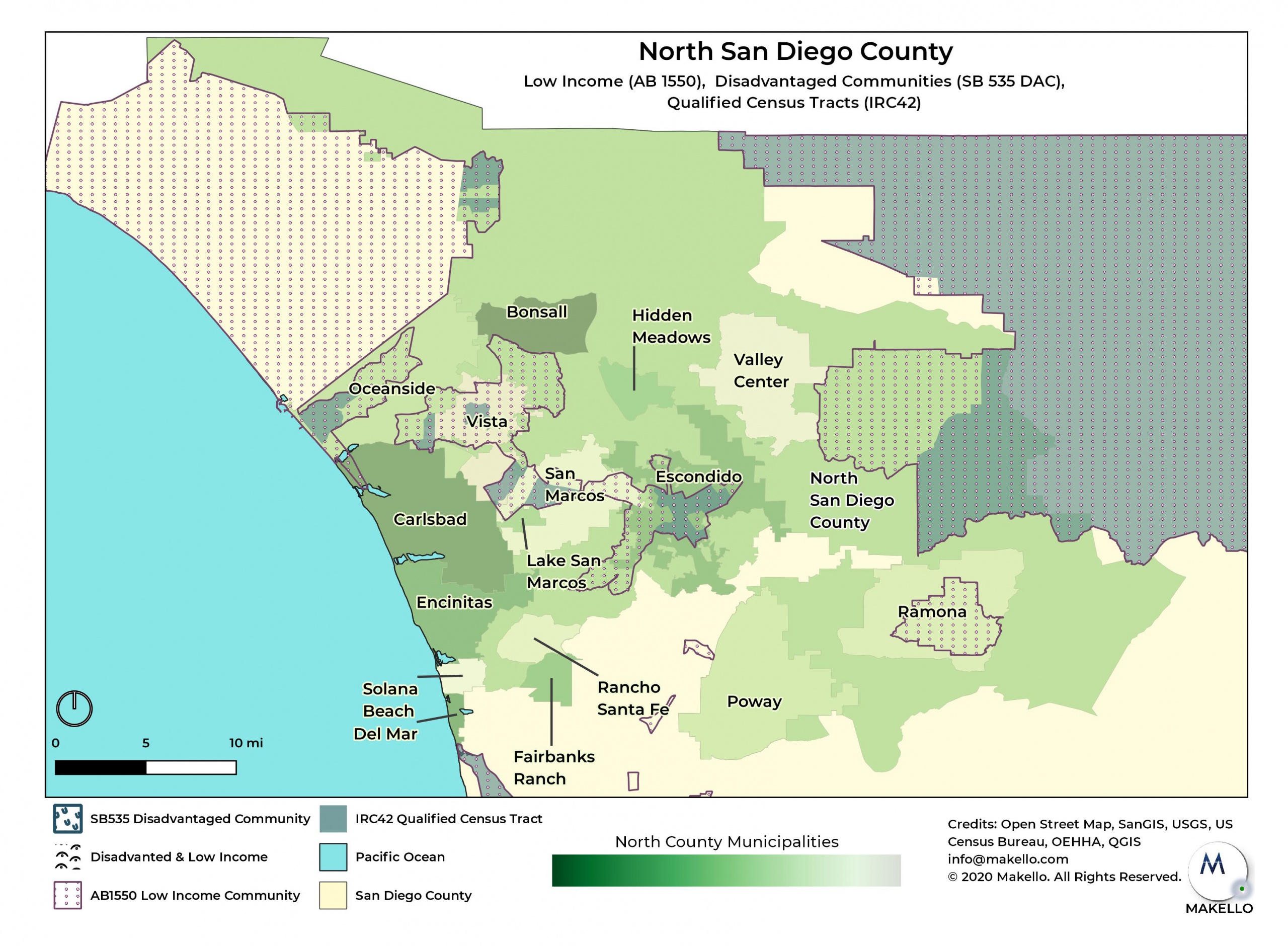
Maps are used for more than directions, and at Makello, we are creating maps to highlight communities within our Service Areas. We have a gallery of maps with community insights and tips regarding solar and electric vehicle adoption.
Makello maps can be used for a variety of reasons. The map above shows Public Electric Vehicle Charging Stations throughout San Diego County and outlines cities and CDPs (census-designated places) that make up East County San Diego. Individuals can use this map to locate where they could charge their electric vehicles. Non profits and other agencies can depict social inequity in regards to electric vehicle adoption, which could lead to funding. Many people may not realize how big San Diego County is! Can you think of anything else this and future maps might be used for?
Makello has maps to help prospective Plug-In Vehicle owners determine the current and future availability of public electric vehicle charging stations, in the areas where they work and live. Federal and State programs can provide up to 100% incentives for DC Fast Charging for San Diego, so we built a place where you can pin a location to “Request A Public EV Charger” installation. Our customers find this information very useful in the decision to adopt electric vehicle technology. After all, who wants to run out of battery while running errands or driving home after work?
Book an appointment to receive Makello’s Ethical Energy Savings Report, which is the result of a detailed trade-off study of discount utility rates, grants, rebates, tax credits, and equipment options, to determine the fastest payback and highest return on investment to meet your home, business and vehicle energy needs.
The fee for the Ethical Energy Savings Report is refundable (less the 3rd-Party $15 utility data access charge) or credited towards our installation services, after you attend the presentation meeting and complete a 5 minute survey after permission to operate.
Includes up to 5 hours research by the Makello team, and 1 hour Q&A, by Makello’s Ethical Energy Efficiency Expert.
Many of our clients are concerned about air quality in their community and want to take actions to make improvements where they can be made. In many communities, there are a variety of sources for diesel particulate matter such as trucks, farm and construction equipment, emergency generators, industrial equipment, or older model cars. Makello has utilized the CalEnviroscore data to show our clients where concentrations of particulate matter occur and help those customers adopt solar and battery energy storage for emergencies, reducing the need for diesel generators.
Click on maps and they will open in a new tab at larger resolution. The map shown here shows the diesel particulate matter in cities and CDPs in North County San Diego.
Vehicles with gasoline engines are a significant source of air pollution in urban areas, and although we have adopted high pollution control standards in California, vehicle pollution can still be an issue in many communities.
Vehicle pollution contains many toxic chemicals and plays a role in the formation of smog. There are many health concerns related to smog pollution, including asthma, heart disease, and lung disease; all are conditions that worsen the outcomes for COVID-19. Health risks increase with proximity to freeways and heavily trafficked roads, for fine particulate matter that can enter the bloodstream and lung tissues. Vehicle traffic can also be a source of excessive noise and vibrations, which contribute to stress and high blood pressure, or injuries to pedestrians.
At Makello we strive to accommodate all our customers needs and provide equal access to information for everyone. Our maps are color coded specifically to be able to be interpreted by those who are color blind as well. This map shows traffic density in cities and CDPs of South County San Diego.
Gasoline engines idling in traffic achieve lower miles per gallon and produce pollution. Traffic density represents the number of vehicles in an area producing pollution. Areas with high volumes of traffic have more pollution. Electric vehicles are a great way to reduce pollution on your daily commute or while you are out on the town.
Book a FREE 15 minute appointment to: 1) Find out how Makello can help you. 2) Discuss your energy needs. 3) Get a FREE Energy Savings Estimate.
Jet engines are another source of pollution. The aviation industry is working on electric airplanes and efficiency improvements for new designs. For now, residents in communities impacted by air overflight can take advantage of incentives to purchase new or used Plug-In Vehicles and install solar panels with energy storage batteries. The energy cost savings can be used for indoor air filtration and water purification, among other methods to improve health.
Our maps use a variety of symbols, outlines, colors, labels, etc. to easily depict information. Above, mini airplanes show the flight paths over the Chollas Creek Watershed. Residents under the flight paths are more prone to air and pollution related illnesses.
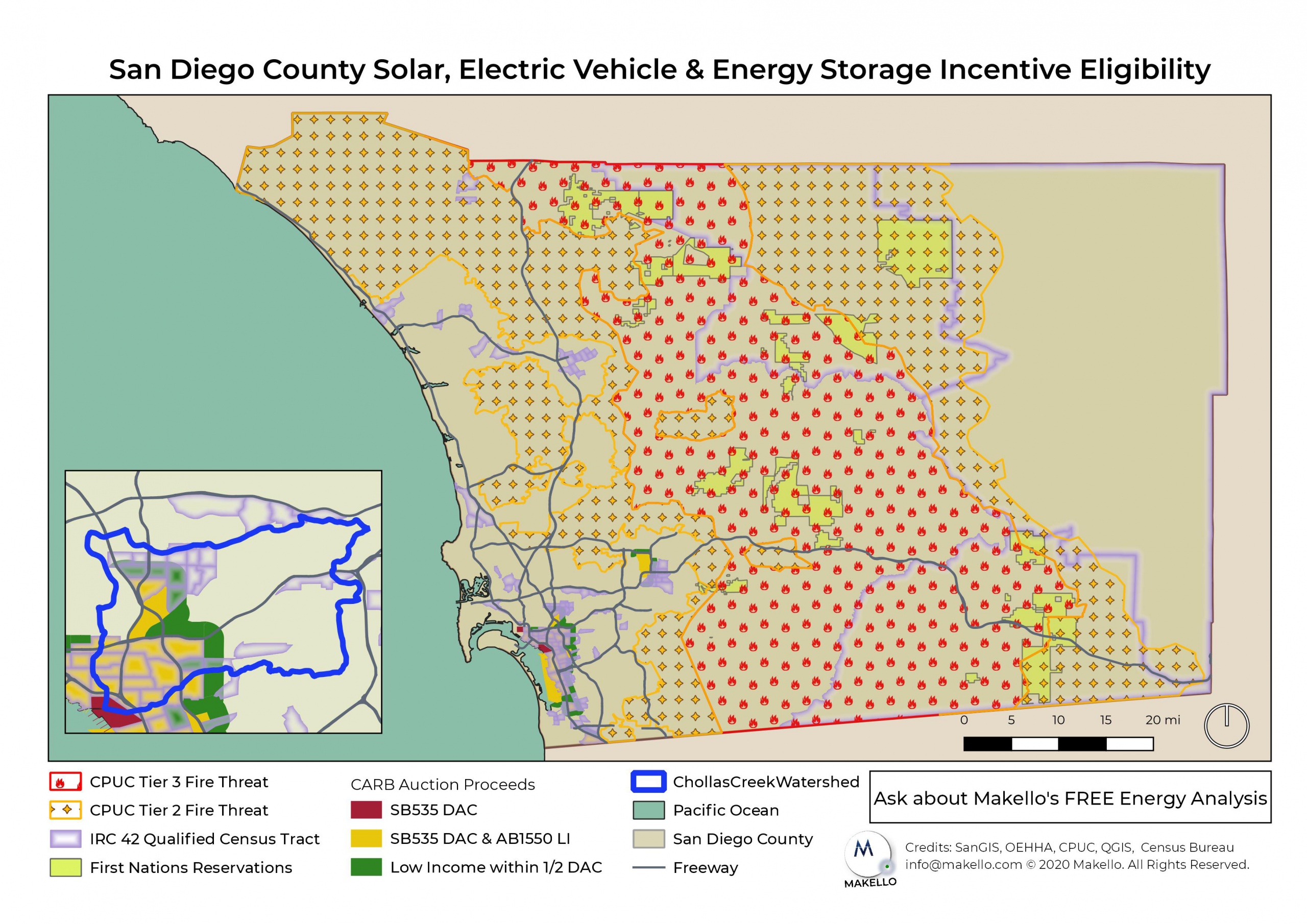
The rebate programs can be confusing, and finding all the correct data and maps to check for eligibility can be time consuming and prone to errors or misunderstandings. Makello researched the programs and data used to determine eligibility, then developed a program eligibility map for parcel level qualifications. We’ve eliminated several steps and are able to easily show a customer their property’s location in relation to the program criteria. Check out our Service Areas link and get a Free Energy Savings Estimate today.
Up to 100% SGIP Rebate and Tax Incentives qualifiers: Level 2 or 3 High Fire Threat District; Disadvantaged or Low Income Communities; electric well pump; SDG&E Public Safety Power Shut-off events.
Makello is developing GIS services and creating maps useful to the solar power, electric vehicle, and energy storage industries, as well as for our teaming companies, including several non-profit organizations. Maps are an important method for analyzing and presenting data.
We will examine redlining and clean-air technology access by the San Diego African American community in this blog. See the editor’s note below on how we will be using the Census Bureau term African American as defined by the Census Bureau: Race for Residents of African ancestry or birth including both US Citizens and non-US Citizens. For more info on data sources and terminology, references are provided at the end of this article.
Makello works with non profits and other agencies to create maps for Environmental Justice initiatives.
Editors Note: Click to view Makello’s commitment to finding words and methods to accurately represent data while conveying inclusion of the appropriate demographic.
Makello began using maps to analyze data and learn about our community in 2019. From time to time, we intend to share some of the maps we’ve developed but there are challenges to presenting the data accurately and transparently, especially with regards to designations for Race, Identity and Ethnicity.
The US Census counts all people living within the Boundaries of the United States and Territories. The data collected is by Race, not citizenship status. The Census data uses terminology that can easily be misunderstood because of common usage of terms vs. the Census Bureau definition. The Census Bureau meaning of the term is often lost as the data filters down to the public through agencies and businesses.
The Census Bureau uses the terms African American, Asian American, Native American, Hispanic, White and Other to define Race. Citizenship or immigration status is not counted. The loss of context of these words may prevent accurate and full understanding of data. People may feel invisible or may be unintentionally misled.
You may have noted a few potential difficulties in the short list of the terms presented. That is where the struggle lies when attempting to represent residents without being US-Centric or Ethno-centric. Acceptable terminology changes through time, is understood differently in separate regions and countries, by different cultures and ethnicities. Individuals infuse meaning in words based on their life experiences, making classifications difficult.
Maps may focus on a specific demographic for any number of reasons. It can be difficult to adequately portray diversity on the map with charts or graphs. Please refer to the two examples below.
Makello is committed to the difficult task of finding words and methods to accurately represent data while conveying inclusion of the appropriate demographic. We make great effort to research and vet language. Language and identities change. Unfortunately, there is no all encompassing, perfect language for describing people. What one person thinks is a great label and strongly identifies with, the next person may reject or find offensive. We accept open and honest feedback and hope you enjoy the information we present.
African Americans in San Diego are concentrated in southwestern San Diego County.
The first question to answer is where are the communities with 10% or more of the African American residents? A map of the demographic data from the CalEnviroscreen 3.0 is the simplest method of discovery. CalEnviroscreen obtained demographic data from the US Census Bureau and retained the US Census Bureau demographic descriptors in their report. Our map above shows the population is largely concentrated in the area to the east of Downtown San Diego which will be the area we focus on for the purpose of this blog.
Why is the population so heavily concentrated in this area? With a special thanks to University of Richmond’s Digital Scholarship Lab, a look at the 1930s New Deal Era Home Owners’ Loan Corporation Redline Maps may help to answer this question.
The Home Owners’ Loan Corporation (H.O.L.C.) was created during the Great Depression New Deal Era and the program trained many home appraisers in the 1930s. The H.O.L.C. created a neighborhood ranking system known today as redlining. Grades were assigned to residential neighborhoods by local real estate developers and appraisers in over 200 cities. These maps and neighborhood ratings set the rules for decades of real estate practices. The grades ranged from A to D.
The Green Area- Grade A = Best: Always upper-middle-class to upper class White neighborhoods defined as posing minimal risk for banks and other mortgage lenders, as they were “ethnically homogeneous” and had room to be further developed.
The Blue Area- Grade B= Still Desirable: Neighborhoods with all or mostly White, U.S. born residents were defined as sound investments for mortgage lenders.
The Yellow Area- Grade C =Declining: Residential neighborhoods with working class and/or first or second generation immigrants from Europe. The housing stock was typically older and often lacking the current utilities of the day.
The Red Area- Grade D= Hazardous: These neighborhoods were considered to be “infiltrated” with “undesirable populations” such as Jewish, Asian, Mexican, and Black families. The neighborhoods were more likely to be located near industrial areas and the housing stock consisted of older, less well maintained buildings.
Are you ready to save money on solar power, EV charging or Energy Storage? Get an instant quote from Makello!
These grades formed the basis for federally backed mortgages. Many banks refused to lend to areas with the lowest grade, making it impossible for people in these neighborhoods to become homeowners and preventing them from building generational wealth.
As you can see from the map, many of the areas that were labeled undesirable in the 1930s are still the areas where African Americans are concentrated. The practice of redlining has had a long term impact on segments of our community that has yet to be resolved.
1930s redlining still impacts African American communities 90 years later.
Makello is an advocate of green transportation options, providing FREE Energy Savings Estimate services including an analysis of potential electric vehicles to fit your needs, so it was only natural we take a look access to public charging stations African Americans have in the former redlined areas. The results were………….. well, see for yourself.
Less than 10 public electric vehicle charging stations are located within the African American communities.
The data from the US Dept. of Energy Alternative Fuels Data Center may be mapped and compared to the CalEnviroscreen Demographic Data. The neighborhoods with the highest concentrations of African American Residents do not have easy access to public electric vehicle charging stations. One consequence is this discourages San Diegans with electric vehicles living outside these communities from driving to businesses in these neighborhoods and spending money. The lack of access to public charging stations also discourages the residents of these neighborhoods from purchasing electric vehicles because they don’t have the ability to conveniently charge their vehicle. This is especially true for multi-unit dwellers where there are structural and parking challenges to overcome when installing EV charging stations. This creates additional barriers to EV ownership, keeping the community from reducing pollution, developing business opportunities, and creating jobs in their neighborhoods.
Book an appointment to receive Makello’s Ethical Energy Savings Report, which is the result of a detailed trade-off study of discount utility rates, grants, rebates, tax credits, and equipment options, to determine the fastest payback and highest return on investment to meet your home, business and vehicle energy needs.
The fee for the Ethical Energy Savings Report is refundable (less the 3rd-Party $15 utility data access charge) or credited towards our installation services, after you attend the presentation meeting and complete a 5 minute survey after permission to operate.
Includes up to 5 hours research by the Makello team, and 1 hour Q&A, by Makello’s Ethical Energy Efficiency Expert.
We’re shifting gears now and will be examining the energy cost burden in the City of San Diego. The energy cost burden data was obtained from the 2019 San Diego Climate Equity Report and overlaid the demographic data from the CalEnviroscreen 3.0. Generally speaking, the energy cost burden was calculated as a weighted average for each census tract and divided by the median household income for each census tract to obtain the energy cost burden score. For more detailed explanation of the energy cost burden, please visit the San Diego Climate Equity Report page.
The white outlined areas in the map posted below have the lowest energy cost as a percentage of Median Household Income and the dark green areas have the highest energy cost burden. Most of the African American San Diegans are in the minty green areas and have an energy cost burden of 1.3%- 2.7%. There is one area with 18-28% of the African American residents and a 4-5.4% energy cost burden.
This cost puts an additional financial strain on those residents with more modest incomes and often prevents the residents from using air conditioning or heaters in bad weather, increasing some health risks especially for elderly and health challenged individuals. Or the residents may use older, less energy efficient equipment, increasing energy cost and pollution.
Energy cost impacting African American communities.
One potential solution for reducing the energy cost burden and pollution is solar energy and battery storage. We mapped solar adoption rates from the San Diego 2019 Climate Equity Index report and again, overlaid the demographic data from CalEnviroscreen 3.0. The areas outlined in white have the least access to solar energy. Many African Americans are living in areas where at best, there are per capita 0.05 solar photovoltaic systems resulting in these residents having a low ability to decrease pollution due to electricity production and consumption in the home, reducing overall energy cost, and protecting against power outages.
African American communities in San Diego have low access to solar energy systems.
Returning to redlining, banks’ historical unwillingness to loan money in these communities have left many residents underbanked and underserved. Solar Systems, Electric Vehicles, Battery Storage Systems are investments that can improve personal finances and the quality of life for anyone that can afford a purchase, or qualify for financing. Beyond traditional loans or leases, community members can use the State of California’s Property Assessed Clean Energy (PACE) financing for home upgrades and energy upgrades. PACE is not a loan and does not appear on an individual’s credit report. PACE funds are repaid on the annual property tax bill.
This concludes our discussion for now. Please stay tuned for additional articles where we take a look at other issues and demographic segments of San Diego Residents.
Makello is a program featured guest presenter and video educator for the community, speaking about EVs, discount utility rates, making money with energy storage, enhanced incentives for qualified individuals, charger types, public charging, home charging, grants, rebates, incentives and many clean air benefits.
Book a FREE 15 minute appointment to: 1) Find out how Makello can help you. 2) Discuss your energy needs. 3) Get a FREE Energy Savings Estimate.
On August 4, we premiered our Public EV charging demonstrations and interviews for the CSE‘s Clean Vehicle Rebate Project webinar series presentations, in cooperation with Groundwork San Diego. The videos are the first of an EV101 educational video series. Click on the images below to view the EV101 Public and Home Charging Videos.
EV101 Public Charging https://www.youtube.com/watch?v=khHYpqB5WnQEV101 Home Charging https://www.youtube.com/watch?v=cJKqHfpXQ38
Filter for charger type (Level 2 J1772; Chademo, CCS, Tesla)
Click on a charger station to select.
Get directions
Confirm charger information (Is it Available?)
Drive to location
EVgo charging station outside Northgate Market. Makello hosted a booth to educate the community about Plug-In Vehicle benefits and affordability at the grand opening of this charging station in July of 2019.
There’s certain things you need to know before you choose a public charger location.
Brand – Which EV Public Charger company to use?
Cost ($/kWh) – Membership or Subscription?
Distance / Location – Is it convenient for my commute or driving route?
Connector Type – Is it compatible with my vehicle?
Speed – Level 1, 2 or 3?
Availability – Is there a charger available at the desired time?
Range – Is it fast enough to charge the battery to a desired level, if it is time limited?
Brand
Search online to compare Public EV Charging companies in San Diego.
Cost
Public EV Charging companies may charge a membership fee, monthly subscription or a la carte cost/kWh. The end cost varies, but is usually between $0.25/kWh – $0.35/kWh, which is roughly $2.50-$3.50/gallon gas cost equivalent.
Distance / Location
Use the App to choose a Charger that is convenient for my driving and parking habits and destinations.
Book an appointment to receive Makello’s Ethical Energy Savings Report, which is the result of a detailed trade-off study of discount utility rates, grants, rebates, tax credits, and equipment options, to determine the fastest payback and highest return on investment to meet your home, business and vehicle energy needs.
The fee for the Ethical Energy Savings Report is refundable (less the 3rd-Party $15 utility data access charge) or credited towards our installation services, after you attend the presentation meeting and complete a 5 minute survey after permission to operate.
Includes up to 5 hours research by the Makello team, and 1 hour Q&A, by Makello’s Ethical Energy Efficiency Expert.
Connector Type
There are 4 Connector Types: Tesla, CHAdeMo, CCS Combo or J1772. Not every charging location supports all 4 of them. That’s why it’s important to compare charger locations beforehand – Is it compatible with my vehicle?
There are 4 Connector Types: Tesla, CHAdeMo, CCS Combo or J1772.
Speed – Level 1, 2 or 3.
Level 1 is the slowest AC charging and uses common household current, 120v, 3 prong outlet: 1.5kW (Up to 2kW). The purpose is overnight charging or for long parking duration.
Level 2 charges faster than level 1 and would be ideal for 4-5 hours spent at the mall (J1772 connector): AC Fast Charging (Up to 19kW) The purpose is overnight fast charging, convenience fast charging or for short-medium parking duration.
Level 3 is DC fast charging. Think about stopping to charge your vehicle on a long road trip while grabbing a 30 minute lunch. (CHAdeMO or CCS Combo): (Max power 400 kW) The purpose is fastest charging for the shortest duration.
Reservations / Availability
Use the App to see if a location that supports my vehicle’s connector type is available and reserve it!
Are you ready to save money on solar power, EV charging or Energy Storage? Get an instant quote from Makello!
Range
The faster the charge speed, the longer the EV driving range.
Is it fast enough to charge the battery to a desired level, if it is time limited?
Public chargers are often time limited to 30 minutes – 60 minutes of charging. Just enough time to grab lunch at the mall!
Businesses like malls, movie theaters and casinos expect longer charging periods, so you can find locations to charge up from empty to full on Level 2 or Level 3.
If you can’t find a conveniently located public EV Charger, then “Request A Public EV Charger” – put a pin on the map to suggest a location for future consideration.