A Measured Impact of SDGE Devastating Export Credit Rate Drop

What changed with SDG&E rates?
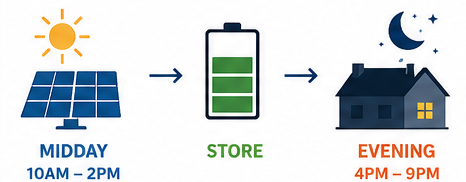
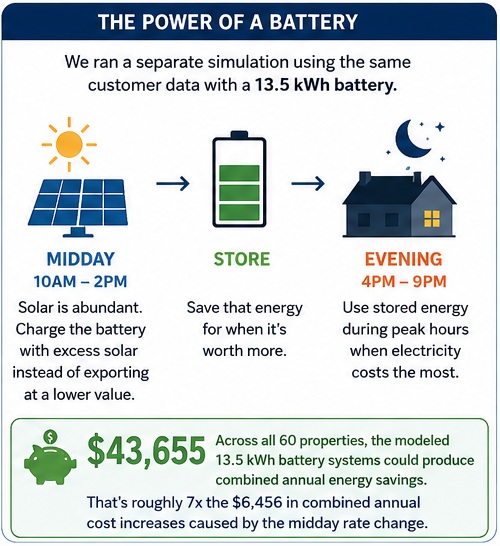
Suggested electric solar-battery usage for Midday solar charging and Peak Rate electric battery consumption.

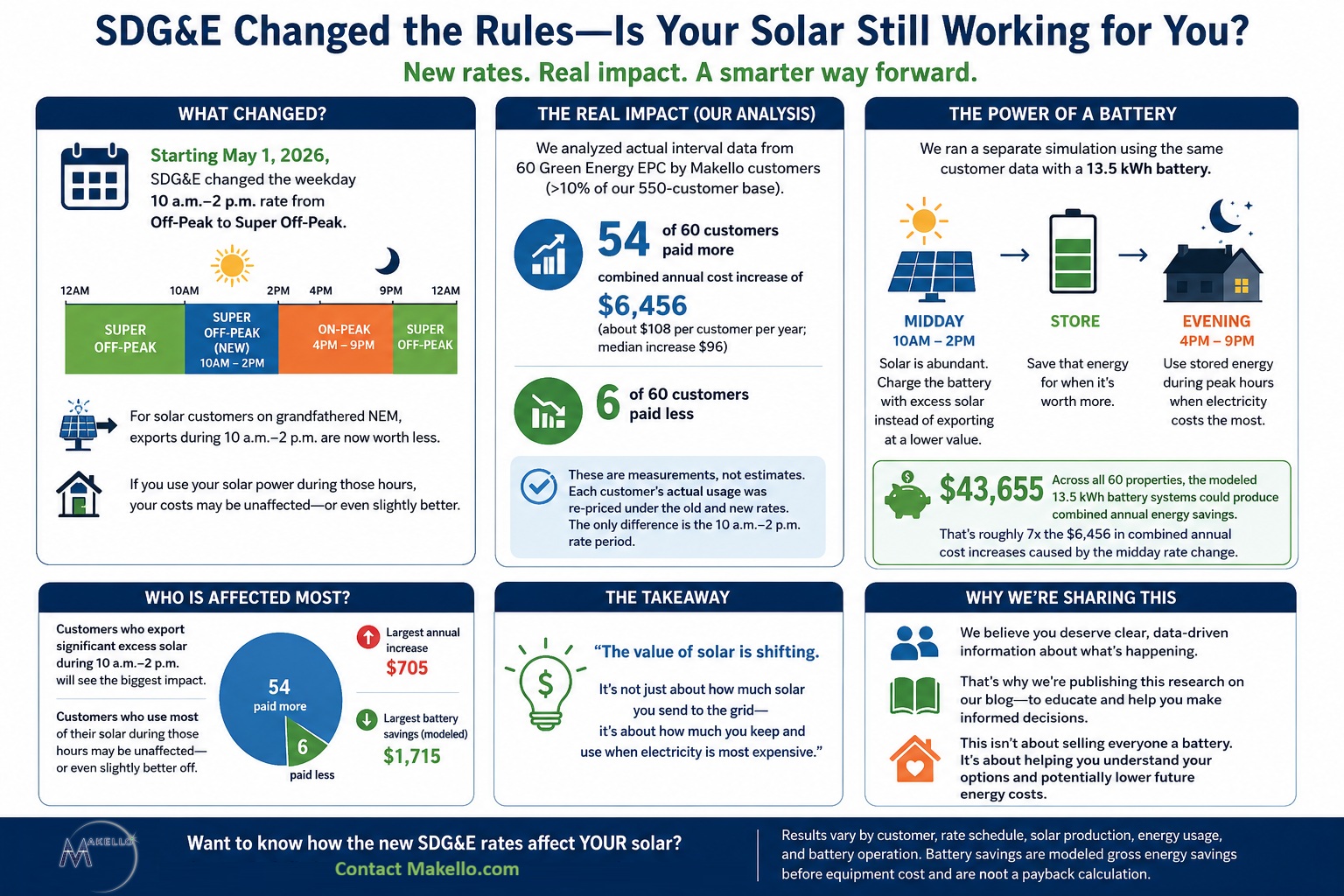
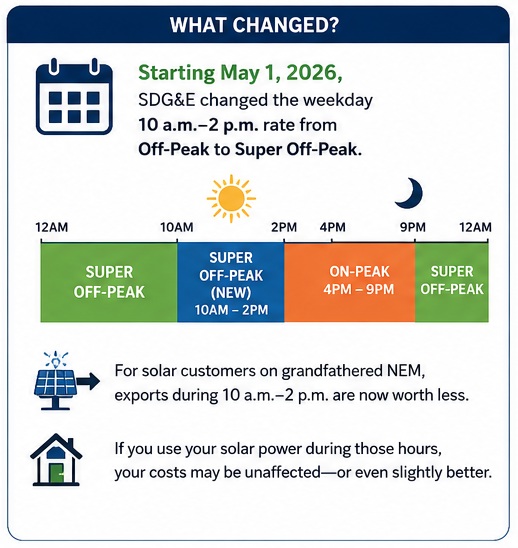
Effective May 1, 2026, SDG&E replaced the weekday Off-Peak rate with Super Off-Peak rate between 10am and 2pm year round. Previously those midday solar peak production hours were credited for Export to SDG&E at Off-Peak rate credit value, in every month except March and April.  SDG&E On-Peak rate remains 4pm to 9pm.  Weekends remain on the same Super Off-Peak rate as before during midday 10am-2pm. 

For a customer on grandfathered Net Energy Metering (NEM) tariff, moving the lowest cost Super-Off Peak rate to the peak solar production hours cuts the export value. Accounts with loads that consume solar power midday instead of exporting solar power to SDG&E, are unaffected or slightly better off, because the cost of importing electricity during those hours became cheaper.
SDG&E 10am-2pm Super Off-Peak Rate Change: Measured Impact Across the Customer Base

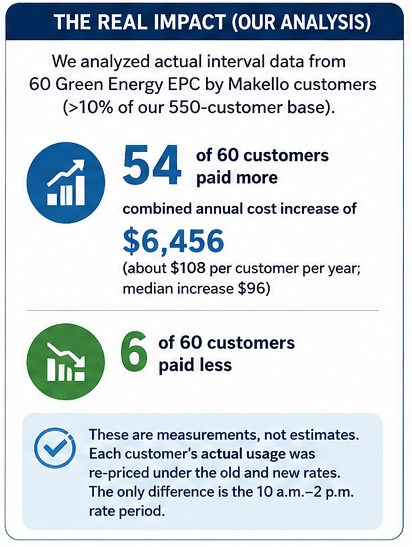
The Center for Community Energy and Makello.com analyzed 60 Green Energy EPC by Makello installed solar or solar-battery customer’s SDG&E metered interval data, which is slightly more than 10% of Green Energy EPC by Makello’s 550 installed customer base.  Fifty-four of the 60 accounts analyzed will pay more because of the change SDG&E made on May 1, 2026, and only 6 pay less. The combined increase is $6,456 a year, however the same 60 properties would save $43,655 a year with the addition of a 13.5kWh battery, which is about 7 times the cost of the Super Off-Peak midday period change that decreased the Solar Export Credit Value.
How were the numbers produced?

Each premise’s own metered intervals were re-priced twice, once under the Off-Peak rate, and once under the Super Off-Peak rate. The electric load, utility rate and the  solar or solar-battery system are the same in both runs. The only difference is which SDG&E rate the midday hours fall, so the difference between the two runs is caused by the period change and by nothing else. These are measurements, not estimates. 
Under Net Energy Metering (NEM), each period’s net kilowatt hours (kWh) settles at that period’s generation rate. Delivery is close to flat across periods and earns no credit on export, so it is unaffected by the change and drops out.
The whole bill moves by the amount shown below. 

SourceNumber of Meters MeasuredNumber with higher SDG&E billAnnual Cost Increase
Green Button 1111$1,253
UtilityAPI4943$5,203
Combined6054$6,456

The potential add-on battery figure is a separate simulation on the same interval data, for charging the battery from solar surplus, and discharging the battery against the 4pm to 9pm Peak Rate. 

Annual increase for Existing Solar SDG&E AccountsNumber of Meters MeasuredAnnual Utility Cost Increase for 10am-2pmAdd-On Battery Annual Savings for 10am-2pm
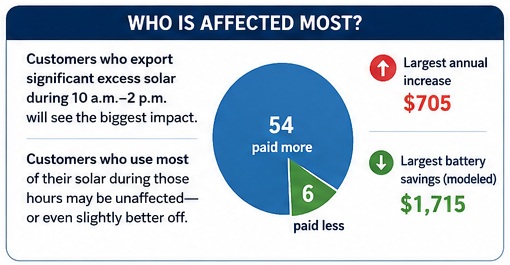
Over $3001$705$1,715
$200 to $3004$1,017$4,653
$100 to $20023$3,265$19,104
$50 to $10020$1,530$14,269
Under $5012-$61$3,914

Every measured meter, sorted by Annual Cost Increase

CustomerCityCCAScheduleSuper Off-Peak rate change Cost / (Benefit) per year 10am-2pmPotential Annual Battery Cost Savings 10am-2pm (13.5 kWh example)
C.B.El CajonSDCPDR-SES$705$1,715
E.L.EncinitasSDCPTOU-DR$288$1,000
D.D.San DiegoSDCPDR-SES$267$1,702
P. F.EncinitasSDCPDR-SES$236$810
E.W.EscondidoCEADR-SES$226$1,141
K. J.La MesaSDCPTOU-DR1$194$728
M.D.EscondidoSDCPDR-SES$191$807
B.B.OceansideCEAEV-TOU-5$188$970
R.C.OceansideCEATOU-DR1$183$625
C.D.CarlsbadCEADR-SES$180$683
C.P.AlpineSDCPTOU-DR1$172$1,103
L.W.San DiegoSDCPDR-SES$168$509
S.P.La JollaSDCPDR-SES$157$1,351
G.S.San DiegoSDCPEV-TOU-5$156$873
R.W.San DiegoSDCPTOU-DR1$154$1,032
J.Z.EscondidoCEATOU-DR1$150$1,164
C.C.San DiegoSDCPEV-TOU-5$131$1,208  
D.M.EncinitasSDCPDR-SES$127$768
G.B.San DiegoSDCPDR-SES$124$1,180
R.D.El CajonSDCPTOU-DR1$118$661
O.T.San DiegoSDCPDR-SES$113$938
E.H.La MesaSDCPDR-SES$113$568
S.B.Chula VistaSDCPDR-SES$113$482
M.D.Rancho Santa FeSDCPEV-TOU-5$112$864
R.G.FallbrookSDCPTOU-DR1$110$393
J.G.San DiegoSDCPEV-TOU-5$106$956
A.K.San DiegoSDCPTOU-DR1$104$658
S.M.EncinitasSDCPEV-TOU-2$101$583
T.W.EncinitasSDCPTOU-DR1$99$638
L.G.CarlsbadCEAEV-TOU-2$96$544
D.Y.EncinitasSDCPTOU-DR1$96$698
D.M.EncinitasSDCPEV-TOU-5$89$254
E.M.CarlsbadCEATOU-DR$89$814
C.C.EscondidoSDCPTOU-DR1$89$900
J.S.La JollaSDCPDR-SES$88$430
J.O.EncinitasSDCPTOU-DR$85$974
M.M.EncinitasSDCPEV-TOU-5$80$951
C.W.San DiegoSDCPDR-SES$79$675
E.B.San DiegoSDCPTOU-DR1$76$634
E.S.EncinitasSDCPTOU-DR1$76$877
D.M.San DiegoSDCPEV-TOU-2$74$797
S.G.La MesaSDCPDR-SES$72$1,041
N.G.EncinitasSDCPTOU-DR1$68$628
T.G.EscondidoSDCPDR-SES$57$639
D.S.EncinitasSDCPTOU-DR$56$587
A.J.EncinitasSDCPEV-TOU-5$55$655
A.S.EncinitasSDCPDR-SES$53$971
A.B.San DiegoSDCPTOU-DR1$53$562
L.B.San DiegoSDCPEV-TOU-5$43$460
J.P.El CajonSDCPTOU-DR1$39$642
C.P.San DiegoSDCPTOU-DR1$38$923
P.H.San DiegoSDCPTOU-DR1$35$360
T.U.Spring ValleySDCPDR-SES$26$84  
D.G.EncinitasSDCPTOU-DR1$12$437
S.M.VistaSDCPTOU-DR1($1)$299
B.R.Del MarCEATOU-DR1($4)$214
C.B.CarlsbadCEADR-SES($9)$12
B.G.La JollaSDCPTOU-DR1($27)$349
A.A.EncinitasSDCPTOU-DR1($63)$40
A.E.La JollaSDCPEV-TOU-5($150)$94 

What the numbers say- Only midday exporters are hurt, making a battery even more useful

The median SDG&E increase is $96 a year and the mean is $108. Clean Energy Alliance(CEA) customers are hit harder per meter, on average $122 annual increase, vs  $105 annual increase for San Diego Community Power(SDCP) generation customers.  The reason for the difference between the two Community Choice Aggregators (CCA) is because the gap between Clean Energy Alliance’s(CEA’s) Off-Peak and Super Off-Peak rates is wider than the gap between San Diego Community Power’s(SDCP’s) Off-Peak and Super Off-Peak rates. 

Only 6 utility meters are better off with the midday rate change, by as much as $150 a year, because they import or self consume at midday instead of exporting, so cheaper Super Off-Peak rate helps them. The dividing line is whether the array is sending excess solar power to the grid at midday, or otherwise that the electric loads are consuming the solar power. A battery is a load that absorbs the excess solar production and stores it for use later when utility rates are higher, or when there is a utility outage.  

How each customer’s CCA was determined

The generation provider matters, since Clean Energy Alliance(CEA) and San Diego Community Power(SDCP) price the affected hours differently. The pricing difference was resolved two ways. First, the best resolution is reading the generation supplier from their own bills. From our sample data, forty-one of the forty-nine UtilityAPI meters’ intervals were read directly from the supplier named on their own bills. That is ground truth and needs no assumption. The remaining 8 were assigned by town, on the basis that Community Choice Aggregator(CCA) membership enrollment is automatic and only 1%-2% of customers choose to opt out. 

The town to CCA map was derived from the bills of the other customers rather than from general knowledge, then checked against the identified customer. Cross checking the data this way caught two errors. The word Vista appears inside Chula Vista, which would have put seven San Diego Community Power customers into Clean Energy Alliance. Escondido turns out to be genuinely mixed, with both suppliers serving different Escondido addresses in the bill data, so the Community Choice Aggregator (CCA) cannot be reliably assigned solely by town name. Escondido and Vista addresses default to SDCP if billing information is not available, which produces a more conservative result.

Data that was excluded from our sample and why

Nine meters were not included in the analysis. Five meters did not have any interval data. Two meters did not have a resolvable supplier or a recognisable town indicated on their interval data. One meter is served by a third party rather than a CCA so these rates do not apply, and one meter was a duplicate.

Additionally, twenty solar exporters are on tiered or two period schedules that the recent SDGE Super Off Peak Hours change does not impact. Two solar exporters are on tariffs that could not be classified. Where a premise had several meters over time, through a meter change or a replacement, only the most recent was counted. For example, three different meters over time at one address would otherwise have counted that customer three times.

Analysis Assumptions

Whenever the numbers above are quoted we used annual netting rather than monthly banking with a true up. With regards to the battery impact, battery dispatch is a simple rule, charge from surplus and discharge against the on peak window, so it is a working figure rather than an optimised one. Delivery is treated as flat across periods, which the bills support. Battery savings are gross energy savings before equipment cost, so they are a savings side and not a payback. Where a customer’s interval history is shorter than a year, we scaled the result to a year, and the number of days behind each figure is in the underlying data.
Key Takeaways

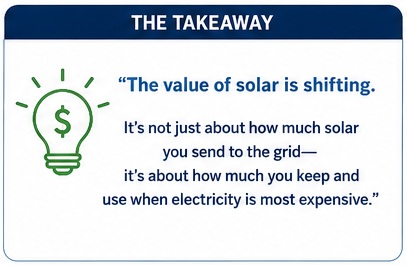
California has the enviable position of producing so much excess solar at noon that there often aren’t enough loads to utilize the solar production being pushed out to the grid. Switching from a spinning the meter backwards to earn credits mindset to using a battery to capture excess production and discharge the battery during on-peak periods can be a game changer for solar customers now that those midday export credits have been devalued.

The goal is no longer to indiscriminately export excess to the grid during high solar production periods but rather to utilize energy storage to hold excess production onsite and discharge the battery during the periods of the day with the most expensive rates with onsite loads prioritized before excess is exported to the grid.

Thank you, Jose and Center for Community Energy, for the excellent research and analysis!

Makello is an authorized distributor for Green Energy EPC by Makello, Inc. CA Lic #1110498

Utility Pirates Stole Your Solar Treasure!

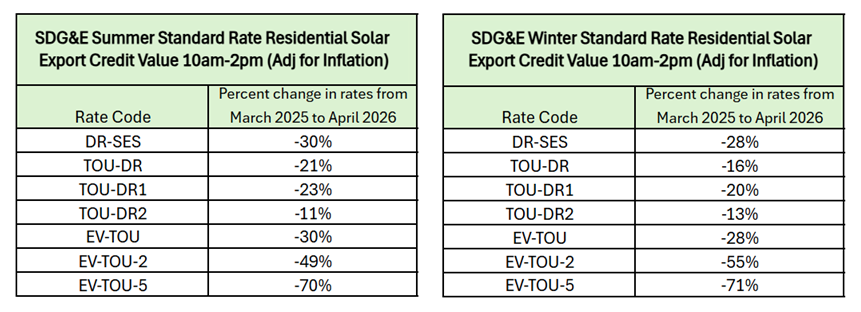
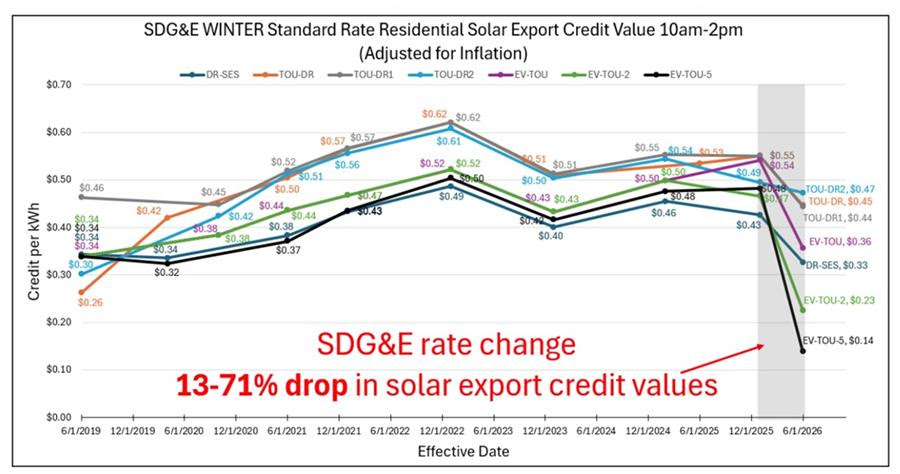
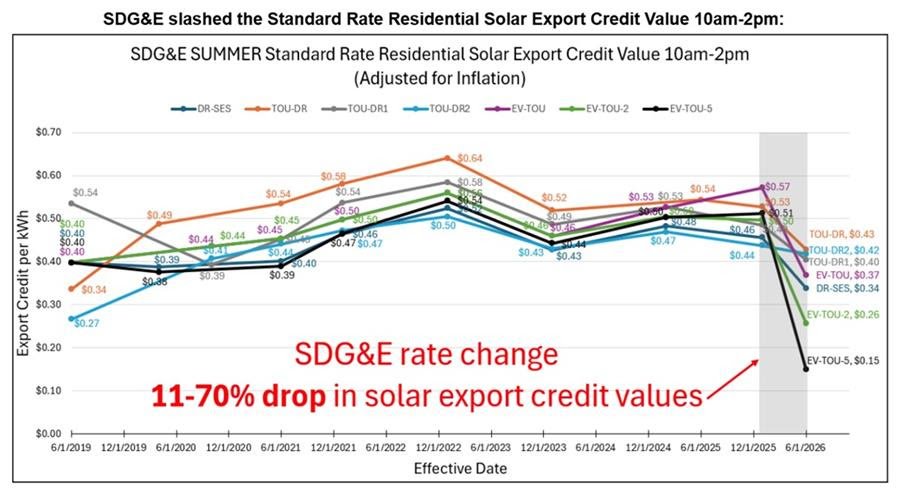
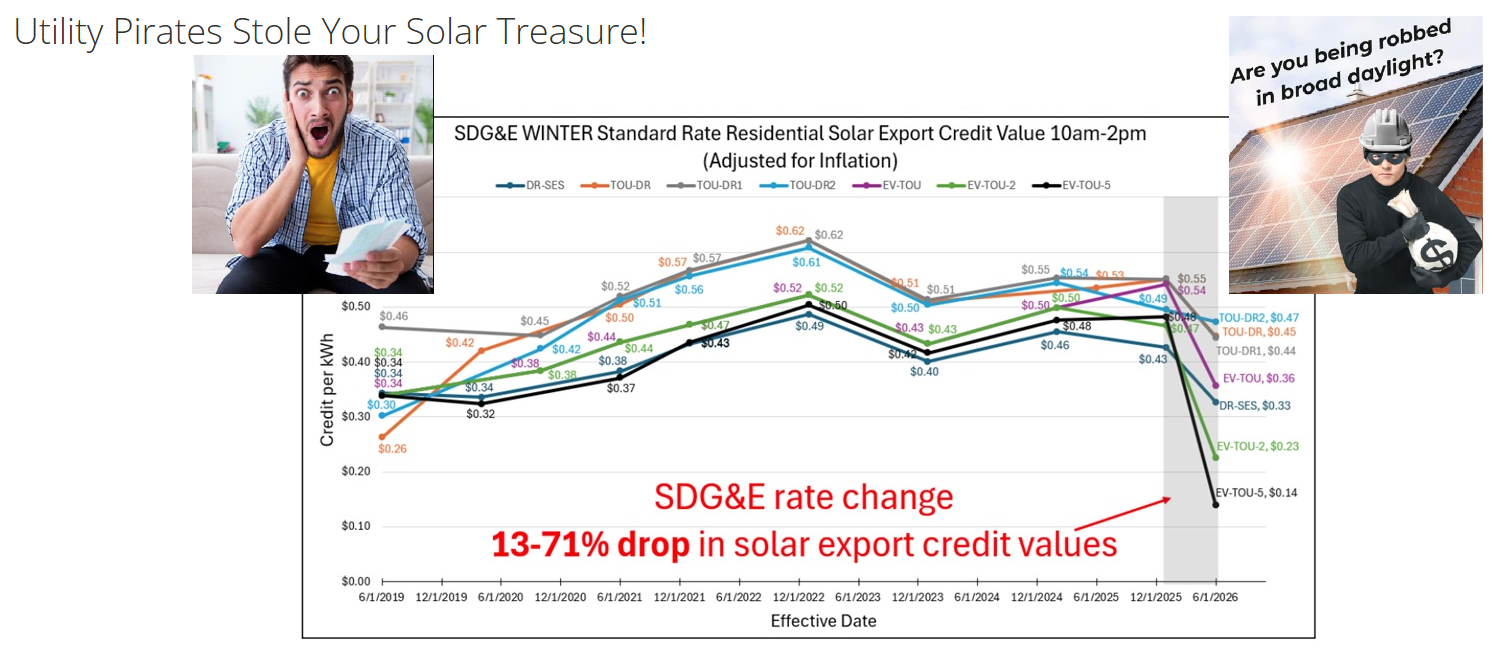
SDGE solar export credit value just dropped 11%-71% during 10am-2pm solar peak production hours

SDG&E Changed the Rules – Is Your Solar Investment Losing Value?

If you invested in solar power to lower your electric bills and gain more control over your energy costs, there’s something you need to know:

Your solar panels produce the same clean electricity as always.  What’s changed is the solar export credit value just dropped 11%-71% during peak solar production hours, making a battery even more useful.

With SDG&E’s newer time-of-use rate plans, the excess solar energy you send to the grid during the peak solar production hours of the day is worth far less than electricity you buy back during expensive evening and morning hours.

So while your solar system may be performing as expected, many owners are finding their savings aren’t what they used to be and bills went up!

If you are interested how the rate change may affect you, send us your utility interval data and a pdf of your most recent bill. A video with instructions can be found here or a written guide can be found here.

The Rules Have Changed

Utilities can change rate structures—even after you’ve invested in solar.

That means the value of your solar overproduction credits can shrink while the cost of buying electricity later in the day continues to rise.

“If my solar is producing the same energy, why are my bills increasing?”

Keep More of What You Produce

The solution isn’t necessarily more solar—it’s using more of the solar energy you already generate.  Run the loads during the solar production hours and add energy storage for the loads that must run after 4pm.

A battery stores your excess daytime production so you can power your life during expensive evening hours instead of purchasing electricity from the grid.

The more solar energy you use, the less you’re affected by utility rate changes.

Protect Your Investment

Your solar investment is still valuable – but today’s rate structures reward owners who maximize their own energy use.

Produce it. Store it. Use it yourself.  If you don’t have battery, get it now!

That’s how you keep more of your savings—and more control over your energy future.

Don’t let changing utility rates determine the value of your investment. Keep your treasure where it belongs—with you.

GET IN CHARGE OF YOUR ENERGY!

Get a Free Energy Analysis

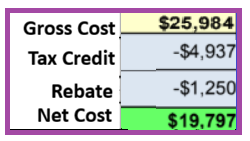
Can Your Home-Based Business Qualify for Solar + Battery Tax Credits?

If you own a business and work from home, your solar and battery installation may qualify for significant federal tax credits and rebates.

Many business owners don’t realize that the business-use portion of their home can unlock commercial clean energy incentives through the federal 48E tax incentive structure, potentially allowing them to claim a substantial percentage of the system cost.


How Business Use Qualification Works
If part of your home is used for business purposes, the solar and battery system may qualify proportionally based on either:

● Square footage used for business

● Percentage of total energy use attributed to the business

This means business use may qualify for up to 78% solar-battery incentives proportionally, depending on your tax structure and eligibility.

For example:
If 40% of your home’s energy use supports your business operations, your eligible incentives may apply to that 40% business-use portion.


Incentives for Non-Profit Organizations
Eligible non-profit organizations may qualify for:
Federal Incentives

● 30% Solar Tax Credit (as a rebate)

● +10% Domestic Content

● +10% Energy Community

Total Potential Benefit
Up to 50% Rebate × Business Use %
This can significantly reduce upfront costs for qualifying churches, schools, charities, and other nonprofit entities operating from owned properties.


Incentives for For-Profit Organizations
Eligible for-profit businesses may qualify for:
Federal Incentives

● 30% Solar Tax Credit

● +10% Domestic Content Tax Credit

● +10% Domestic Content Tax Credit

● +15% to 28% Depreciation

● Based on tax filing category

● Gross income

● Depreciation method used

Total Potential Benefit
Up to 65%–78% Tax Credit × Business Use %
This makes solar + battery systems one of the most powerful tax-advantaged investments available for business owners.


Who May Qualify?
Home office or business-related usage on a residential meter may qualify if the business generates income from one of the following:

● Self-employed individuals reporting business income on Schedule C

● Independent contractors

● Sole proprietors

● Single-member LLCs taxed as sole proprietorships

● Partners in partnerships (subject to specific rules)

● S-corporation shareholders (via corporate accountable plan reimbursements)

Important Note
A remote employee working from a home office cannot claim Business Use deduction. However, an employee-owner may qualify depending on structure and reimbursement setup.


How to Reserve Federal Tax Credits


To qualify for Federal Income Tax Credits and Depreciation for Business Use:

Option A
Pay a minimum of 5% of the Gross Cost by July 4, 2026
to reserve the tax credit and install by 2030.

Option B
Pay a $1,000 Down Payment
and install by December 31, 2027.

These timelines may help preserve eligibility under current federal incentive programs.


Why This Matters

Solar + battery systems are no longer just energy upgrades—they are strategic financial tools. For business owners working from home, the right system structure may deliver:

● Lower utility costs

● Backup power security

● Major federal tax savings

● Accelerated depreciation benefits

● Improved long-term property value

Understanding your business-use percentage can make a major difference in total savings.


Disclaimer: Makello.com and Green Energy EPC by Makello, Inc. are not tax experts.
This article is for informational purposes only and is not tax advice. We cannot guarantee incentive acceptance, fund availability, or final incentive amounts. Please consult your CPA or tax professional regarding your specific eligibility for business-use solar incentives on residential or commercial properties.

Reserve Up to 78% Solar-Battery Incentives by July 4, 2026!

Safe Harbor for Solar & Battery Incentives in 2026: What Owners Need to Know

If you’ve been thinking about adding solar or battery storage to your property, 2026 brings a mix of opportunity and urgency. The landscape has shifted significantly over the past two years, and understanding what’s changed could make a substantial difference in your long-term savings.

The Big Change: Tax Credits in 2026

● Residential personal-use 30% solar and battery tax credits ended in 2025.

● However, solar and battery systems tied to Business Use are still eligible for tax credits in 2026, and these projects can be reserved now and built through 2030.

This means both commercial properties, and residential properties where homeowners who can legitimately classify part of their energy usage as business-related, such as a home office, rental activity, or EV used for business, may still qualify for meaningful incentives.

Why Timing Matters

There is a critical window to act. Contracts signed and a minimum of 5% Safe Harbor fee received before July 4, 2026 may still qualify for incentives, even if adjustments are made later through change orders. This gives owners flexibility while locking in potential financial benefits.

Exploring Your Options in Residential Business Use

Every home and energy setup is different, but most scenarios fall into a few categories:

● NEM Expansion (e.g., 3-module add-ons)
Ideal for homeowners looking to expand an existing system without losing the cost savings from a grandfathered utility rate.

● Solar + battery combinations
Increasingly popular due to rising electricity rates and grid instability.

● Battery-only installations
A strong option for homes already equipped with solar.

Within each of these, eligibility and savings can vary due to several factors.

Here are some examples of common scenarios for comparison:

● Busine Use Percentage

● Availability of local rebates (like San Diego Community Power’s Battery Savings Program)

● Whether the system is designed for backup power vs. cost savings

Battery Systems: A Growing Trend

While the solar market has slowed, battery adoption is accelerating. Homeowners are prioritizing energy independence and protection against outages.

It’s also worth noting:

● A battery designed purely for cost savings can be $4,000–$6,000 less expensive than a full backup system.

● Battery installations are more complex, requiring more labor, which affects pricing and margins.

Market Reality: A Volatile Few Years

The solar industry has experienced major turbulence:

● Equipment prices have fluctuated due to tariffs, inflation, and supply chain disruptions

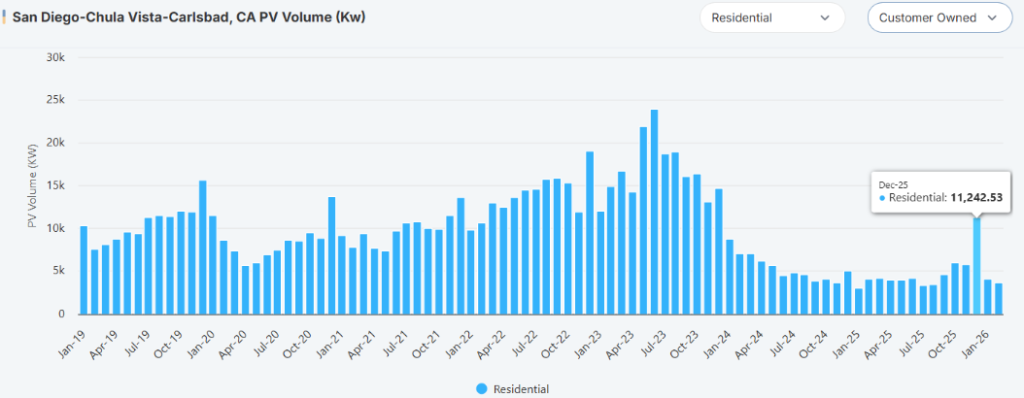
● The market saw a sharp contraction in 2024–2025, with many companies shrinking or exiting

● 2026 is shaping up to be one of the lowest-volume solar installation years in recent history

Credit: Ohm Analytics dashboard marketplace

At the same time:

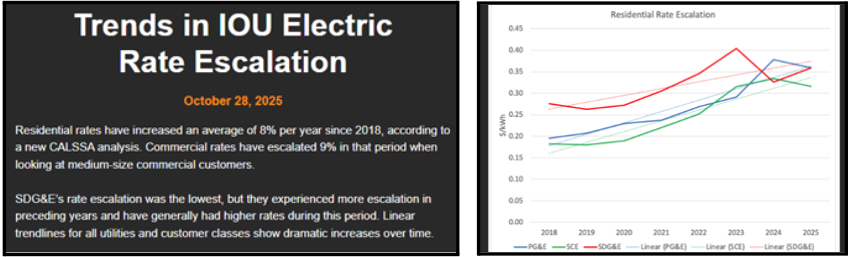
● Electricity rates have increased ~8% annually since 2018, doubling roughly every 7–9 years depending on rate structures

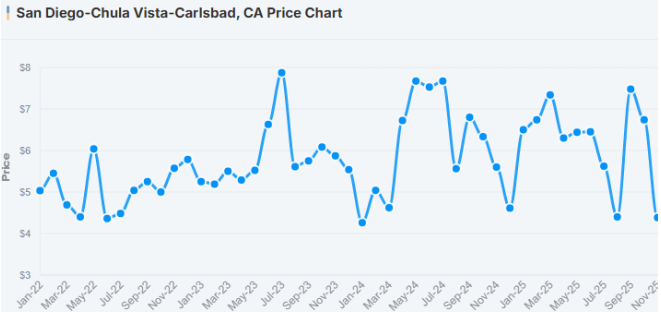
● The average solar PV cost/watt in 2025 ranged from $4.50 to $7.50 per watt, with regional averages around $6/watt, due to the 1kW CEC-AC add-on NEM Expansion limit.

Credit: CALSSA member newsletter. Click to become a CALSSA Member
Credit: Ohm Analytics dashboard marketplace

What This Means for You

Despite market uncertainty, the fundamentals still favor energy investment:

● Utility rates continue to rise steadily and SDG&E is already the highest cost utility power in the U.S., at $0.91/kWh Peak Rate (EV-TOU).

● Battery adoption is increasing due to real-world reliability needs

● Incentives still exist—but are now more nuanced and tied to usage type

The key question is no longer just “Should I go solar?” but rather:
“How can I structure my system to maximize savings under current rules?”

Final Thoughts

2026 isn’t the easiest year to navigate solar decisions—but it may be one of the most strategic.

If you’re considering solar or battery:

● Evaluate whether any portion qualifies as business use

● Understand your rate plan and energy consumption patterns

● Act before key deadlines to preserve eligibility

The opportunity hasn’t disappeared—it’s just become more tailored.

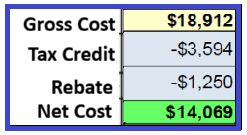
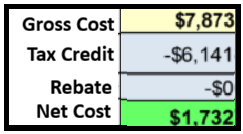
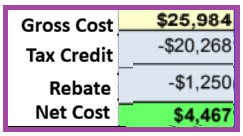
There’s a variety of options available for Residential Business Use NEM Expansion, for existing solar. Green Energy EPC by Makello, Inc has many hundreds of Current Customers with Net Energy Metering registrations that are eligible for an Alumni Discount. Click on the option that best matches your add-on Solar Only, Solar-Battery, or Battery Only NEM Expansion cost summary, to see a contract that is available for you to fill out, sign and return by May 1, 2027. Of course, Makello.com will be glad to help you through the process.

Solar Only Solar & BatteryBattery Only
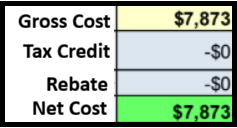
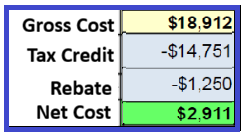
0% Business Use
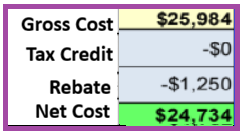
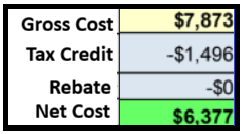
25 % Business Use
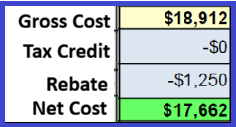
100 % Business Use

Remember you have until 2030 to build. You only need to pay a minimum of 5% before July 4, 2026 to Reserve your Solar Tax Credit and Depreciation incentives!

How Do You Download Your 15 Minute Interval Data?


You are working a solar company and they have a lot of questions to determine the optimal system size that best matches your energy goals. Now you’ve been asked to download your SDGE Energy Usage data. There’s Green Button Data, Utility API Authorization, Two-Factor Verification or any other number of options. What do you need to do and how do you do it?

At Makello, we request either downloading Green Button data in 15 minute intervals from your SDGE account or to authorize Utility API collection of data on your behalf and this article will focus on those methods.

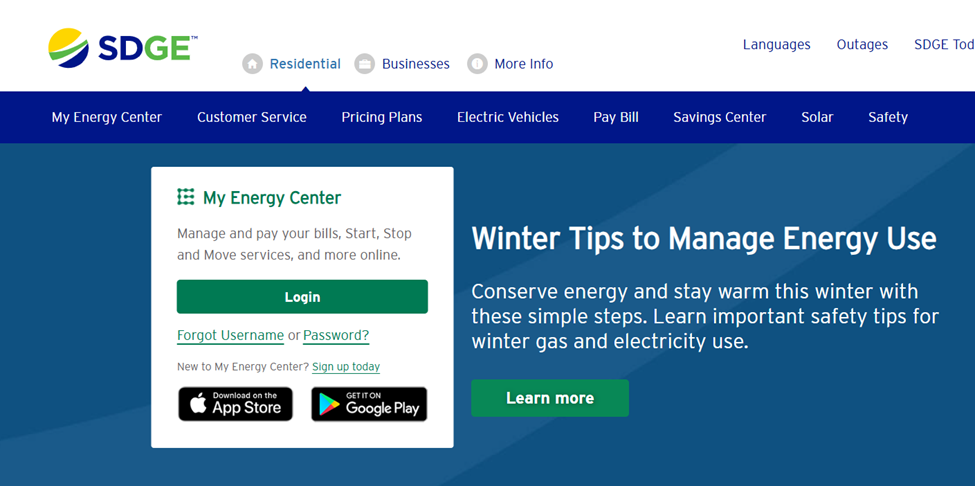
SDGE My Energy Center Login

The first step to downloading your interval data from SDGE My Energy Center is to navigate to https://www.sdge.com/

Click on Login in the home page if you have already set up an online account to view your SDGE bills. First Time Users of SDGE My Energy Center should click on Set Up Today and follow the steps to register. You may have to login after registration. If you have two factor authentication activated, you will be asked to enter in a code that is sent to the email or phone number you have on file.

Green Button Data Download

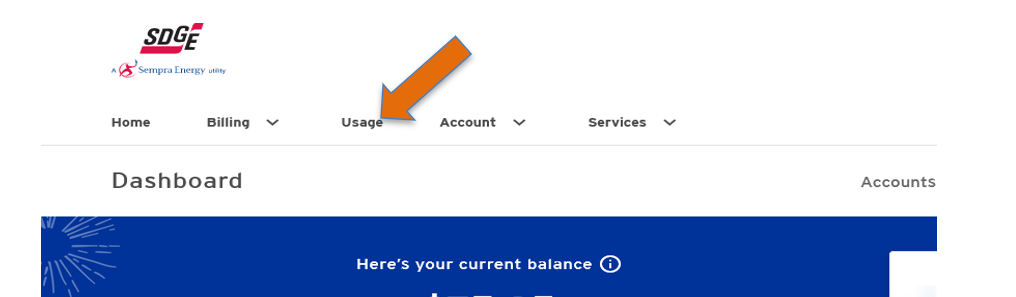
After successful log in, you will see your dashboard. The dashboard design may vary due to your enrollment in a Community Choice Aggregator or not.

Click on the Usage tab at the top of the dashboard.

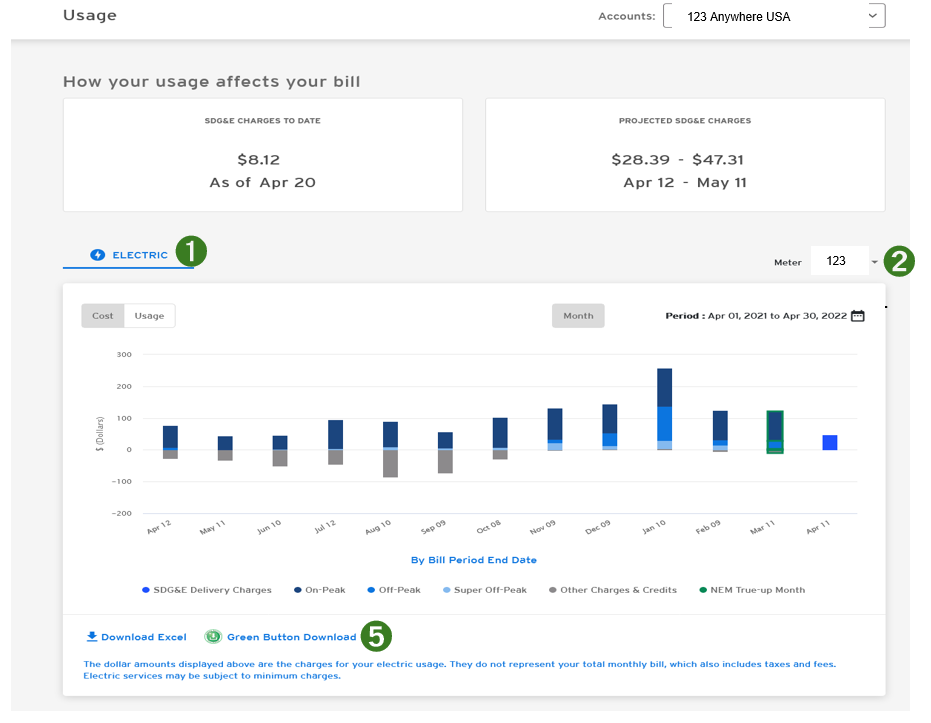
You can download your data from your Usage page.
1. Select Usage from the drop down menu in the Usage Tab.
2. Select your electric Meter from the drop down menu on the right side of the page.
3. Scroll down to the bottom of the page.
4. In the bottom left corner, you will see button for Download Excel and Green Button Download.
5. Click on Green Button Download to download data.  

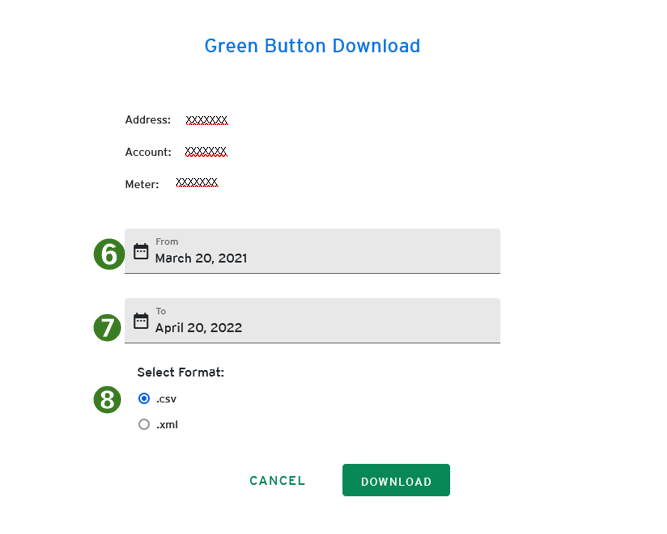
6. Set the date in the drop-down tab to download as many months of data as possible. Twelve (12) full months of data is preferred but one month of usage data is needed if  available.  
7. Under the Select Format heading, click .csv button (this step applies to electric meters only), then click download.
8. Under the Select Format heading, click .xml button, then click download (this step applies to both gas and electric meters for customers with both types of meters).
9. Repeat steps 1-8 for each meter that services the property, gas and electric.


Turning SDGE Two Step Verification Off or On

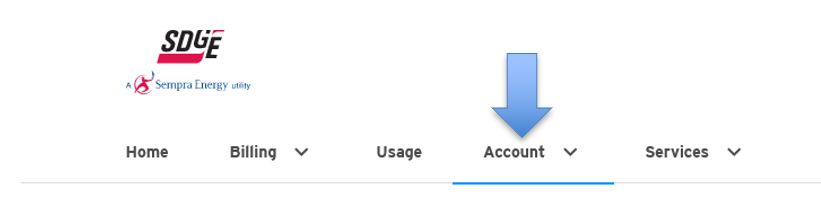
Turn 2 Step Verification off or on by clicking on Account in menu bar.

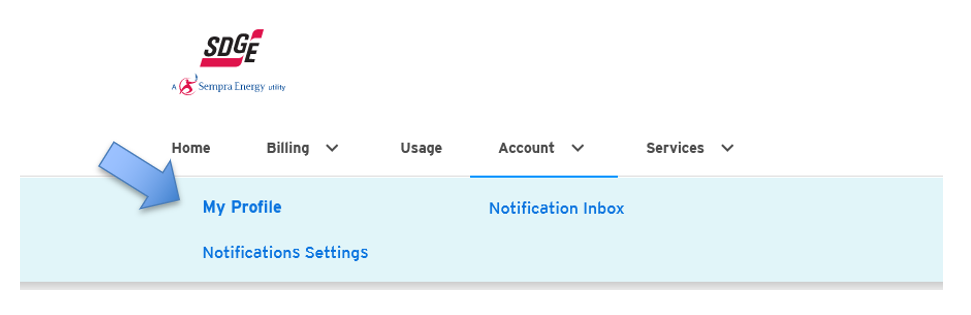
Then select My Profile from the drop down menu.

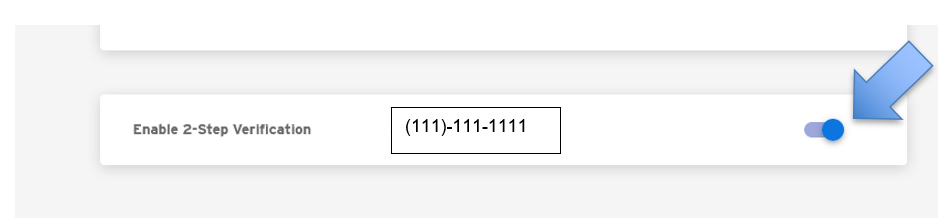
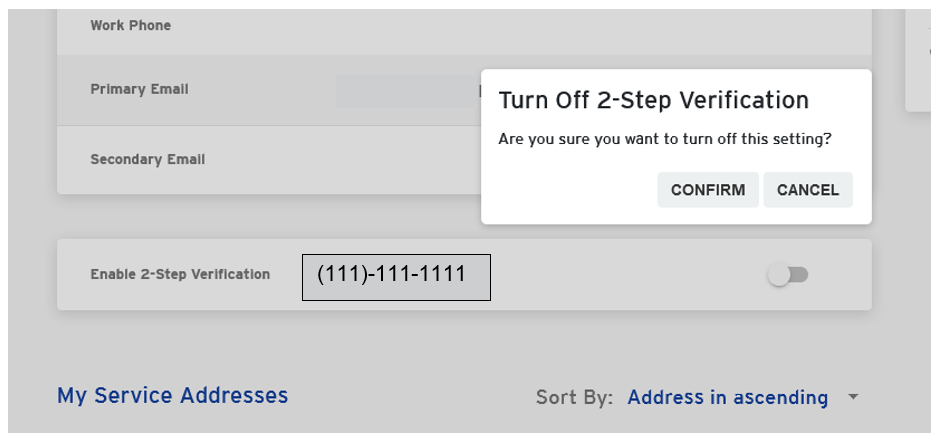
Scroll to the Enable 2-Step Verification section and click on the blue button on the right side of the screen to turn off the 2 Step Verification.

Click on Confirm in the pop up menu.

You have turned off the 2 Step Verification. Please note: 2 Step Verification must be completed prior to authorizing Utility API data collection.

To Turn 2 Step Verification back on, simply return to your Account, select My Profile, scroll down to Enable 2-Step Verification and click on the grey button on the right side of the screen, click on Confirm.  

Authorization of Utility API Data Request via Link


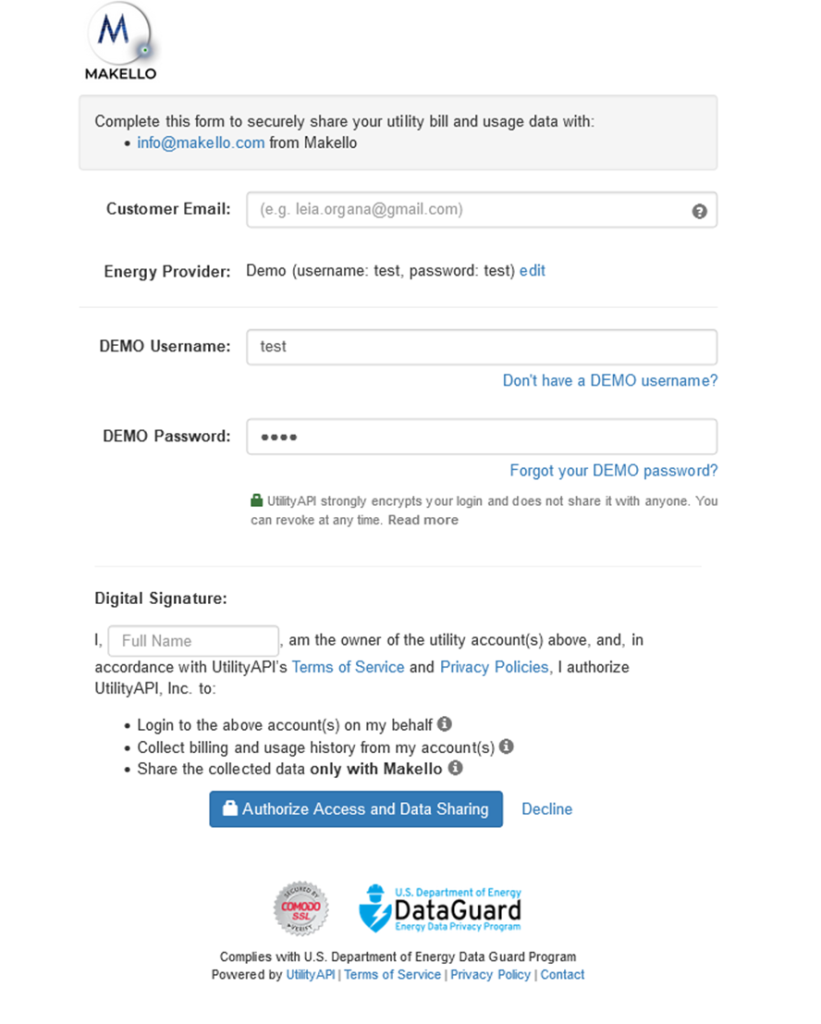
Please click on the Utility API Authorization link provided by Makello in the email you received.

You should be brought to a screen similar to the picture below. Please provide the requested information and click Authorize Access and Data Sharing.

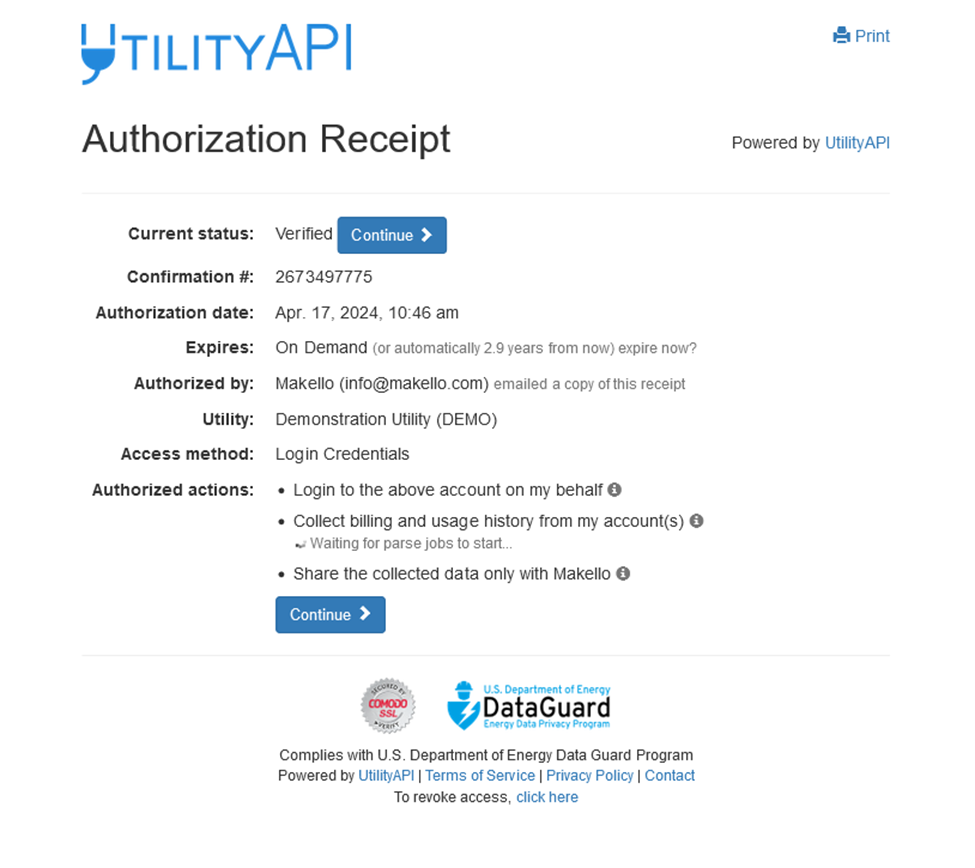
You should receive an authorization receipt similar to the picture below after authorization has been completed.

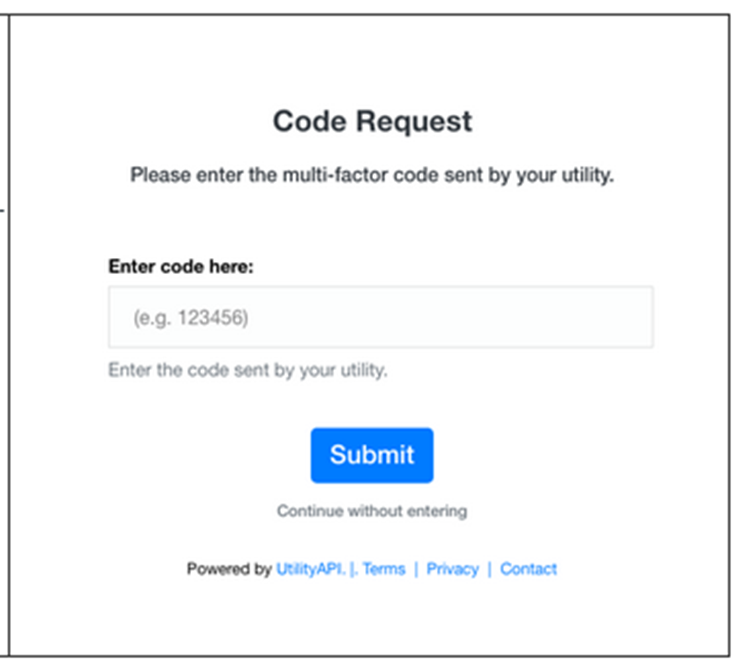
If your SDGE account has  two-step verification, you should then receive a two-step verification code from SDGE sent via text message.  Please enter the code in the space provided.  An example of  the screen  where you enter the two-step verification code provided in the image below.

Alternatively, you may manually deactivate and reactivate the multi-step verification for your SDGE by following the steps previously outlined.

Please note: 2 Step Verification must be completed prior to authorizing Utility API data collection.

Utility API Data Collection Refresh Historical Data

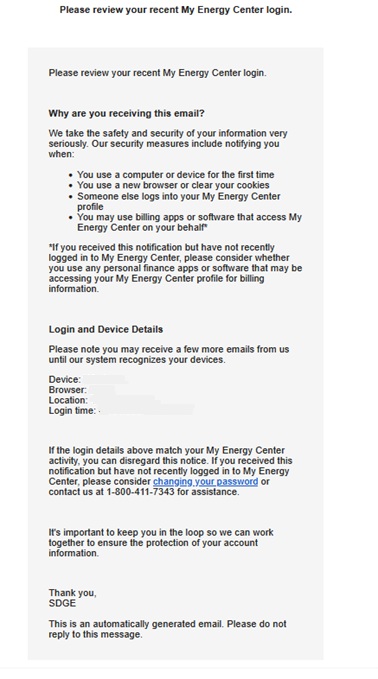
When Utility API Refreshes Data via a new collection, you may receive a message informing you of the activity on your account.

You may find out more about Utility API https://utilityapi.com/

SDGE Utility Bill Download Instructions

Next document needed is a .pdf copy of your bills

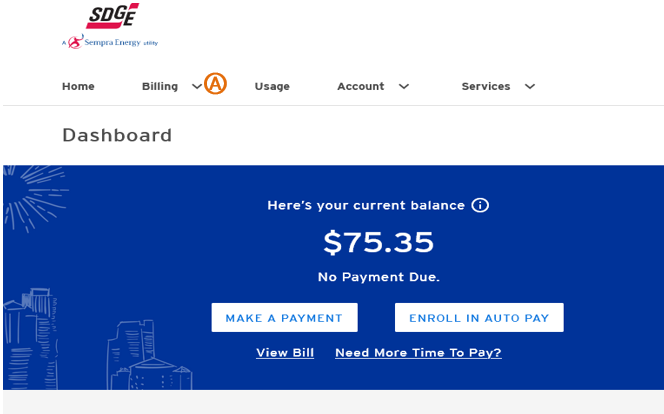
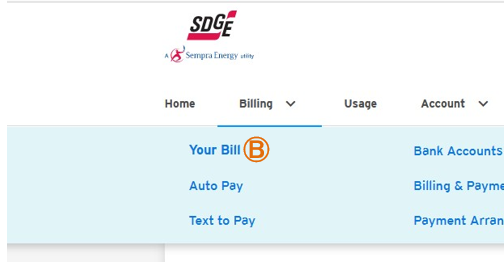
A. Click on Billing drop down menu at the top right of your dashboard.

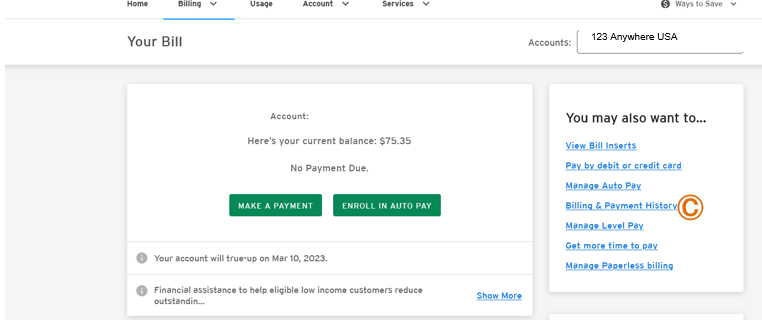
B. Click on Your Bill from the Billing drop down menu.

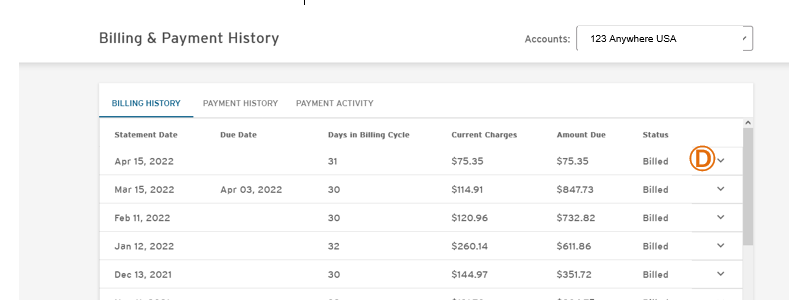
C. Click on the link for Billing & Payment History from the menu on the right side  of the menu.

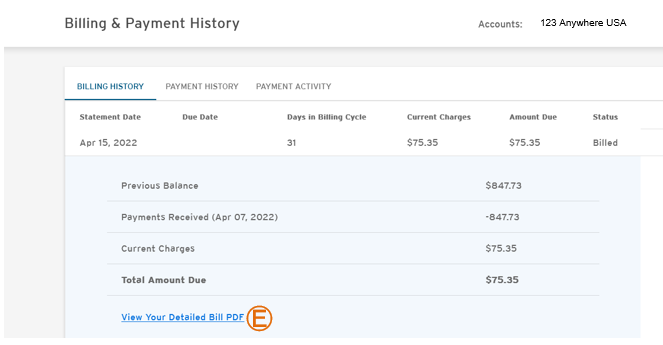
D. Click on the drop down menu arrow on the right side of the screen to display your bill.

E. Click on the View Your Bill PDF link.

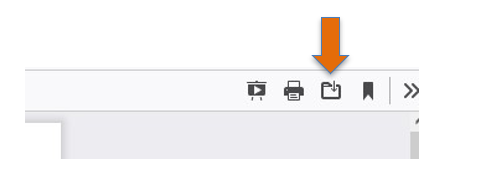
F. Click on the folder icon on your computer’s menu bar to download the file. Save the .pdf file to the folder of your choice.

G. Return to the Billing & Payment History Screen and repeat the download process detailed in steps D-F for as many of the most recent months of Bills available, up to twelve (12) months of Bills.

    Green Energy EPC by Makello CA Lic # 1110498
New SGIP Developments December 31, 2025

There are important updates to the SGIP rebate program coming.

The good news is SGIP AB 209 incentive budgets are open for submissions and will remain so.

However, CPUC Decision 25-12-003 impacts the SGIP Rebate Program significatnly on December 31, 2025. SGIP ratepayer incentive budgets are closing for new ratepayer application submissions including applications being submitted for the waitlist in the following budget categories:

             Large-Scale Storage

             Small Residential Storage

             Residential Solar and Storage Equity – Ratepayer

             Non-Residential Storage Equity

             Equity Resiliency

             Generation

December 20, 2025 is the last day to press the “submit” button for the incentive budgets listed above.

Ratepayer funding allocations discontinues after 2025. Applications in a “Waitlist” status on December 31, 2025 face cancellation.

Please reach out to SCE, CSE, PG&E, or SoCalGas if you have any questions regarding the changes to the SGIP Program. You may find program administrator contact information at https://www.selfgenca.com/home/contact/

Green Energy EPC by Makello CA Lic # 1110498
California utility customers may now qualify for higher SGIP battery rebates!

More customers may now qualify for SGIP rebates!

The California Public Utilities Commission (CPUC) has expanded the eligibility requirements for SGIP rebates.

The new supplementary criteria for qualifying for SGIP rebates are:

1. Experience one public safety power shutoff event (PSPS)

AND

2. Experience one de-energization or power outage from an actual wildfire that occurred on or after January 1, 2017. 

*** The CPUC is referencing CalFIRE or similar agencies for the definition of wildfire.
***Additional eligibility requirements may apply. 

  • $1,000 to Reserve Solar Battery & SGIP Rebate Preparation by Makello
    (Don’t wait until the SGIP Rebate is gone!)

*Makello, as an authorized distributor for Green Energy EPC (CA Lic 978836), cannot guarantee SGIP acceptance, funds availability, and rebate amount. Only the SGIP program administrator, can approve the Rebate Reservation Form application. When the SGIP program administrator accepts our application on your behalf, once approved, you’ll have up to 12 months to decide when to install, or request an extension.


A $1,000 refundable fee reserves your Solar Battery and SGIP Rebate Preparation, which includes the required site survey, Energy Analysis and purchase contract to sign, prior to the SGIP Rebate Reservation Form (RRF) submission.

This new eligibility criteria augments the original pathways to eligibility for SGIP rebates. You may qualify for a SGIP rebate even if you live outside a high fire-threat district as defined by the CPUC because the electric grid infrastructure boundaries do not match the high fire threat district boundaries. You may experience PSPS or de-energization events due to the wildfire because the fire perimeter disrupts your electric service or your electric service is on a circuit that is partially inside an area at risk for wildfire even though your home is not located in the at-risk zone. 

Please note, the CPUC high fire threat district boundaries are different from the CalFIRE high fire threat zones. You cannot use the CalFIRE high fire threat zones to determine SGIP eligibility.

Makello is able to help you prepare for electric service disruption with solar and battery storage. We start with a thorough energy usage analysis, sit down and talk to you about your energy usage and goals, design a custom system to meet your needs, complete and submit SGIP rebate apps for you. We strive to make it easier for you. 

If you are worried about your electric service being disrupted because of your medical condition or need electric equipment to treat your medical condition, please contact SDGE and notify them of your needs. SDGE is also able to help you determine your eligibility for special electric rates. Additionally, installing a solar system with battery storage may also benefit you. Please contact Makello and we will work with you to determine if solar or battery storage is right for you. You may also qualify for rebates on your installation. 

If you want to know if you have qualifying PSPS events or de-energization events due to an actual wildfire, please check with SDGE or your local utility provider to find out the number of PSPS events or wildfire caused de-energization or power outage events your electric circuit has experienced. Then contact Makello to get started on your solar electric or battery storage project. 

Click here to Reserve Solar Battery & SGIP Rebate Preparation for Makello’s SDG&E Territory

Makello is an authorized distributor for Green Energy EPC by Makello, Inc. (CA C-10: #1110498)

Step 7 – Small Residential Energy Storage Rebate Is Open!

NeoVolta Energy Storage Diagrams
NeoVolta’s AC and DC coupled solutions work with existing residential solar systems. NeoVolta (San Diego, CA) has lithium iron phosphate (LiFePO4) chemistry ‘safer by design’.
https://www.pv-magazine.com/2021/09/23/residential-battery-inverter-from-the-united-states

New Self-Generation Incentive Program (SGIP) Rebate application for Step 7 – Small Residential Energy Storage funding, becomes available starting Monday, Sept 27, 2021, at a rebate value of $0.15/wH.

Caller: “Quick question. I already have solar, so which Battery is right for me? I need an answer ASAP, because SGIP Rebates are back and who knows for how long.”
Response: “If you already have a solar, then NeoVolta battery can work with just about any existing system, and is lowest cost to integrate as an AC Coupled solution, for up to 9.2kW solar. There are exceptions to the rule, if the existing solar is landing on a Renewable Meter Adapter (RMA), but we have custom solutions in that case. And, the NeoVolta battery can be DC coupled to solar as well, up to 8.448kW DC, using Tigo TS4-A-O Power Optimizers.

Californian’s reaped over $1B in SGIP Rebates.  Don’t miss out!  It is possible to qualify for up to 100% incentives for your solar battery in the Equity Resiliency $1/wH category and up to 85% in the Equity $0.85/wH category.

  • $1,000 to Reserve Solar Battery & SGIP Rebate Preparation by Makello
    (Don’t wait until the SGIP Rebate is gone!)

*Makello, as an authorized distributor for Green Energy EPC (CA Lic 978836), cannot guarantee SGIP acceptance, funds availability, and rebate amount. Only the Center for Sustainable Energy (CSE), the SGIP program administrator, can approve the Rebate Reservation Form application. When the CSE accepts our application on your behalf, you’ll be approved – and you’ll have up to 12 months to decide when to install, or request an extension..

A $1,000 refundable fee reserves your Solar Battery and SGIP Rebate Preparation, which includes the required site survey, Energy Analysis and purchase contract to sign, prior to the SGIP Rebate Reservation Form (RRF) submission.  (The refundable fee terms are in the “Addendum-to-the-Green-Energy-EPC-contract-1” reference section below.)

Enphase’s AC Coupled solutions are eligible for SGIP Rebates. The Encharge’s lithium iron phosphate (LiFePO4) chemistry is safer by design and is 2021 EES Award Winner! https://enphase.com/blog/encharger-battery-wins-2021-ees-award

The SGIP Program may become wait-listed, it may be funded again, and it may run out of funds at any time, so it is critical to proceed quickly to process your SGIP Rebate.*

Click here to Reserve Solar Battery & SGIP Rebate Preparation for Makello’s SDG&E Territory


Makello Helps You Save Even More, With Energy Storage Solutions

Makello will help you:
1 – Qualify for rebates, incentives and discount utility rates.
2 – Suggest Energy Efficiency measures, to right-size of the solar and battery system.
3 – Determine if an existing electric panel can qualify for solar and battery.
4 – Provide an Ethical Energy Savings Report.
5 – Provide a purchase and installation contract for a solar and battery system to meet your goals and the site conditions.

LG Chem’s DC Coupled solutions are eligible for SGIP Rebates. LG Chem is one of the world’s top battery suppliers since 2016, with RESU Lithium-Ion batteries.

Makello offers NeoVolta, Enphase and LG Chem Advanced Energy Storage for residential solar and battery installations in our SDG&E territory for 2021 Reservations. (We are experienced with Outback and Sonnen battery systems as well.)

Reference:

Green Energy EPC and State of California Required Documents:

NeoVolta Documents: (For a new or existing solar panel system, with or without a solar inverter)

Enphase Documents: (For an existing Enphase microinverter solar panel system; M215, M250, S280, IQ7X, IQ8X). Note: S280 must be replaced with IQ8X inverters at extra cost $250/solar module installed. Note: M215 and M250 existing Enphase microinverters adds $900 to Gross Cost.

LG Chem Documents: (For an existing solar panel system using SolarEdge battery ready inverter; SE3800A-USS2, SE7600A-USS2, SE3800H-USS3, SE7600H-USS3)

Attachments

Makello pays it forward, on KPBS Evening Edition

pay it forward, solve inequity, share solutions

Makello CEO Charlie Johnson was recently interviewed by KPBS Investigative Reporter Claire Trageser for the KPBS Evening Edition story “Lending Ends Monday For Third Round Of PPP, Which Aims To Correct Inequities“

Makello pays it forward by giving back to the community in many ways. In this case, on May 5th, we shared information with KPBS Evening Edition to follow up on their original story, “Businesses In San Diego’s Majority White Communities Received By Far The Most PPP Loans“, which aired on May 3rd.

We hoped KPBS would help us to inform the public in a timely manner about the difficulty of navigating the PPP program especially for minority owned and small businesses. Due to other media demands, KPBS was not able to publish this at an earlier date.

After many hours of work in reaching out to SBA banks, agents, and bank VIPs, Makello was able to secure grant funds. These funds are allowing us to reach out to underserved communities with an Energy Upgrades Lifeline, that will provide solar power, plug-in vehicles, and storage solutions for eligible customers, to improve cash flow.

We know other business owners were shut out of PPP loans. We want them to know there are other funding options available such as Energy Upgrades LIFELINEs for businesses.

Includes up to 5 hours of research, modeling and processing of applications for Grants, Rebates, Tax Credits, Discounts, Promotions and Subsidies, for San Diego businesses.

For Makello’s customers, the journey may begin with solar power, however, “The Road to Energy Independence” can include plug-in vehicles and energy storage.

Includes up to 5 hours of research, modeling and processing of applications for Grants, Rebates, Tax Credits, Discounts, Promotions and Subsidies, for San Diego businesses.

Welcome to Makello

solar power, energy storage, electric vehicles, upgrade
Energy Upgrades LIFELINE- Hurry Before It’s Too Late!
battery backup power 2020
Get On The Road To Energy Independence!

Are You In Need of an Energy Upgrades LIFELINE?

In Case of Emergency, An “Energy Upgrades Lifeline” Pays For Itself
Get on the road to Energy Independence!

Did you know that, whether or not you have an existing solar energy system, you can tap into a combination of up-front incentives, financing, to build up your savings into a 6-Month Emergency Fund and lower monthly costs? 

Read more about the Energy Upgrades LIFELINE.

In Case of Emergency, An “Energy Upgrades Lifeline” Pays For Itself
Once-considered luxury items, such as Solar Power, Plug-In Vehicles, and Energy Storage, now payback quickly for cash purchases and are within reach for most homeowners, due to up-front incentives and lower total monthly costs from loan or Property Assessed Clean Energy financing.

Book a FREE 15 minute appointment to: 1) Find out how Makello can help you. 2) Discuss your energy needs. 3) Get a FREE Energy Savings Estimate.

How it Works

Makello performs the Energy Analysis:

  • Site survey.
  • Shading analysis.
  • Cash flow analysis.
  • Trade-off study.
  • Custom proposal.

Makello can provide you with a FREE Energy Savings Estimate! If you share your utility data with us we can create a solar energy system that is specific to your needs. We will NOT share your data.

Our model can also show the cost saving benefits of a Plug-In Vehicle or Energy Storage system, or both, in addition to your solar system. All of our team works to get you the most comprehensive, thorough Energy Analysis in the San Diego area as quickly as possible.

The software engineers are constantly updating our computer model to reflect the most current utility rates and product costs. We have a dedicated GIS analyst who can qualify you for as many rebates and incentives possible. Our Energy Efficiency experts can also provide other solutions to reduce energy costs such as appliance changes or switching utility rates. Press one of the buttons to see how much you can save!

Learn more about: Solar Panels, Plug-In Vehicles & Energy Storage

Are you ready to save money on solar power, EV charging or Energy Storage? Get an instant quote from Makello!

utility black out battery back up power
Where Will You Be In The Next Blackout?
Makello makes driving easy as 123
Makello Makes Driving Electric as Easy as “1-2-3”
battery backup power 2020
Get On The Road To Energy Independence

Joyrider Changes Everything (2021)

Electric vehicle. Ride and drive Liberty Station
3.96 minutes Sci-Fi 1/25/2021 (USA)
Electric Vehicle EV Grin Joyrider
Joyrider EV Grin drive electric now
Get your own EV Grin. Joyrider

Synopsis: An EV “Ride N Drive” event takes a supernatural detour, when riders temporarily, uncontrollably and inexplicably become “Energy Zombies”, smitten by the overpowering experience of driving electric for the 1st time, with instant torque, no noise and zero emissions.

Click to watch Joyrider “Fozzy’s Makello Story”. Do you think Joyrider should be a series? Leave a comment in YouTube, Like, and Share!

Director: Patrick Canler.

Writers: Charlie Johnson, Agustin Mata.

Editors: Patrick Canler, Christina Morales Hemenway.

Actors: William May-Kidd: Charlie Johnson; Ping “Tek” Han: Songxuan Liu; Flint “Fozzy” Bjorn: Jarod Donahue.

Mythology

In 1916, Camille Jenatzy, a race car driver known for his red beard as “the Red Devil”, reportedly contacted an unknown driver-mechanic named Otto Stiggler by Telegraph. The message requested for Otto to take his place for hire, in the first race to the top of “Pike’s Peak” Colorado Springs, Colorado, driving a “La Jamais Contente”, the first Electric Vehicle to break the 100km/hr speed record, modified to improve driver position aerodynamics.

first electric vehicle jamais contente
Illustration of the original “La Jamais Contente”, first automobile and Electric Vehicle to reach 100 km/h, in 1899.
Electric Vehicle Jamais Contente
Photo of Camille Jenatzy and his wife riding in the “La Jamais Contente”

While the vehicle was “in transit from Belgium”, Otto was instructed to practice often at Pike’s Peak, to learn the dirt race course’s hairpin turns, dips and ruts, while using his preferred selection of many gas powered vehicles of the day.

”La Jamais Contente” arrived 2 days before the 1st Pike’s Peak Race, and was transported by carrier truck directly to the starting line to preserve battery charge for the course. By the time the prototype vehicle was unpacked, the 1916 Pike’s Peak course access was about to close.

Pikes Peak Colorado Springs
The condition of this 1943 road is a significant improvement to the early Pikes Peak races.

Otto managed to convince a departing race attendant, Ali Madohan, to allow him to drive the course. Ali gave Otto a signal flare to use when he reached the finish line at the top of Pike’s Peak, or in case of emergency.

According to Ali, with help from a Good Samaritan, Otto struggled to squeeze his lower body into the recessed cockpit. The shape of the cockpit required the upper body to be reclined in an almost supine position, below a nearly fully enclosed canopy that reporters described as “a metal coffin with a “cupola” shaped protrusion for the driver’s head”.

After pushing the vehicle to the starting line, Ali received a “ready sign” hand signal through the “cupola” opening slit, and the attendant waved the starting flag.

“La Jamais Contente” leapt from the Start Line quickly and silently, but within seconds, according to Ali’s statement, “there was a simultaneous flash of light and a crack of thunder,” which reportedly knocked several birds to the ground, temporarily stunned, and sent Ali ducking for cover with his hands over his ears.

This mysterious nearby object was found to transmit wireless power.
Tesla wireless power transmission
These three lights in a nearby field are pictured receiving wireless power.

Ali was quoted as saying, “I heard a mixture of barking and laughing. The barking seemed to come from the trees above and below both sides of the road. The laughing sounded like it came from inside a big metal drum, and it reverberated off the canyon rock walls, until the car disappeared into the hills beyond the 3rd turn.” Any objective observer would have assumed Otto was howling with laughter.

Upon witnessing a flare that originated from the finish line area, Ali recorded an unofficial pre-trial time of 20:45.90.

Otto and “La Jamais Contente” did not return to the Start Line to qualify for the 1916 Pike’s Peak race. The first Penrose Trophy was awarded to Rea Lentz with an official record time of 20:55.60, driving an internal combustion engine vehicle.

After several days missing, and at the request of Otto’s family, local officials formed a search party. The carrier truck was reportedly found near the former site of the Tesla Experimental Station, which was a wireless power transmission test facility.

Nikola Tesla Colorado Springs Pike Peak
Nikola Tesla sitting under his transmitter in his Colorado Springs lab surrounded by millions of volts.
Nikola Tesla Colorado Springs lab
Nikola Tesla created an experimental station outside of Colorado Springs to test wireless transmission of electric power.

A printed telegram transmission from Jenatzy was located in the truck and detectives contacted authorities in Belgium for more information. The truck was found to have been purchased anonymously at auction from the lot of decommissioned assets originating from Tesla’s Experimental Station.

Colorado detectives learned that the unidentified carrier truck who called himself “Dino” had fled the area. A rambling note in the vehicle, alleged that Otto was not the race driver of the modified “La Jamais Contente”, and that a man who identified himself as ‘Camille’ was seen near Otto before the race, assisting with preparations.

The family of Camille Jenatzy was interviewed and they reported to authorities in a sworn statement, that Camille Jenatzy died in 1913, and that the original “La Jamais Contente”, was in Belgium, and that no one had contacted them from the United States about shipping Camille’s prize winning, record setting electric race car.

The vehicle was never recovered and the circumstances surrounding Otto’s disappearance remains a mystery, as to who was the driver, Otto, “Dino”, “Ali”, “Camille”, or as some believed, Camille’s ghost, or possibly Nikola Tesla himself.

What some attribute to folk lore, others say is conspiracy, yet others say is fact. But is it possible that wireless power was part of “La Jamais Contente” unofficial Pike’s Peak record? Tesla had recently designed, tested and de-commissioned the preliminary version of the “Wardenclyffe Tower” nearby in Colorado Springs. Tesla’s invention later proved capable of transmitting power wirelessly through the atmosphere, via a propagating wave through the Earth’s mantle, as he claimed, to any location around the world.

Wardenclyffe Tower Nikola Tesla New York wireless power
Nikola Tesla designed and built the Wardenclyffe Tower in Long Beach, New York between 1901 and 1902 to experiment with wireless power transmission. Click on the photo to learn more.

About The Creators

Joyrider is a fictional story loosely based on actual events, for the purpose of entertainment, sharing and exploring the concept of the “EV Grin”, which is the infectious joy and smile that instantly takes over a person when they first experience driving electric.

Makello is a diverse team with backgrounds in software engineering, environmental science, management, GIS, and home and business energy services. We are committed to help reduce greenhouse gas pollution and work with non-profit and community organizations to help educate the public about Solar Panels, Plug-In Vehicles, & Energy Storage benefits. If you are interested in any of these technologies in your home, contact us for a FREE Energy Savings Estimate! With rebates and incentives they can be cheaper than you may think!

Click on the videos below to learn more.

solar power, energy storage, electric vehicles
Welcome to Makello!
battery backup power 2020
Get On The Road To Energy Independence!
utility black out battery back up power
Where Will You Be In The Next Blackout?

Energy Upgrades LIFELINE 1-2-3

In Case of Emergency, An “Energy Upgrades Lifeline” Pays For Itself
Get on the road to Energy Independence!

Pandemic stressing out the family finances? Turn your home and vehicle into a clean energy emergency fund!

Getting laid-off is stressful even in the best of times. In the midst of a pandemic, job loss and financial surprises can drain your savings account fast. Did you know that whether or not you have an existing solar energy system, you can tap into a combination of upgrade incentives and financing that can return money to you.  A Solar, Plug-In Vehicle and Energy Storage lifeline!

Recently, a solar-powered homeowner asked Makello to quote adding a Level 2 electric car charger for their Nissan Leaf, an installation often priced at $500 or less. Most solar companies refuse to take these small jobs as they are unprofitable for the installer.

But at Makello, we look at things differently. We know from experience that with the dizzying array of Solar Power, Plug-In vehicle, and Energy Storage incentives and energy cost savings, energy upgrades can pay for themselves. When the homeowner shared that their rooftop solar was installed for free under a low-income residential solar program (SASH), and that they had been laid off due to the pandemic, we started crunching numbers to see what we could do.  

We offered a plan to improve the homeowner’s cash flow and create a 6-month emergency reserve fund out of available incentives.

Makello Energy Analysis. LIFELINE Cost Savings Over Time
As you can see in the savings over time graph, the system is cash flow positive every year, meaning lower annual cost, through the term of the PACE financing, and then savings accelerates.

How did we do this?

Find Incentives  → Optimize Upgrade  → PACE financing  → Create 6-month ‘Lifeline’.

  1. Incentive Finder – Makello’s own GIS mapping database uses the home’s geographic location to determine eligibility for a wide variety of energy upgrade grants, rebates, discounts and tax credits.
  2. Optimize Upgrade – Makello’s own Energy Analysis software shows the optimal Solar, EV, and Energy Storage upgrade plan, for the eligible incentives. In California, benefits such as  emergency backup power for home and vehicles, water pumps, air-conditioning, air-purifying and fire-fighting equipment can all be worked into the upgrade plan.  In this case, Makello showed that a larger upgrade would tap into $23,448 in incentives, and give the homeowner more solar, energy storage, a second EV and Level 2 charger. 
  3. PACE program financing – The State of California offers a Property Assessed Clean Energy (PACE) financing plan.  Homeowners can qualify based on a recent tax return or pay stubs.  The financing does not appear on a credit report, is not considered a loan, does not trigger a property reassessment, and can transfer to the next home buyer.
  4. Create a 6-month financial ‘lifeline’ –  Makello’s “Lifeline” incentive payment program tracks the incentives and requirements, and allows the homeowner to choose the best time to draw on their earned incentives.  In the example used here, a homeowner can decide after receiving the up front incentives to purchase a new or used Plug-In Vehicle, further reducing their monthly costs, or pay their most urgent bills, such as mortgage, food, and medical. 
CA Property Assessed Clean Energy program (PACE) financing

Makello’s GIS mapping database, uses county parcel location to help homeowners determine eligibility for a wide variety of solar programs.  We also use mapping to help non-profit organizations to design programs in disadvantaged communities that promote solar energy and electric vehicle incentives for economic and environmental benefit.

Makello works with non profits and other agencies to create maps for Environmental Justice initiatives.

How the PACE Program works:

CA Property Assessed Clean Energy program (PACE) financing

The PACE program is intended for those that can demonstrate the ability to pay. Homeowners provide a recent tax return or a pay stubs for income verification, and credit check, and Makello provides the Energy Analysis to show that the energy efficiency project will be cash flow positive. 

Book a FREE 15 minute appointment to: 1) Find out how Makello can help you. 2) Discuss your energy needs. 3) Get a FREE Energy Savings Estimate.

PACE financing ranges from 5 to 30 years term for solar, 10 years for Energy Storage, and can be used for other energy efficiency improvements, such as electric panel upgrade, EV Charging, and a long list of energy efficiency upgrades.  PACE can be as low as $0 down. It provides tax deductible interest.

For our homeowner in this example, Simple Payback is possible in 3.7 years through Annual Energy Cost Savings.  That means it’s a good deal for a cash purchase or loan. For those on a fixed income, traditional loans might not be a viable option. In the cases where PACE financing is Cash Flow Positive, we can present the PACE option as an alternative to traditional loans and leases.

Makello provides full disclosure about PACE terms and program information, as well as programs offered through banks and credit unions. Please contact us and we’ll be happy to discuss the alternatives.

Click on the videos below to learn more.

battery backup power 2020
Get On The Road To Energy Independence!
utility black out battery back up power
Where Will You Be In The Next Blackout?
Makello makes driving easy as 123
Makello Makes Driving Electric as Easy as 1-2-3

Our Mission, Vision and Purpose, Since 2010

Extreme competition in the solar industry and falling prices has resulted in poor quality workmanship, electrical problems, roof leaks, gimmicks, and unethical behavior.  Who can you trust to upgrade your most valuable asset, your home?

Book a FREE 15 minute appointment to: 1) Find out how Makello can help you. 2) Discuss your energy needs. 3) Get a FREE Energy Savings Estimate.

Makello aims to fix the broken solar industry with a full-disclosure report by an Ethical Energy Efficiency Expert, and documentation of the highest quality workmanship and components, to protect the budget and the home warranty.

Makello’s Mission is to tackle climate change by delivering clean energy solutions to improve social and environmental justice. 

Why?  Because Disadvantaged Communities, often located downstream and downwind of pollution, are extremely costly to rebuild after increasingly frequent weather disasters, and are impractical to relocate to escape sea level rise.

Makello Team City Heights 5k run
The Makello Team (left to right) Agustin, Ola, Linda, Charlie

Makello’s Vision is for you to join the Energy Ecosystem in a way that fits your life.  We can help you use incentive programs to afford a Plug-In Vehicle and Solar Power to charge your car and your home, and we can help you create a back-up clean Energy Storage system for emergencies.

Makello CEO Charlie Johnson
CEO and founder of Makello, Charlie Quux Johnson, receiving a North County Climate Change Alliance award at the NCCCA’s “EV Show Kicks Gas”

The choice is yours. Make your energy costs and emissions low with Makello, to get “On the Road to Energy Independence!”

Public Electric Vehicle Charging Station Access Inequity
Public access to EV Charging Stations is unevenly distributed. Makello’s mapping can show the inequity that may inhibit green technology adoption in some communities.

If you caIf you can’t find a conveniently located public EV Charger, then click on “Request A Public EV Charger” to suggest a location for future consideration, to be built with up to 100% Federal and State of California incentives.

Makello works with non profits, such as the CSE, North County Climate Change Alliance, SD 350 and Groundwork San Diego other entities to create maps for Environmental Justice initiatives.

To learn more about Makello, click on the videos below.

utility black out battery back up power
Where Will You Be In The Next Blackout?
battery backup power 2020
Get On The Road To Energy Independence!
Makello makes driving easy as 123
Makello Makes Driving Electric as Easy as 1-2-3

At Job-I-Con, Makello’s Win is “Made in the Shade”

Makello’s display at the entrance of the KRA San Diego Career Centers career fair. Credit: KRA

Skyline showcases are difficult to manage.  At the September 18, 2019 “Job-I-Con” Hiring Event, held at the San Diego Library, 9th floor, the window walls stand 25’ tall, on 3 sides. The east wall and roof shade cast the entire room into heavy contrast between 10 AM and 12 PM.  

Book a FREE 15 minute appointment to: 1) Find out how Makello can help you. 2) Discuss your energy needs. 3) Get a FREE Energy Savings Estimate.

Makello understands what daily solar progression, heat gain, glare and backlighting issues from floor to ceiling windows can do to participation at a trade show.  For greatest exposure to candidates before they break a sweat, sometimes a good location choice is near the entrance. 

The aisles surrounding our table pass by Makello video displays, where “Why Makello?” and “What We Do” plays on repeat, next to our job postings.  Engineers drawn to the videos of Solar Power, Plug-In Vehicles, and Energy Storage soon create noise and crowding in front of our table.  

If pictures are worth a thousand words, it makes sense why our visitors often arrive with a good understanding about our mission, our vision and our purpose.  When job seekers are able to relate their goals and experiences to the company as a whole, it is possible to go beyond the currently open positions and find added value or new opportunities.

Despite her initial reservations about the match between a solar company and her interest in GIS Maps, Linda Boisvert stands out among the 60 visitors.  Makello Research Assistant position adapts to a GIS mapping focus.  An On-The-Job training program by San Diego Workforce Partnership makes it possible for Makello to invest in Linda’s skill development, using her Associates degree and lab work, to solve business technological challenges.  Linda’s background in Anthropology and Drafting/CAD, along with 11 years of HOA Management experience, helps Makello discover new potential revenue streams.

Linda’s mapping accomplishments shine in Makello’s Service Areas and in blog articles, such as “African Americans Concentrated in Diverse Redlined San Diego”, which highlight issues of Environmental and Social Justice, Transportation, and Health.  Makello receives recognition from several non-profit organizations for our educational webinars and board presentation of the map and analysis.  We look forward to continuing to support community development programs and hospitals throughout San Diego with valuable interactive research maps.  

Linda’s demographic and incentives maps uncovers an “Energy Upgrade LIFELINE” program for low income and medical care qualified residents, and for fire-threat communities.  Thousands of San Diego homes and businesses can qualify for up to 100% incentives on Solar Power, Plug-In Vehicles, and Energy Storage. Affordable Energy Independence!

Metro Career Centers and the San Diego Workforce Partnership empowers the San Diego community by connecting jobs to qualified applicants.  Makello encourages San Diego companies to get outside of the bubble and make valuable connections at workforce.org.

Makello works with non profits and other agencies to create maps for Environmental Justice initiatives.

1930s redlining impacts African American communities today
1930s redlining still impacts African American communities 90 years later.
North County San Diego DAC LIC
Disadvantaged Communities (SB535 DAC) and Low Income Communities (AB 1550) in North County San Diego are eligible for additional SGIP Rebates.

A 6 Month Emergency Fund, Right Now?

In Case of Emergency, An “Energy Upgrades Lifeline” Pays For Itself

Recently, a solar powered homeowner inquired about adding a Level 2 charger for a 2013 Nissan Leaf, typically a $400 installation. Most solar companies would refuse the job due to low profit.

In Case of Emergency, An “Energy Upgrades Lifeline” Pays For Itself
In Case of Emergency, An “Energy Upgrades Lifeline” Pays For Itself.

Makello rose to the challenge and used our Energy Analysis tool to present an “Energy Upgrades Lifeline” option that improves the homeowner’s cash flow and can provides a “6 Month Emergency Fund”.

Parcel level GIS mapping software made by Makello, is used to determine eligibility qualifications for a wide variety of energy upgrade grants, rebates, discounts, credits and deductions.

Makello works with non profits and other agencies to create maps for Environmental Justice initiatives.

The rooftop solar on the home was installed for free in 2012 by Grid Alternatives through the SASH program, for qualified low-income residential California homes. An Energy Upgrade Lifeline can work even if the property already has solar.

One of the homeowners was temporarily laid off due to the pandemic. An Energy Upgrade Lifeline can qualify for financing by the State of California based on prior year tax return.

Makello’s Ethical Energy & Cost Savings Analysis provides $23,448 Incentives upfront for adding more solar, energy storage, a 2nd EV and a Level 2 charger.

What makes the solution possible is a Property Assessed Clean Energy (PACE) financing method that does not appear on the credit report, is not a loan, does not trigger a property reassessment and can transfer to the next home buyer.

CA Property Assessed Clean Energy program (PACE) financing

PACE financing ranges from 5 to 30 years term for solar, 10 years for energy storage, and can be used for other energy efficiency improvements.  PACE can be as low as $0 down, it provides tax deductible interest, there are no pre-payment fees, and no credit minimum.

The PACE program is intended for use by those that can demonstrate the ability to pay. There are safeguards to protect against abuse, such as a soft pull credit check, income verification from a recent paycheck or tax return, and a requirement that the energy efficiency project is cash flow positive, as it is here:

Makello Energy Analysis. LIFELINE Cash Flow Positive
Click to Enlarge

What makes the solution a “Lifeline” is that the incentives payments can be used as a reserve. In an emergency, the basic expenses such as mortgage payment, food, and medicine are met.  The system is designed to be cash flow positive, meaning lower cost monthly and annually, than the baseline status quo.  

Makello’s “Lifeline” Incentive Payment timing gives the homeowner flexibility to make decisions on what to do with the money and when to put the reserve to use.  In this case, after 6 months, the homeowner can decide to use some or all of the Incentives to purchase a Plug-In Vehicle to further increase energy cost savings, or for another important use.

Simple Payback is possible in 3.7 years through Annual Energy Cost Savings.  That means it’s a good deal for a cash purchase or loan. For those on a fixed income, traditional loans might not be a viable option. In the cases where PACE financing is Cash Flow Positive, we can present the PACE option as an alternative.

Makello Energy Analysis. LIFELINE Cost Savings Over Time
(Click to enlarge) As you can see in the savings over time graph, the system is cash flow positive every year through the 10 year PACE financing and then savings accelerates.

Book a FREE 15 minute appointment to: 1) Find out how Makello can help you. 2) Discuss your energy needs. 3) Get a FREE Energy Savings Estimate.

Makello’s Optimal Cost Savings Plan has other benefits for California in 2020, such as emergency backup power for home and vehicles, water pumps, air-conditioning, air-purifying and fire-fighting equipment.

Makello is ethical in our approach, offering full disclosure about PACE terms and program information, bank and credit union loan alternatives.

CA Property Assessed Clean Energy program (PACE) financing